Deputies are tired and afraid: the risks of the crisis of a single-party majority in parliament for the state and society

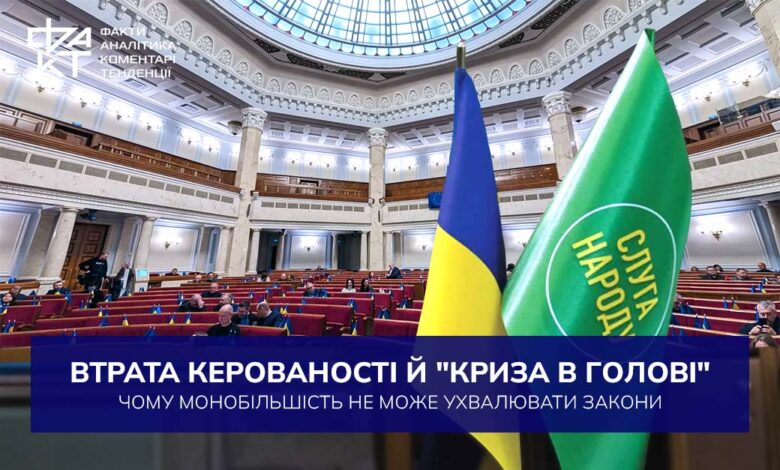
The monomajority, which is supposed to pass vital laws during the war, is today unable to secure even the minimum 226 votes. Deputies are tired and confused, they are afraid to vote, important laws are failing, and critically needed money from international partners is hanging in the air. This political crisis is not just irritating society, but actually threatens national security and the survival of the state’s economy. Each delay can cost billions, and critical social and defense spending can cost lives.
Internal crisis of the monomajority and paralysis of the legislative process
The tension accumulated over the years in the parliamentary monomajority has reached a level where the faction that controls the entire legislative process can no longer guarantee the adoption of critically important decisions that directly affect the State Budget, the economy, and the fulfillment of international financial obligations. The unfolding of this crisis affected the state’s ability to respond promptly to economic and military challenges, and the internal disputes of the “Servant of the People” turned into a systemic factor that paralyzes the work of parliament in wartime.
Problems with securing votes in the Verkhovna Rada became especially noticeable during the consideration of draft laws necessary to fill the State Budget and fulfill international obligations. The first deputy head of the Servant of the People faction, Andriy Motovilovets, reported that gathering votes for important bills has become a difficult task since the beginning of the year. Gathering votes even for laws that are obligations to key donors — the International Monetary Fund (IMF) or the European Union — is virtually impossible. He cited the example of the law on taxation of digital platforms, which was supported by only 168 deputies during the vote, out of the required 226, which demonstrates how even previously unproblematic initiatives have become problematic for making decisions.
As Motovylovets notes, the main factor in this paralysis of the council was fatigue, confusion and fear among deputies after high-profile anti-corruption investigations that affected five parliamentarians in the case of allegedly receiving money for voting. At the same time, the key problem is that the Servant of the People faction has lost its core. When votes are collected in parliament, it is clearly understood which deputies are ready to support this or that law.
“Currently, the situation is such that we cannot vote for our commitments. The Servant of the People faction is my family, and the current situation is as follows: fatigue, multiplied by confusion and fear, has led to the fact that the arguments about collecting votes no longer work. And I have no plan for how to get out of the situation today,” – said the first deputy chairman of the faction.
However, it became difficult to do this after the NABU and SAPO suspected five deputies from the Servant of the People. During the investigations, 17 people’s deputies and heads of parliamentary committees were summoned for questioning, some of whom had already served as witnesses. This situation created a chain reaction effect: even those deputies who did not have direct suspicions began to avoid participating in the votes for fear of falling under the attention of anti-corruption agencies.
The reduction of the stable core of the vote was another manifestation of the faction’s internal crisis. If previously about 180 deputies consistently supported the legislative initiatives of the leadership, now only 111 consistently vote. Even arguments about critically important financing from international partners, in particular the IMF and the Ukraine Facility, are no longer sufficient motivation, and it is difficult for deputies to ensure the necessary result for the adoption of draft laws, without which the State Budget cannot function properly.
Motovylovets believes that the history with the law on NABU and SAPO has shown how unpopular decisions can have long-term political consequences for those who dare to support such initiatives. Deputies who voted for this document faced criticism and the consequences of unpopular decisions, and this experience forms a persistent fear in the faction to participate in the legislative process, even when it comes to economic or budgetary issues necessary for the stability of the state and support for business.
So, the inability of the people’s deputies to vote for important laws is associated by the first deputy head of the “Servant of the People” faction with fear of anti-corruption bodies. This indicates that he is covering up the failure of the faction, shifting responsibility to the anti-corruption bodies, instead of recognizing his own political incapacity, ignoring the systemic problems of the faction and internal strife.
The president of Ukraine was forced to react to the situation in the parliament, who stated that the deputies must fulfill their duties under martial law, and the current uncertainty of part of the parliament arises due to a “crisis in the minds”, and not due to problems of society.
“Why are there a thousand amendments to this or that law, either from the EU or from the IMF? Who are these amendments for? Why should this one party “Servant of the People” sit and cross out these amendments? A parliamentary crisis? You know, the crisis is in people’s heads. I’m not talking about society now, but about some of the so-called “statesmen.” “A crisis is always when you are looking for it and you definitely do not solve it,” Zelenskyy noted.
The president’s criticism also concerned the parliamentary opposition, which delays the adoption of laws, in particular, those necessary for the implementation of international agreements and integration with the EU. Even laws that are not sharp always have to be negotiated with the opposition forces, long-term persuasion is needed to demonstrate the unity that is so often talked about.
In general, the current situation demonstrates a deep crisis of the faction, in which the arguments of the leadership no longer guarantee a result, and fear and uncertainty are beginning to prevail over political logic. The faction, which once ensured quick decision-making, is now in a state of uncertainty and fear that paralyzes the legislative process. In a war situation, when the speed of decision-making is critical, such a loss of control by the parliament creates risks for national security, the State Budget, social spending, and the ability to respond promptly to domestic and international challenges, turning even technical bills into a subject of complex negotiations and uncertain results.
A critical turning point in the monomajority: from triumph to paralysis of votes
Andriy Motovylovets’ statements about the fatigue and confusion of the people’s deputies are, to put it mildly, surprising. They emphasize the deep dissonance between the physical and emotional fatigue of the people’s deputies and the extreme challenges that the military, doctors, and families of the deceased face every day. Maybe society should feel sorry for the deputies? They are tired, and those who risk their lives on the front lines every day, working in hellish conditions without the right to a break, do doctors and medical staff who fight around the clock for the lives of the wounded and sick not feel exhausted? The families of the dead, left without any support, do not experience sleepless nights and suffering? Aren’t people who were forced to become IDPs, having lost their homes and everything they had earned for years, tired?
The contrast between parliamentary fatigue and the extraordinary efforts of those who really save and support the state and society emphasizes the depth of the moral and emotional crisis of the monomajority. Society constantly criticizes the parliament for corruption scandals, unwillingness to work, absenteeism, button-pressing for money in envelopes, the adoption of controversial laws and a luxurious life, which increases the feeling of detachment from reality and exacerbates distrust of the Verkhovna Rada.
The parliamentary crisis, which has been brewing for years within the monomajority, has today entered a phase of open dysfunction, which threatens not only the legislative process, but also the state’s ability to govern effectively under martial law. The monomajority, which in 2019 was perceived as an unprecedented electoral triumph — the formation of the first monocoalition in the history of Ukraine by the Servant of the People faction — has turned into a burden seven years later that paralyzes key state institutions and makes the adoption of reform laws extremely difficult.
The deep nature of the crisis lies in the destruction of the internal unity of the pro-government force, which is manifested in the reduction of the stable core of the vote. Analytical data shows that during 2022–2023, the Servant of the People faction was able to independently secure the minimum required 226 votes in only 17 cases, most of which fell on the first months of a full-scale invasion, when the threat of a coup forced politicians to put aside internal strife. However, by the beginning of 2026, the working core of the faction had shrunk to 120–170 deputies, which makes the adoption of any reform laws, especially those that are “beacons” of the International Monetary Fund and the European Union, practically impossible without complex backroom agreements with the opposition or the remnants of pro-Russian groups.
The degradation of the monomajority is due not only to the decrease in the number of deputies in the chamber, currently a record small number of parliamentarians are working — 401 people’s deputies, but also to a deep psychological and moral crisis within the faction. The deputies who in 2019 marched under the banners of “new faces” were in reality deprived of real subjectivity and the right to their own position. This has given rise to a state of depression and low motivation, when a significant part of the people’s deputies only dreams of completing their mandate, and the leader of the faction, David Arakhamia, is forced to publicly acknowledge the approach of a major crisis due to the mass desire of deputies to leave politics. It is noteworthy that since the beginning of the work of the Council of the 9th convocation, 28 people’s deputies have been deprived of their mandate for various reasons, 23 of whom have transferred to other positions.
One of the most destabilizing factors for the current parliamentary configuration has been the intensification of the work of anti-corruption bodies – NABU and SAPO. The processes, which in expert circles have received the ironic name “envelope genocide”, destroyed the old system of faction management, which was based on indirect payments for loyal votes. The presentation of suspicions by anti-corruption bodies to key figures, in particular People’s Deputy Yuriy Kisel and other deputies of the “Servants of the People” faction, on suspicion of receiving illegal benefits, caused fear and at the same time a wave of indignation within the monomajority. Deputies sabotage voting even on technical or European integration laws, waiting for the position of the Office of the President on the pressure of anti-corruption bodies, which creates a stalemate in the interaction of the legislative and executive branches and complicates the adoption of any important decisions.
It should be noted that the populist rhetoric of the head of state that deputies who do not want to work should be sent to the front is another empty slogan. Initiatives to change the legislation on mobilization in order to forcibly send parliamentarians to the army are legally dubious, as well as politically destructive. The drawing up of a mandate automatically deprives a deputy of a deferral from conscription, and the mass deprivation of mandates will lead to the loss of legitimacy of the parliament, since it is impossible to hold new elections in wartime. Everyone understands this well, which is why the president’s rhetoric is perceived skeptically.
In addition, Zelensky’s criticism of the opposition for “insufficient support” for European integration laws also looks manipulative, since a single majority cannot secure votes without internal discipline. At the same time, opposition forces, in particular “European Solidarity” and “Voice”, often become drivers of the adoption of draft laws related to the Armed Forces of Ukraine and the IMF, demanding real dialogue, rather than unquestioning approval of directives from the Office of the President.
The historical experience of Ukrainian parliamentarism shows that the Verkhovna Rada has always been a source of heated debates and conflicts, but it has remained a platform for seeking consensus through procedural mechanisms and early elections. After the Orange Revolution, the period of coalitions demonstrated the parliament’s ability to compromise even after their collapse and political crises.
The peak of parliamentary struggle fell on the period 2005–2008, when coalition formation and the distribution of key positions became extremely difficult and even dramatic. However, despite numerous scandals and political agreements, the parliament maintained its legitimacy and ensured the stability of the state. The current situation is fundamentally different, because martial law excludes the possibility of dissolving the parliament and holding new elections, and the authorities’ attempts to put pressure on it through threats pose a serious threat to the legitimacy of the legislative branch and the trust of international partners.
The “Expensive” Parliament and the Economic Consequences of Its Crisis
The State Budget for 2026 provides UAH 4.78 trillion for the maintenance of the Verkhovna Rada, of which UAH 865.5 million is separately allocated for financing parliamentary parties. The distribution of these funds looks like this: UAH 585.5 million for “Servant of the People”, UAH 169 million for “European Solidarity”, UAH 111 million for “Batkivshchyna”. At the same time, approximately UAH 1.65 billion is allocated for legislative activities, including the salaries of people’s deputies.
It should be noted separately that the maintenance of one deputy costs the state about UAH 3 million per year. This amount includes salary, accruals, compensation for the performance of duties, housing rent, travel around Ukraine and the maintenance of assistant consultants, for whom the monthly fund has been increased to UAH 132.6 thousand per deputy. In addition, the maintenance of the Verkhovna Rada apparatus is added, which includes compensation and material assistance to people’s deputies, maintenance of the car fleet, information and analytical support, the work of the Rada TV channel and the Holos Ukrainy newspaper, as well as the operation of administrative buildings, including energy and repair work.
The overall picture shows that the functioning of the parliament costs the state a significant amount, which makes the crisis of the monomajority not only political, but also economically critical.
At the same time, the economic dimension of the parliamentary crisis is particularly acute, as sabotage of legislative processes has a specific price that can be estimated in billions of euros. Ukraine enters the spring of 2026 with an unbalanced economy and complete dependence on external financing. Failure to vote on IMF demands — such as taxation of digital platforms or amendments to the tax code — jeopardizes the release of 90 billion euros of EU loan assistance under the Ukraine Facility.
Instead of ending internal factional strife, working effectively, seeking compromises to ensure a stable legislative process, and building stable support through dialogue with the opposition, the Office of the President remains hostage to short-term agreements with situational allies from Dovira and the remnants of the former OPZh. However, these agreements are becoming increasingly expensive, unstable, and only further shake the already shaky balance in the session hall. This deepens the chaos in parliament instead of taming it.
A necessary step is also to reform the internal discipline of the monomajority faction. Restoring an effective voting core that will ensure the minimum required number of votes is possible only through a transparent system of motivation, consultations with deputies and constructive dialogue, and not through pressure or threats. Using procedural mechanisms of the rules of procedure, involving committees and working groups for preliminary verification of support for laws will avoid situations when a critically important bill can be sabotaged due to a lack of votes.
The current composition of the parliament has no other option but to start negotiating. Ignoring the current crisis and living in the realities of 2019, when the monomajority carried out any will from above, is a direct path to a full-fledged state collapse, because a paralyzed parliament cannot ensure the vital activities of the country.