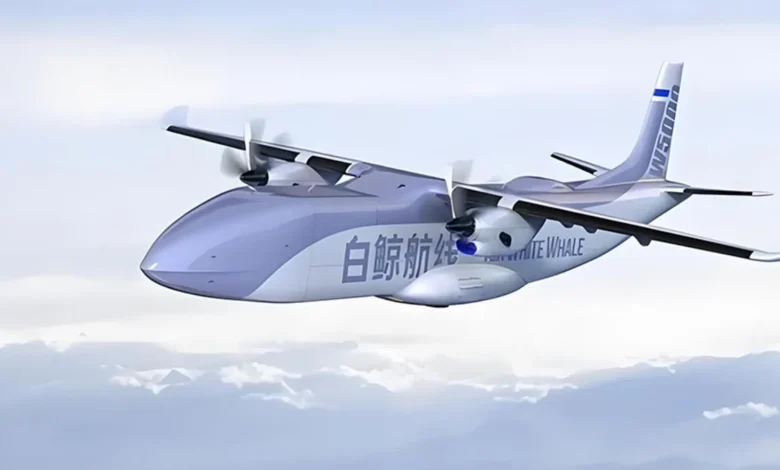
In China, a 7.5-ton unmanned cargo plane took off from Zhuzhou Airport in Hunan Province. It climbed to a height of 300 meters, covered 36 kilometers at a speed of 220 km/h and landed 16 minutes later. This is reported by Indian Defence Review.
The aircraft carried the AEP100, a megawatt-class hydrogen-fueled turboprop engine developed entirely by Aero Engine Corporation of China. According to a Xinhua news agency report on the flight, it was the world’s first test flight of a hydrogen-fueled turboprop engine of such power.
The engine operated normally during the flight and maintained stable performance from takeoff to landing. After completing the planned maneuvers, the plane returned safely.
Experts from AECC, a Chinese state-owned company that develops and manufactures engines for airplanes, helicopters, drones and satellites, said the flight confirmed that China has the full technological chain for hydrogen aircraft engines – from key components to full engine integration.
“The AEP100’s uniqueness is not just that it took off. It’s what happens inside the engine. The AEP100 burns liquid hydrogen directly in a turbine cycle – the same basic approach used in conventional jet engines to burn kerosene. It does not rely on hydrogen fuel cells to generate electricity for electric motors – the path chosen by Western manufacturers such as Airbus for their first commercial hydrogen-powered aircraft,” explains the Indian Defence Review.
Direct combustion of hydrogen offers higher power density and is easier to scale up — both important for larger aircraft. However, the main trade-off is fuel management. Hydrogen burns hotter than kerosene and must be stored at cryogenic temperatures of around minus 253 degrees Celsius. The report notes that keeping liquid hydrogen cold throughout the flight remains a key engineering challenge.
AECC did not disclose how the AEP100 fuel system withstood the thermal stresses during the 16-minute flight. The test was intentionally short, but sufficient to confirm stable engine operation. However, it did not answer questions about durability, maintenance frequency or fuel efficiency over the operational life.
The aircraft’s engine is a turboprop, meaning it drives a propeller rather than directly creating jet thrust. This configuration fits the initial use cases outlined by Chinese officials: unmanned cargo transportation, island logistics and regional routes where infrastructure can be controlled more tightly than in large passenger hubs.