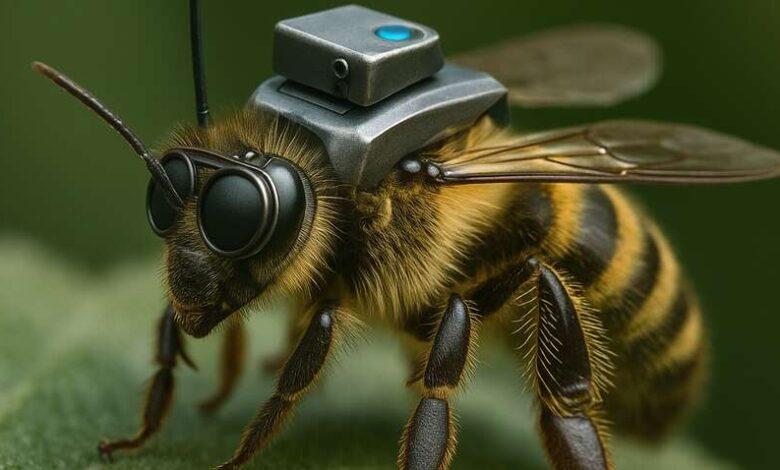
In China, researchers are turning ordinary bees into high-tech cyborgs by implanting microchips in their brains that allow them to control the direction of flight. The project, which is being developed by the team of Beijing Institute of Technology professor Zhao Zeliang, aims to use cyborg bees in search and rescue operations, as well as in secret intelligence operations.
Scientists have developed an ultralight brain controller weighing 74 milligrams — the smallest in the world. It is fixed on the bee’s back, after which it transmits signals directly to the nervous system of the insect with the help of three needles. According to the results of the tests, nine out of ten bees responded to these signals and flew in the specified direction.
Researchers believe that thanks to their compact size, ability to camouflage and high maneuverability, cyborg bees can penetrate into narrow spaces – where a person or a drone cannot pass. They can be equipped with micro-cameras, sensors, listening devices – to collect information during emergency situations or in military conditions.
In their scientific paper published on June 11 in the Chinese journal Mechanical Engineering, Zhao’s team notes that such bio-robots have advantages over artificial counterparts: they are better camouflaged, more durable and adaptable to the environment. In particular, they are proposed to be involved in urban combat, anti-narcotics raids, counter-terrorism and reconnaissance in hostile environments.
However, the project still has a number of limitations. The biggest problem is power supply: powerful batteries are not enough for long, and larger batteries put too much weight on the bees. In addition, different types of insects require different configurations of devices, because they have different signal reception points.
The technology is not new — similar experiments were conducted by scientists in the USA, Japan, and Singapore. For example, in Singapore, cockroaches were equipped with microchips to search for people under the rubble after the earthquake. However, the Chinese development is currently the smallest and most accurate among all analogues.
China is also working on other miniaturized technologies, including the introduction of mosquito-sized drones for aerial surveillance in June.