Control systems and security in schools: The Ministry of Internal Affairs has introduced new security standards

Зміст
ToggleThe issue of protecting students and employees of educational institutions during martial law is gradually becoming a matter of clear state requirements that must be met regardless of the size of the school or its location. The Ministry of Internal Affairs of Ukraine has approved updated security rules, which provide for the mandatory presence of security guards, the use of metal detectors, and constant video surveillance in educational institutions.
What has changed in security rules in schools
The new rules, enshrined in the Ministry of Internal Affairs Order No. 28 of February 8, determine how schools should organize access control to buildings, technical equipment, and the work of security guards. The document details requirements that could previously be implemented partially or depend on the financial capabilities of a particular institution, and now move into the category of mandatory standards.
The updated requirements concern several key elements that together should create a system capable of responding to both military threats and everyday risks that arise in any large group. This involves a combination of physical control, technical surveillance, and verification of visitors so that the school does not remain an open space where one can enter without any restrictions.
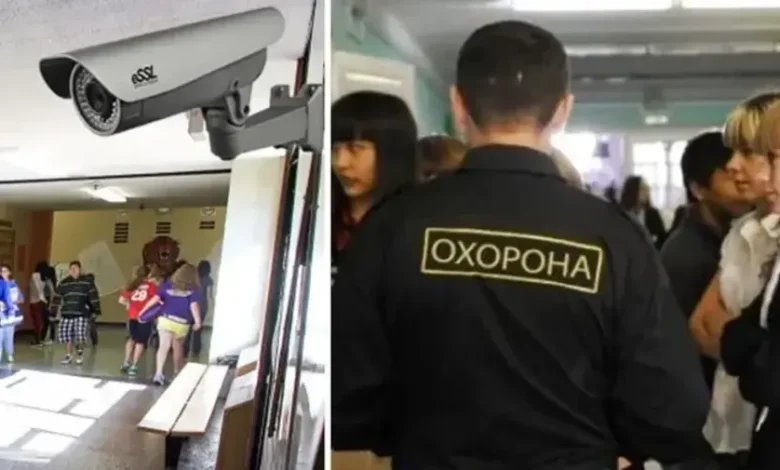
The new rules stipulate that professional security must be organized in each educational institution, and metal detectors must be used at the entrance for some students, employees, and all visitors. Additionally, a mandatory video surveillance system is being introduced, which will operate constantly and record events in key areas of the school infrastructure.
Professional security as a mandatory condition for school operation
One of the main changes was the establishment of a requirement for physical security, which should not be random or temporary, but professional and organized according to certain standards. According to the order, security functions can be performed either by security police units or by private companies that have the appropriate license, which actually eliminates the practice of “taking turns” without proper training and responsibility.
Separately, the document defines the time frames that should discipline the organization of the process, as the security guard must take up his post no later than 60 minutes before the start of classes. This requirement indicates that security is not viewed as a reaction to a problem, but as a system that works even before students and staff enter the school.
Duties of security guards and control of the territory during the day
The order is not limited to a general statement about the presence of security guards, but details what functions security officers must perform. Security guards are expected to regularly patrol the school’s territory and premises, which allows them to notice suspicious objects or situations that may pose a danger in time.
The list of duties also includes checking the operability of the alarm system, controlling the access regime, and facilitating the evacuation of participants in the educational process to shelters in case of danger. This approach demonstrates that the school security guard is viewed not only as a person standing at the entrance, but as part of an organizational structure that must act in emergency situations.
Metal detectors: who will be checked and how it will work
Another fundamental innovation was the mandatory metal detector check, which will apply to students in grades 5–11, school employees, and all visitors. Thus, control is primarily directed at those who move around the territory of the institution more independently and have wider access to various premises.
It is separately stated that the number of metal detectors must correspond to the number of functional entrances to the school, which actually obliges institutions to organize the inspection so that it is not symbolic. This is important, since one frame or one handheld device in a large school often turns into a formality that is unable to provide real control.
In January 2026, the government approved a list of dangerous objects and substances that are prohibited from being on the territory and in the premises of Ukrainian schools, gymnasiums and lyceums. The very fact of the existence of such a list indicates a desire to consolidate the rules not at the level of general prohibitions, but through clearly defined wording that simplifies control and reduces the possibility of misinterpretations.
In combination with metal detectors and security, this list actually creates a mechanism that allows not only to record violations, but also to prevent them at the entrance, without bringing the situation to a conflict or a dangerous incident inside the school.
Video surveillance: where should the cameras be located and how long will the recordings be stored
The technical component of the new rules concerns video surveillance systems, which must operate continuously, not episodically, and record what is happening inside the educational institution. Cameras should cover building entrances, corridors, halls, stairwells, assembly halls and sports facilities, that is, those places where a large number of people are constantly present or there is active movement.
At the same time, the document clearly prohibits the installation of cameras in rooms for personal use, in particular in restrooms and locker rooms, which maintains the line between security and privacy. Camera recordings must be stored for at least 30 days, so that in the event of incidents it will be possible not only to respond to the situation immediately, but also to restore the chronology of events if the threat was noticed late.
Panic button and emergency police call system
A separate set of requirements concerns the possibility of an operational call to the police, which in conditions of war and general tension in society acquires practical importance. The order obliges schools to install an emergency call system, which can be either a stationary panic button or a mobile analogue.
Such a decision has obvious logic, because in a critical situation, every minute can be crucial, and a phone call does not always guarantee speed or the ability to explain what is happening. The presence of a panic button creates a more direct mechanism for communication with law enforcement agencies.
Passage regime and access control to buildings
The document provides for a tightening of the procedure for admission to school premises, which means stricter control over who is on the premises and for what purpose. This approach changes the very logic of the school space, because the school is no longer perceived as an open building where visitors can enter without a clear procedure.
That is why not only technology in the form of cameras or metal detectors becomes important, but also the discipline of organizing entry and exit, controlling visitors, checking suspicious situations, and adhering to clear rules that must operate daily, and not only during times of increased threat.
Financing without involving parental funds
One of the most important points of the order was the clarification that financing security measures cannot be carried out at the expense of students’ families. This provision is directly directed against the practice of schools shifting the costs of security guards or technical equipment to parent committees, which created inequality between educational institutions and constant conflicts in communities.
Thus, the issue of security is transferred to the plane of responsibility of the state and local authorities, since it is they who must ensure compliance with the established requirements, without turning them into an additional financial burden for families.
What do the new rules mean for the everyday life of students and teachers
The introduction of such standards changes the everyday atmosphere of the educational process, as the school gradually becomes similar to a facility with controlled access, where security is built as a multi-level system. For students, this will mean regular checks at the entrance, the presence of security guards, and constant video surveillance in common areas, which for many will become a new reality that will take some getting used to.
For teachers and administrators, the new rules create additional organizational responsibility, as they must ensure compliance with requirements, control access to the building, and interact with security in the event of an alarm or threatening situation. At the same time, clearly prescribed procedures can reduce the chaotic response that often occurs at critical moments.
Thus, the Ministry of Internal Affairs order consolidates the transition from fragmented measures to a systematic approach, where security, metal detectors, video surveillance, and emergency calls to the police become mandatory elements of the school’s functioning. These requirements do not change the very essence of education, but they do change the conditions in which it takes place, because an educational institution in wartime must remain a place where risks are minimized not by words, but by clear rules and a real organization of control.