Damaged or destroyed housing, ownership of which arose after the destruction: who is entitled to compensation

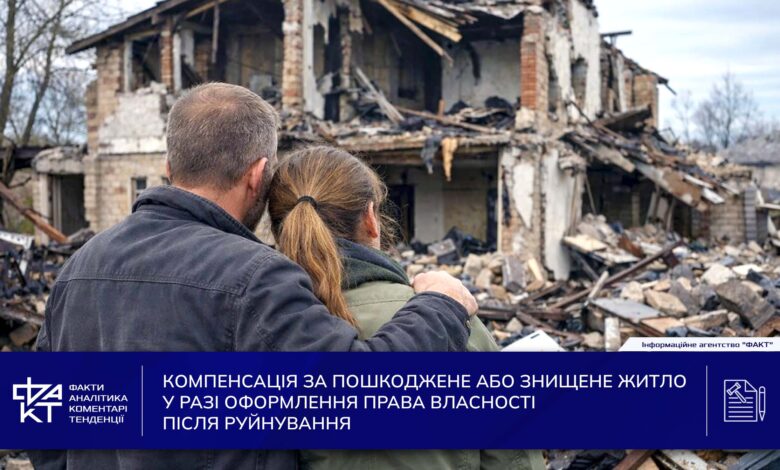
The issue of compensation for damaged or destroyed housing is increasingly arising in situations where the destruction has already occurred, and the ownership of such an object has subsequently been transferred to another person under a purchase and sale agreement, donation or in another way. In practice, this creates a complex legal conflict, since for the new owner, not only the fact of ownership of the property at the time of the application becomes important, but also who owned the house or apartment when the property was damaged as a result of hostilities. Because of this, the key question becomes whether the acquisition of ownership of already destroyed housing provides grounds for receiving compensation under the “eReconstruction” program.
Lawyers of the law association “Repeshko and Partners” commented on how the legislation and case law determine the circle of persons who can claim compensation for damaged or destroyed housing, if the ownership of such an object was registered after the destruction.
Due to the ongoing war and constant shelling, more and more real estate in the country is being destroyed. The degree of destruction can vary – from broken windows to a house half demolished by a rocket. People’s fates also develop differently, so sometimes people have questions: isn’t it easier to sell the property as it is, now and quickly, and start a new life, perhaps even outside the country? Can a person who has acquired ownership of already destroyed housing claim compensation under the “eReconstruction” program?
The issue of providing compensation for damage and destruction of certain categories of real estate objects as a result of hostilities, terrorist acts, sabotage caused by the armed aggression of the Russian Federation against Ukraine is determined by the Law of Ukraine dated 23.02.2023 No. 2923-IX “On Compensation for Damage and Destruction of Certain Categories of Real Estate Objects as a Result of Hostilities, Terrorist Acts, and Sabotage Caused by the Armed Aggression of the Russian Federation against Ukraine, and the State Register of Property Damaged and Destroyed as a Result of Hostilities, Terrorist Acts, and Sabotage Caused by the Armed Aggression of the Russian Federation against Ukraine” (hereinafter referred to as Law No. 2923-IX).
Part two of Article 10 of Law No. 2923-IX provides that the procedure for providing compensation for a damaged real estate object is determined by the Cabinet of Ministers of Ukraine. At the same time, the Resolution of the Cabinet of Ministers of Ukraine dated 04/21/2023 No. 381 (hereinafter referred to as Resolution No. 381) approved the Procedure for providing compensation for the restoration of certain categories of real estate objects damaged as a result of hostilities, terrorist acts, sabotage caused by the armed aggression of the Russian Federation, using the electronic public service “eRestoration”.
Clause 2 of Resolution No. 381 stipulates that the electronic public service “eRestoration” is a service for providing compensation, which is provided on the basis of an application submitted to the State Register of Property Damaged and Destroyed as a Result of Hostilities, Terrorist Acts Against Ukraine, and Sabotage Caused by the Armed Aggression of the Russian Federation Against Ukraine (hereinafter referred to as the Register of Damaged and Destroyed Property), by means of the Unified State Web Portal of Electronic Services, in particular using the mobile application of the Portal Diya (Diya), or in another manner provided for by this Procedure.
According to paragraph 3 of Resolution No. 381, the recipient of compensation is an individual – a citizen of Ukraine, who has reached the age of 18 and has submitted an application through the Diya Portal, in particular using the Diya Portal mobile application (Diya) or in another way provided for by this Procedure, and is the owner (co-owner) of the damaged object, the ownership of which has been confirmed.
At the same time, paragraph 4 of Resolution No. 381 stipulates that the following cannot be recipients of compensation:
- persons to whom sanctions have been applied in accordance with the Law of Ukraine “On Sanctions”;
- persons who have a criminal record for committing criminal offenses provided for in Section I “Crimes against the Fundamentals of National Security of Ukraine” of the Special Part of the Criminal Code of Ukraine;
- heirs of persons specified in paragraphs two and three of this paragraph, in the event that the real estate property belonging to the testator was damaged during the lifetime of such testator.
It should be noted that Resolution of the Cabinet of Ministers of Ukraine No. 381 establishes that the decision to provide compensation is not automatically adopted after submitting an application. For this purpose, a separate commission is created in each community or in the relevant territory to consider such applications. It is formed by the executive bodies of village, settlement, city councils, district councils in the city, if such councils are established, and where military administrations of settlements or military-civilian administrations operate, this function is performed by them. Thus, the issue of compensation for damaged housing that was damaged as a result of hostilities, terrorist acts, sabotage and armed aggression of the Russian Federation against Ukraine is first considered by such a commission, which checks whether the specific situation meets the requirements of the Procedure.
The resolution further determines the cases in which compensation can be provided. First of all, damage to real estate must be caused after the entry into force of the Decree of the President of Ukraine dated February 24, 2022 No. 64 “On the introduction of martial law in Ukraine”, which was approved by the Law of Ukraine dated February 24, 2022 No. 2102-IX. That is, for the consideration of the application, not only the fact of destruction or damage to housing is important, but also the specific time when it occurred.
Particular attention is paid to the location of the property. Compensation can be provided if the object is located on the territory of Ukraine, but here the legislation immediately establishes important exceptions. These rules do not apply to objects located in the territories of active hostilities, in the territories of active hostilities where state electronic information resources operate, as well as in the territories of Ukraine temporarily occupied by the Russian Federation, which are included in the list of territories approved by the Ministry of Development where hostilities are or were conducted or which were under occupation, if on the day of submitting the application for such territories the date of completion of hostilities or temporary occupation has not yet been determined.
Another mandatory condition concerns confirmation of ownership. Information on ownership of the damaged object must be entered in the State Register of Real Property Rights to Real Property. Without this, the commission will not have proper confirmation that the applicant is indeed the owner or co-owner of the property for which he is requesting compensation.
The resolution also takes into account the nature and scale of the damage. Compensation can be received only when the amount of damage does not exceed the amount of compensation determined by paragraphs fifteen and sixteen of clause 10 of this Procedure. An exception is provided only for the case separately specified in clause 25-1. That is, for consideration of the application, not only the fact of damage to the house or apartment is important, but also the limits of the permissible amount of such damage that give the right to payment under this procedure.
It is important to know that clause 14 of the Resolution of the Cabinet of Ministers of Ukraine No. 381 determines the cases in which compensation may be refused. First of all, the reason for refusal is the situation when the application was filed by a person who, according to the rules of this Procedure, cannot be a recipient of compensation at all or does not have the proper authority to apply for such an application. The decision will also be negative if during the inspection it turns out that the application contains inaccurate data regarding the damaged object.
A separate block of grounds is related to the location of the real estate. Compensation will be denied if the object is located in the territory of active hostilities, in the territory of active hostilities where state electronic information resources operate, or in the territory of Ukraine temporarily occupied by the Russian Federation, which is included in the list of territories where hostilities are or were conducted or which were under occupation, and for which the date of completion of hostilities or temporary occupation has not yet been determined as of the date of filing the application.
Another important ground for refusal concerns the nature of the damage itself. If it is established that repair work has already been carried out on the object and the damage has been completely eliminated, compensation for the repair will not be provided, since in this case there is nothing to restore. A refusal is also possible if it turns out that the damage occurred before the entry into force of the Decree of the President of Ukraine dated February 24, 2022 No. 64 “On the introduction of martial law in Ukraine”, which was approved by the Law of Ukraine No. 2102-IX. There will be no compensation if the commission establishes that the property was not damaged as a result of hostilities, terrorist acts or sabotage caused by the armed aggression of the Russian Federation, as well as if during the inspection it turns out that the object was not damaged at all.
A separate condition is provided for apartments in apartment buildings. If the apartment is located in a building where common areas are damaged, compensation may be refused. An exception is possible if, on the day of submitting the application, these damages have already been eliminated or a decision has been made to restore them at the expense of other sources. The condition of the building itself also matters, if it is subject to repair.
The basis for refusal will also be the situation when the applicant himself withdraws his application and submits the relevant notification to the commission in paper form. In addition, compensation will not be awarded if there is no information about the damaged object in the State Register of Property Rights to Real Property, since without such confirmation it is impossible to properly establish the right to apply.
The resolution also does not allow re-applying for the same form of compensation for the same object if a decision has already been made to provide payment for it. An exception is provided only for cases when the property was damaged again as a result of hostilities, terrorist acts or sabotage, as well as for certain situations expressly provided for in paragraphs 10-3 and 17-1 of these Procedures.
Compliance with the general conditions for providing compensation is taken into account separately. If the reported case does not meet these conditions, in particular if the amount of damage exceeds the amount of compensation determined by paragraphs fifteen and sixteen of clause 10 of the Procedure, the payment may also be refused. An exception to this rule is provided only by clause 25-1 of the Procedure.
Another reason for refusal may be the recommendations of the Ministry of Finance of Ukraine on eliminating discrepancies in the data of automated information systems, registers and databases, as well as the results of additional verification of such recommendations, if the identified discrepancies affect the determination of the person’s right to compensation.
Finally, compensation will not be provided if it is established that the applicant has already received from Ukrainian or international organizations, in particular charities, from local governments, executive authorities, enterprises, institutions or organizations monetary or material assistance that was sufficient to carry out the full amount of repair or repair and restoration work necessary to restore the damaged property.
The essence of this legal position is that compensation should restore the losses of the owner who suffered due to damage or destruction of housing. Therefore, payment to a person who received ownership of an already destroyed or damaged object would not mean compensation for the damage caused, but an actual improvement in his property situation compared to the one in which he was at the time of acquisition of such property. In other words, the new owner purchased or received housing already in the condition in which it was after the destruction, therefore it was this property that constituted the content of his property right at the time of acquisition.
Therefore, a person who became the owner of real estate after its damage or destruction is not considered to have suffered property losses as a result of hostilities, terrorist acts or sabotage caused by the armed aggression of the Russian Federation against Ukraine. His property situation did not deteriorate due to the fact of destruction itself, since he acquired ownership after these consequences occurred.
This is exactly how judicial practice approaches this issue. The courts proceed from the fact that the negative property consequences arose for the owner to whom the property belonged at the time of damage or destruction. The new owner no longer has such losses, because he was not the owner of the object at the time when this property was damaged.
Thus, under the Law of Ukraine No. 2923-IX, only those owners of damaged or destroyed real estate objects who owned this property at the time of destruction, as well as their heirs, have the right to compensation. The very fact of subsequent re-registration of the ownership right to such an object does not create the right to payment for the new acquirer.
An additional complexity in this issue is created by the procedure for confirming the ownership right, associated with the State Register of Real Rights to Real Estate. Since this electronic register began to function fully in 2013, information about previously acquired rights is not entered into it in all cases. Because of this, people often mistakenly perceive the date of entry of information into the register as the date of the origin of the ownership right, although in fact these are different things.
During verification, information is entered into the State Register of Real Property Rights to Real Estate about a right that already existed on the basis of a specific title document. That is, in this case, the register only confirms the ownership right, and does not create it anew. In this case, the date of acquisition of the right is considered to be the date when the person actually became the owner under a contract of sale, donation, certificate of inheritance or other document. For example, if information about a residential building was entered into the State Register of Real Property Rights to Real Estate on March 21, 2026, but the ownership right to this building was acquired under a donation contract on April 14, 2007, the person will be considered the owner in the register from April 14, 2007.
Therefore, the decisive factor is not the date of technical entry into the register, but the date from which the ownership right arose on the basis of the appropriate document. Yes, when a donation agreement is drawn up on March 21, 2026, the new owner will be registered in the register from March 21, 2026.
We answer the question: can an owner who has drawn up a donation or purchase and sale agreement for an already destroyed (damaged or destroyed) housing be a recipient of compensation under the eReconstruction program? Definitely no.
If at the time of the destruction of the housing, a person owned only a share in the ownership, and he bought or received another share after the destruction of the property, the right to compensation is preserved only within the limits of the share that he owned on the day of the destruction of the object. That is, the decisive factor here is not how many shares a person has after all subsequent re-registrations, but what volume of ownership he owned at the time the housing was destroyed.
A share acquired later from another co-owner after the destruction of the house or apartment is not subject to compensation. This is explained by the fact that the right to payment is associated with the actual property loss that a person incurred at the time of the destruction of the property. Therefore, if a person became the owner of a larger part of such an object after the destruction, this does not extend his right to compensation, because compensation is possible only for the share that belonged to him at the time the property was destroyed.
We advise you, before submitting an application for compensation, first of all, to find out who owned the housing on the day of its damage or destruction, check the title documents, compare the date of acquisition of ownership with the date of destruction, and separately pay attention to whether the information entered in the state register is confirmation of an old ownership right or the result of a new re-registration after the shelling.
If the object was purchased, received as a gift or otherwise acquired after the destruction, there is no reason to expect compensation for the entire value of such property, while the person who owned it at the time of damage, or his heirs, retain the relevant right within the limits specified by law. If the property was owned only by a share, and the other share was acquired after the destruction of the object, it should be borne in mind that compensation may only apply to that part of the property that belonged to him at the time of destruction.