
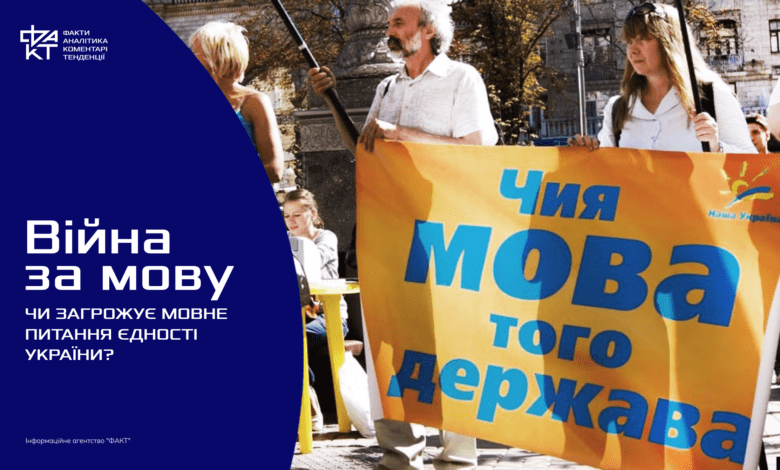
The language issue in Ukraine has become one of the most explosive and controversial factors, which has not subsided for years and is intensifying against the background of political and social changes. Despite attempts at a solution, language remains a tool that divides society into camps, each of which believes that its position is the right one.
At first glance, this issue may seem merely a domestic or cultural issue, but a deeper dive into the issue reveals a political arena where language is used as a weapon for manipulation, division, and even political pressure. It is no longer just a choice between the Ukrainian or Russian languages, it is a question of national identity, state integrity and geopolitical game that affects every citizen.
Russian-speaking regions constantly face pressure for Ukrainianization, while Ukrainian-speaking activists raise concerns about the need to preserve national culture and language. At the same time, the enemies of Ukraine do not miss the opportunity to add fuel to the fire, using the language problem as an instrument of separation and internal conflicts. The battlefield has long gone beyond the boundaries of laws and rights, turning into a spiritual front where every word counts.
How did it happen that the language issue turned from a tool of communication into a tool of war for the hearts and minds of Ukrainians, and why its solution could be key to the future of the country?
A language problem that divides into “own” and “strangers”
After the start of the full-scale invasion, the language issue became even more acute. The Russian language ceased to be just a language of communication, according to many, it became a symbol of the imperial past, which is still trying to dominate Ukraine.
For data survey of the Kyiv International Institute of Sociology, 81% of respondents are in favor of the complete elimination of the Russian language from official communication, or against its use in their region. At the same time, there are 10% of those who would like to see Russian as an official language in their region, or even as a second state language. The most noticeable changes are observed in the South and East of Ukraine. Thus, in the South, 69% are in favor of complete elimination, and 18% want the Russian language to be official in their region. In the East, respectively, 52% support the elimination of the Russian language, and 34% want Russian to be official in their region. The results of the survey show that, regardless of language preferences, Ukrainians consider language the basis of identity, prefer its wider spread, and consider the current situation of Russification to be abnormal.
At the same time, neither Ukrainian-speaking nor Russian-speaking Ukrainians want overly active state intervention. The language law probably meets the wishes of both groups and began to bear fruit even before the war. But still, excessive pressure inflames the situation. Those who fight for full Ukrainization say that the Russian language is an enemy in our home, a tool of cultural colonization used by propagandists. But is banning the Russian language a solution to the problem?
Currently, politicians actively use the language issue with their actions to split society and force people to choose opposite sides. Instead of uniting the nation in the face of a common threat to the state, they fan the flames of conflict. If you want to be a real Ukrainian, speak Ukrainian, some say. Others claim that Russian is part of our centuries-old culture and must be protected. It is simply impossible to find a compromise in such a situation, and therefore every year this conflict becomes tougher. After all, it is impossible to deny the existence of that part of the population of Ukraine that speaks Russian since childhood, but does not feel any involvement in the Russian influence. For them, language is simply a means of communication, and the requirement to speak Ukrainian is perceived as pressure from the state.
Can a person be forced to love a language by command? For many, state Ukrainization, which should promote unity, looks like an instrument of coercion. Instead of the language issue uniting Ukrainians, it creates new fault lines. People who speak Russian feel alienated, misunderstood, and discriminated against. On the other hand, supporters of full Ukrainization see it as a matter of national security, stressing that the language barrier can become a springboard for further political or even military threats.
This part of Ukrainian society tends to consider the Russian language “Putin’s language”, associating it exclusively with Russia’s modern aggression against Ukraine. However, such a position largely ignores the centuries-old history of the language itself, which arose long before the current political events. The Russian language was formed back in the days of Kyivan Rus, having common roots with other Slavic languages, such as Ukrainian and Belarusian. Over the centuries, it developed under the influence of different cultures and peoples, and was not always the language of power or an instrument of repression. During tsarist times, Russian became the language of the empire, and later of the Soviet Union, but its origin and development is a story that cannot be limited to the framework of one political regime. Knowledge of the history of the language helps to better understand its role in the modern world and to separate its cultural and historical value from political manipulation. Without denying the facts of the modern use of Russian as a tool of propaganda, it is worth remembering that it was created at a time when the current political contexts simply did not exist.
The language question through a historical prism
The problem of language conflicts in our country and in the whole world is not new at all and forces various peoples to defend the preservation of their own language and culture from foreign influence. After 1861, when serfdom was abolished in Ukraine, it made it possible for Ukrainians to receive education in their native language in schools, conduct church services in Ukrainian, write and publish books. These opportunities seemed to allow Ukrainians and other enslaved peoples of the Russian Empire to learn more about their own identity, history, language, and origins. But such freedoms frightened the powerful rulers of the empire, and they tried to brutally control the rapid development of the languages of national minorities in their composition.
The first problems with the Ukrainian language arose from an article written by prominent public figure Mykola Kostomarov. In it, he laid out bold proposals for the development of Ukrainian Sunday schools and their increased funding by interested representatives of the intelligentsia. The article was quite progressive and did not contain anti-imperial appeals, criticism of the government or national liberation agitations. This article and the success of Ukrainian schools caused genuine indignation in Moscow journalist Mykhailo Katkov. He was one of the first to express an opinion that still dominates the minds of Russian propagandists to this day, in which he said:What is the Ukrainian language? It never was, is not and cannot be!“. In 1863, Katkov wrote a letter of complaint to the Minister of Internal Affairs, Pyotr Valuev, in which he asked to immediately take brutal measures and stop the activities of Ukrainians who so brazenly begged for funds to develop their “Little Russian” language.
In addition, there was a problem with the churches. Most of them were under the rule of the Russian Empire and conducted their services in Russian. With the growing role of the Ukrainian language, there was a tendency to increase the number of people who went to Ukrainian Sunday schools and churches, where priests read sermons in their native language. Against this background, Russian-speaking churches lost more and more of their parishioners and tried to protect their audience and spread the influence of the imperial Moscow faith to everyone. Numerous translations of the Ukrainian Holy Scriptures fell into the hands of the Kyiv censor Novytsky, who immediately brought the Ukrainian issue to the attention of Peter Valuev. In his letter, Novytskyi complained to the minister about the rapid development of Ukrainian spiritual education and wondered at the very possibility of the existence of the Gospel in the “Little Russian” dialect, when the training of priests and sermons were supposed to take place in the all-Russian language!
Following this complaint, Valuev received another one from members of the clergy of the Russian Church. In it, they stated that they were afraid of the time when the idea of the supremacy of the empire over smaller nations, which the priests had been hammering into the heads of Ukrainians for years, could play against the representatives of the clergy themselves, because Ukrainians would later learn about their people and their own origins. It was the Russian clergy that created “terrible separatists” out of our people just because they wanted to live on their own ethnic territory and study their native language and culture.
All these numerous complaints led to the creation of the Valuev circular, which banned the printing and publishing of scientific and religious literature in the Ukrainian language. The cruelest consequence of this circular was the absence of a ban on the language itself, because Petro Valuev himself sincerely believed that a language would not survive for long when no one would teach and speak it. After the adoption of this resolution, the development of the native language and the activity of scientists froze and fell back for a considerable period of time.
But the oppression of the Ukrainian language by the imperial powers did not stop there. In 1876, Alexander II signed the Emsk Decree, which finally banned the use of the Ukrainian language in all spheres of activity: theater, literature, science, church, and everyday life. This law started the cultural genocide of Ukrainians. The history of the language conflict between Ukrainians and Russians is quite ancient, dating back to 1627, when Tsar Mykhailo issued an order to burn all copies of the Gospel in the Ukrainian language, until the present time, when Russia is trying to destroy Ukrainian identity and culture by all possible means. Our people, despite 395 years of oppression, managed to preserve their native language and popularize its use in all spheres of activity.
However, not only Ukrainians experienced constant conflicts on linguistic grounds. There are many examples of other foreign countries that had problems with multilingualism and were forced to defend their own national language.
Canada is a bilingual country with English and French as official languages. However, the French-speaking part of the country, particularly Quebec, sometimes feels culturally and linguistically separated from the English-speaking part. This leads to social and political conflicts, in particular the Quebec independence movement. Language disputes also affect politics, administrative decisions and business.
Catalonia, an autonomous region in Spain, has its own language – Catalan. Some Catalans strive for independence and official recognition of the Catalan language at the level of the entire country. This leads to numerous protests, political crises and even attempts to declare independence.
There is a great variety of languages in India, but Hindi and English have a special status. Sometimes there are disputes about which language should be used in official documents, education and government institutions. The great role of the English language is due to India’s long stay as a colony of the United Kingdom, during which the British planted their own language among the Indian population of the country.
Nigeria is a multilingual country with numerous ethnic groups and languages. Conflicts between different ethnic groups often involve language issues, particularly in matters of representation in government and education. Nigerians speak numerous local languages such as Yoruba, Hausa, Igbo, Fulani and Tivu. Often, arguing for the majority of representatives of one or another language group in power, Nigerians end up in armed conflicts, military coups and brutal violence, without reaching a consensus on their language issue.
Norway has long had a problem with bilingualism, as the country is torn between its own Norwegian language and Danish, which has dominated the region for a long historical period. In the second half of the 16th century, an economic crisis occurred in Norway, due to which the country became completely dependent on Denmark and ceased to exist until the restoration of statehood in 1814. Norway has turned into a backward Danish colony, deprived of its own cultural center, literature and written tradition, the place of which has been densely occupied by everything Danish. Only in 1814 did the stormy activity to restore the Norwegian literary language and its separation from Danish begin. The local dialects of the Norwegian peasants were not corrupted by a foreign language, and this gave scientists the opportunity to create a full-fledged Norwegian language from them, which became the leading state language in the country.
Foreign experience of language policy
In countries with several languages, the language issue is solved in different ways, depending on historical, political, cultural and social circumstances.
For example, Switzerland has four official languages: German, French, Italian and Romansh. But this does not mean that every citizen owns them all. Each language is used quite calmly in its regions, and government documents are translated into all official languages.
In some countries, languages have official status only in certain regions. Yes, Spanish is the official language in Spain, but Catalan, Basque and Galician have official status in their respective autonomous regions. Some countries may officially recognize one language, but at the same time support the use of other languages at the local level or in cultural spheres. For example, in France, the official language is French, but there are supported regional languages, such as Breton or Basque.
Some countries, like Belgium, set clear language boundaries between regions. Thus, in Belgium, the French-speaking Wallonia and Brussels and the Dutch-speaking Flanders coexist together, where each region uses its own language. Political and social systems adapt to these linguistic divisions.
In the USA, there is no state language at all, and each state recognizes as official the language it deems necessary. Only very recently, in 1990, after the adoption of the law on the protection of native languages (languages of indigenous peoples), states appeared in which two or more official languages were introduced. At the same time, most states have declared English as their official language, because the growing number of residents who do not speak English is a problem for them.
English is the dominant language in Great Britain and serves as the de facto state language, although it is not formally enshrined in the constitution as the only official language. In addition to English, there are regional languages in Great Britain that play an important role in certain parts of the country. Yes, Welsh has official status alongside English in Wales. It is actively used in education, government institutions and on signs. The Welsh Government has a policy of supporting the Welsh language, particularly in schools and the media. About 30% of the population of Wales is fluent in Welsh. Scottish Gaelic is regionally important, mostly in the north and west of Scotland. Gaelic has some level of support in legislation, but not as strong as English. In Great Britain there are various programs to support and develop regional languages. In particular, the Welsh and Scottish governments actively finance projects to preserve language traditions. Bilingual signs, radio and television in regional languages are common practice in these regions.
It is obvious that the language issue in Ukraine is not just a dispute about which language to speak, but a deep conflict concerning the identity, history and future of the nation. This is a field of struggle where the interests of state security, national self-awareness and individual rights of citizens intersect. To overcome this split, it is necessary to find a balance between the support of the Ukrainian language as the state language and respect for linguistic diversity. Only through dialogue, mutual understanding and compromises can a strong national unity be built, where language will become an instrument of enrichment and not division of society.
Society must understand that language is not a weapon, but a tool for communication and self-expression. The Ukrainian language should be the basis of the state, without a doubt, but this process should not turn into forced assimilation. A reasonable language policy is necessary, which takes into account cultural diversity and unites people around the common goal of building an independent, free and strong Ukraine. The language barrier should not become a barrier between people. Otherwise, we risk destroying the very foundation of our society.


