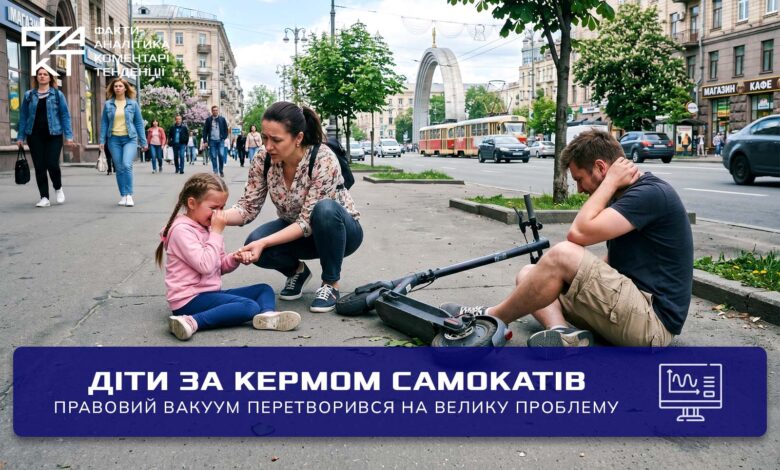
Today, the city’s infrastructure is faced with a challenge for which it was neither legally nor technically prepared. The emergence of freely available electric scooters has changed the urban space, but the sharpest point of tension has arisen where technological progress and children’s unpredictability intersect. Parents who buy or rent this transport for their children often do not realize that they are acquiring a source of increased danger for both the child himself and the pedestrians around him.
Scooters without rules: how children die on the roads and in parks
More than 100 people have already been injured in accidents at the beginning of 2026. In the first quarter, 94 accidents were recorded, which took the lives of 2 people and injured another 107 citizens. However, despite the glaring statistics, the bill designed to regulate the age limit for drivers is wandering around government offices, as if waiting for new tragedies that will force government officials to finally show political determination.
The last weeks of spring 2026 brought a wave of alarming news to Ukraine, which once again forced society to talk about safety on roads and sidewalks. The popularization of modern microtransport, in particular electric scooters, is increasingly turning into terrible tragedies, the victims of which are children.
The May weekend in the Kyiv region was overshadowed by a terrible accident that occurred on May 3 in the village of Gatne. An ordinary day turned into a catastrophe at the intersection of Chumatskaya and Troyandova streets. Two boys decided to divide one electric scooter into two, neglecting basic safety rules. At full speed, their trajectory intersected with a Peugeot passenger car. The collision was so strong that there were practically no chances left: the ten-year-old boy died from his injuries right at the scene, even before the arrival of the doctors. His eight-year-old friend survived, but received serious injuries, and doctors are still fighting for his right to a future in intensive care.
The next day, May 4, the deadly relay of accidents moved to Khmelnytskyi. The life of an eleven-year-old teenager was cut short in the Mykhailo Chekman Park, popular among the townspeople. The boy was moving along a specially equipped bicycle path, where, it would seem, he was completely safe from cars. However, a split-second loss of balance led to a fall, and the blow to the head turned out to be critical. Despite the fact that the child was promptly taken to the intensive care unit of the Khmelnytskyi City Children’s Hospital, and the doctors did everything possible, the boy could not be saved.
The scale of the problem goes far beyond isolated high-profile cases, taking on the signs of a systemic trauma crisis. Representatives of the Khmelnytskyi City Children’s Hospital state that an average of six to seven patients who have received serious injuries while riding scooters seek help at their facility every day.
The dynamics of hospitalizations has forced law enforcement officers and regional media to openly talk about the critical aggravation of the situation. Commenting on the death of a teenager in a Khmelnytsky park, inspector of the district police department Vira Mazur announced the opening of criminal proceedings under Article 291 of the Criminal Code of Ukraine, which provides for liability for violation of current transport rules. Currently, investigative bodies are conducting comprehensive measures to establish all technical and procedural circumstances of this incident, which led to the death of a child.
The problem of uncontrolled movement on electric scooters affects not only the drivers themselves, but also those who are simply walking around the city. At the end of April, a two-year-old child fell under the wheels of a two-wheeled vehicle in the very center of Lviv. The teenager who was driving the scooter lost control or did not react to the toddler in time, hitting the girl. As a result of the impact, the child received a closed head injury and serious facial injuries. The little victim had to be urgently hospitalized.
All these alarming cases are a cruel reminder that speed and ignoring protective equipment and rules for passenger transportation on scooters can cost health and life.
Dangerous microtransport: why the law is years late
Statistics of road accidents involving owners of light personal and low-speed electric vehicles in Ukraine began to be counted separately in 2024. If in the first 12 months of official monitoring, the National Police recorded 503 incidents in which 12 people died and 538 were injured, then the following year the scale of the problem doubled. Statistics for 2025 recorded a jump to 845 accidents, where 19 people lost their lives, and 912 received injuries of varying severity. Child injuries were especially critical, because in just 7 months of 2025, 692 road accidents involving minors on scooters and mopeds were recorded, which led to the death of 26 children and the injury of another 686 people. Statistics for 2026 only continue to record a trend of increasing victims of such accidents.
The consequence of such threatening dynamics was the growth of social tension, which resulted in the creation of an electronic petition demanding the introduction of mandatory driver’s licenses for users of unicycles and electric scooters. The author of the appeal appeals to the daily chaotic realities, where gadget owners maneuver at high speed through pedestrian zones, unpredictably fly under the wheels of cars, neglect elementary safety rules and practice dangerous trips together on one device.
Despite the fact that the law has already granted scooter drivers the status of full-fledged road users, most of these devices still do not require any permits to drive. The legal foundation for resolving this issue was laid by Law No. 2956-IX, which abolished the previous practice of identifying scooters with pedestrians, which previously blocked the prosecution of violators.
The document introduced the term “electric wheeled vehicle” into the legal field, dividing it into two clear groups. The first group consists of lightweight personal devices with a power of up to 1000 W, capable of accelerating to 25 km/h, which form the basis of commercial rental services. The second group includes low-speed vehicles weighing up to 600 kg with a speed range from 10 to 50 km/h.
The legal recognition of a device as a vehicle today does not depend on the presence of a state license plate or driver’s license. An important precedent was the conclusion of the Supreme Court of March 2023, according to which an electric scooter, due to the presence of an engine, was recognized as a source of increased danger. This automatically imposed on drivers the obligation to strictly comply with traffic rules, but the implementation of this norm faces the problem of age-related irresponsibility.
Children and adolescents chaotically move along highways without observing lane separation and maneuvering rules, but children under 14 years of age are generally exempt from legal liability for damage caused – their parents are financially responsible for their actions. Teenagers aged 14 to 18 are already responsible for themselves, although in the absence of their income, the financial burden falls back on the family. However, the main challenge is not the desire of the younger generation to ride, but the lack of a systematic mechanism for controlling this process. The current version of the traffic rules still does not mention this type of transport, so patrol officers are forced to rely on internal departmental instructions of the Ministry of Internal Affairs, which liken scooter riders to cyclists. The National Police openly admits that such tools do not correspond to the scale of the threat and insists on immediate parliamentary changes.
While law enforcement agencies are waiting for relevant decisions from the Verkhovna Rada of Ukraine, there is a steady trend in the commercial segment to expand activities. In particular, the fleet of vehicles of sharing operators currently amounts to approximately 10 thousand units, demonstrating quantitative growth despite the factors of martial law and migration challenges. The private segment is not subject to calculation at all, since such devices are not registered. Meanwhile, the internal instructions of the Ministry of Internal Affairs establish strict age limits for movement: children under 7 years old are allowed to ride exclusively on sidewalks and only under adult supervision, children from 7 to 14 years old – within parks, yards and stadiums, and adolescents from 14 years old and adults are required to move on bike paths, or, in their absence, on the edge of the roadway.
Trying to get ahead of the central authorities, some cities have begun local regulation. Back in 2021, Kyiv obliged rental operators to programmatically limit speed via GPS and mobile communication in crowded places. Ivano-Frankivsk completely closed its central pedestrian zone “Stometrivka” to scooters due to regular injuries to passers-by. Dnipro has introduced speed limits, banned parking near educational institutions and declares its intention to limit the age of users to 16 years.
However, all these municipal restrictions apply exclusively to rental transport, which is administered by 12 all-Ukrainian and regional companies. The undisputed market leader is the Bolt service, represented in the capital and 11 other large cities. Operators prescribe age limits in applications, but this control largely relies on the honesty of the customers themselves. For their part, large companies are trying to integrate technological solutions.
Thus, in addition to cooperation with city halls on geofences, Bolt is implementing sensor systems for detecting “tandem” trips, which record a sharp change in mass and block the movement of the device. A systemic solution to the crisis could have been a bill adopted in the first reading back in 2020, which had a chance of significantly reducing the level of injuries. Instead, the document got stuck in the relevant parliamentary committee for almost 6 years and was resuscitated only in the fall of 2025 for final revision and submission to the voting hall.
The updated concept of legislative changes is based on the idea of absolute priority for pedestrians in urban space. The document duplicates the age restrictions on cycling zones, which are currently contained in the instructions of the Ministry of Internal Affairs, but creates a serious logistical dilemma. Since the infrastructure even in such large cities as Kyiv, Lviv and Vinnytsia is poorly developed, and the length of bicycle paths does not exceed 10% of the total network, fourteen-year-old teenagers will be legally forced to the side of roads with heavy traffic, which creates enormous risks for their lives.
Among other innovations of the bill is the provision of municipalities with the official right to independently mark zones where the movement of microtransport is completely prohibited, for which a new road sign will be introduced. The document will also set a speed limit of 25 km/h for roads and 10 km/h for pedestrian zones, finally criminalize pair riding, and move the use of protective helmets and warning lights from optional recommendations to a strict legal requirement for every driver.
Europe against scooter tragedies: rules that work
The rapid spread of light electric transport has forced countries around the world to urgently review traffic rules, as child injury statistics indicate the high vulnerability of young drivers. Today, international practice shows a clear trend towards tighter regulation, although the approaches to age restrictions themselves still differ significantly.
There are countries with a strict model, such as Ireland and Switzerland, where getting behind the wheel of an electric scooter is allowed only from the age of 16. Other countries have chosen a more moderate path: in Germany and Italy, this threshold is 14 years, and Italian legislation additionally requires minors to wear a helmet and have an AM category driving license for mopeds. More liberal rules apply in Austria, France and Poland, where independent travel on public roads is allowed from the age of 10–12. However, even with this approach, there are strict conditions. For example, in Poland, teenagers are required to have a special “bicycle card” or other driver’s license, and younger children can ride only in residential areas under adult supervision.
For Ukraine, where the legal status of micromobile transport is still adapting to the realities, this international experience offers ready-made guidelines. Domestic legislators should pay attention to the need to introduce a clear age limit for access to public roads and cycle paths. An important step should be close cooperation with rental operators to block the possibility of renting for children through state digital services or bank cards. Also, critically regulate the movement of teenagers on sidewalks and, following the example of European colleagues, develop school programs for obtaining basic certificates of knowledge of traffic rules.
The need for such strict restrictions is confirmed by the position of international organizations, which have recently unanimously advocated raising the age limit. In particular, the European Transport Safety Council (ETSC) insists that children can be allowed to drive electric scooters only from the age of 16. Experts emphasize that in addition to the age threshold, mandatory safety conditions should include limiting the maximum speed, a strict ban on carrying passengers, and an unconditional requirement to wear a protective helmet.
Such warnings have a deep medical justification, which is discussed in detail by specialists from the American Association of Pediatrics. Children’s bodies are biologically and neurologically not ready to drive high-speed vehicles. From an anatomical point of view, the prefrontal cortex of the adolescent brain, which is responsible for controlling impulsive actions and sober assessment of risks, is still in the process of formation. When driving a scooter seems too easy, a child has an illusory sense of complete security, which pushes them to take unnecessary risks and provokes accidents.
The situation is also complicated by the unformed visual apparatus at the age of 7 to 14. Children’s peripheral vision during this period works much worse than that of adults, so it is difficult for them to notice an object appearing from the side in time, as well as correctly calculate the speed of another person’s car or another pedestrian.
Modern urban space has reached a point where the speed of technological development has significantly outpaced the speed of adaptation of the regulatory framework. Micromobility, which was created as a tool for ecological and fast movement, has actually become a new factor in accidents in the conditions of unprepared urban infrastructure and the absence of a clear user identification system.
In Ukraine, the question of where exactly the line lies between the personal responsibility of citizens and the obligation of the state to control the safety of public space remains open. While the legal vacuum persists, the urban environment continues to function in a high-risk mode, where each trip carries great danger for both pedestrians and drivers.