Forced evacuation of children from active combat zones without their parents’ consent: risks of applying the new law

The state has finally stopped the policy of persuasion where parental irrationality borders on danger to children. The new law, signed by the president, defines the procedure for the mandatory forced evacuation of children who are in areas of active hostilities, even in the absence of their parents’ consent. It also regulates the powers of state authorities when carrying out forced evacuation measures and makes relevant amendments to the Family Code of Ukraine and the Law of Ukraine “On the Protection of Childhood”.
At the same time, the real effectiveness of this initiative remains in question due to the complexity of its practical implementation. Authorities risk encountering even more sophisticated methods of hiding children, which will only add tension to the already critical conditions. There are also fears that without the creation of an effective system of social support and guarantees of rapid family reunification, the law may provoke a wave of distrust that will nullify all efforts to save children.
No more persuasions under fire: how the law on forced evacuation without guardians’ consent will work
In frontline communities, which are under daily gunfire, the situation worsens every time the contact line approaches residential areas, but a significant number of parents continue to ignore the threat, turning their own homes into a trap for children. Only in the fourth year of the war did the introduction and practical application of the legal regime of martial law reveal a gap in the legislation regarding the establishment of a ban or restrictions on the entry, entry and stay of citizens in settlements from which mandatory evacuation is being carried out.
Also, the lack of clear regulatory regulation during the war complicated the forced evacuation of children by decisions of regional military administrations from areas of active or potential hostilities, in particular due to the resistance of parents or legal representatives, who negatively perceived such measures.
Therefore, there is now an urgent need for a legal mechanism that allows taking the safety of a child from the sphere of exclusively private choice of adults to the area of responsibility of law enforcement agencies.
The Law No. 12353 signed by the President of Ukraine determines the procedure for the forced evacuation of children from areas of active or possible hostilities, zones of armed conflict and settlements near the front. At the same time, the decision on such evacuation is made by military administrations, and the mechanism for its implementation is detailed in order to avoid delays and contradictions in critical situations. At the same time, the powers of state authorities during the organization of mandatory evacuation are specified.
The law also eliminates the legislative gap regarding the possibility of introducing a ban or restriction on the entry, entry and stay of people in settlements from which mandatory evacuation has been declared. Amendments have been made to the Law of Ukraine “On the Legal Regime of Martial Law” in terms of civil protection measures during a special period, to the Family Code of Ukraine and the Law of Ukraine “On the Protection of Childhood”. In addition, the obligation of parents or legal representatives to ensure safe living conditions for a child during martial law, to comply with decisions of military administrations on the forced evacuation of children and to be responsible for the proper upbringing and development of a child has been clarified.
The new law radically transforms the powers of the police, providing law enforcement officers with a legitimate tool for rescuing children even in the absence of the official consent of their parents or guardians. From now on, the procedure is based on a clear vertical of decisions, according to which military administrations, relying on analytical data and forecasts of the operational command, determine critical risk zones where the presence of civilians is unacceptable.
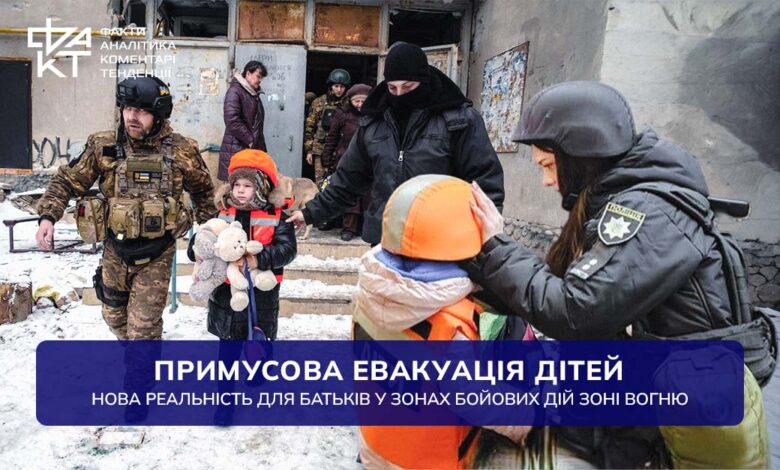
The organizational side of the process is taken on by the police accompanied by one of the parents, however, in cases of categorical refusal of adults to leave the dangerous region, the child is forcibly evacuated with subsequent transfer to the supervision of guardianship authorities. This approach eliminates the legal uncertainty that previously forced rescue services to spend precious time on persuasion in conditions where every minute of delay could end in tragedy.
Emotional attachment to one’s home and fear of the unknown in other regions often outweigh rational arguments about a mortal threat, and the belief that it is better for a child to be in a basement with his parents than in safety, but with strangers, becomes a fatal mistake. The state is forced to intervene in this destructive logic, since the child, due to his age, is unable to objectively assess the scale of the risk and becomes a hostage to the choice of adults.
The tragedy of Ukrainian childhood in the conditions of full-scale war
The tragedy of Ukrainian childhood in the conditions of full-scale war has turned from a short-term shock into a permanent, deeply echeloned crisis, where each dry figure of the report hides a radical change in the life landscape of an entire generation. As of the beginning of 2026, about 2,589,900 minors remain in the grip of forced displacement, which is actually equal to every third uprooted little Ukrainian, whose home has become a memory or a disaster zone. This mass of human destinies is split into two unequal streams:
- nearly 1,800,000 children are seeking refuge in foreign jurisdictions;
- approximately 791,000 internally displaced persons continue their journey within the country, trying to adapt to life in temporary shelters.
A deep analysis of the situation indicates that more than 1.5 million children are still in direct contact with the consequences of the war, living in regions that have either become the scene of hostilities or are closely adjacent to the contact line. For this category of the population, the war has ceased to be a headline in the news, transforming into a daily routine accompanied by artillery shelling, the systematic destruction of basic infrastructure and a critical shortage of water and electricity.
If we compare these data with the indicators of general evacuation, a rather sharp social differentiation emerges, when a significant part of minors has either already left or continues to remain in the epicenter of risk, which indicates a serious gap in the resources and capabilities of families to ensure the physical safety of their children.
The most acute concentration of threats is currently observed in the Donetsk region, where more than 26,000 civilians are within reach of active hostilities in the territory controlled by Ukraine. It is noteworthy that among this number, about 12,405 are children, which is almost half of the total number of residents of the most dangerous communities and significantly exceeds the average share of minors in the population structure of the country. Such a dense presence of children in points where the front passes at a distance of a few kilometers emphasizes the dramatic complexity of the choice of parents, whose decisions to evacuate are often paralyzed by a lack of economic support or specific social circumstances that keep them under fire.
Direct losses among the youngest population add a final, most somber dimension to this picture, as official statistics for 2025 record the deaths of 630 children and the injuries of more than 1,960 people. Although these figures only partially reflect the intensity of daily terror, they clearly outline the geography of violence, where the Donetsk and Kharkiv regions consistently remain the bloodiest spots on the map of children’s suffering. Ultimately, we are dealing with a multi-level deformation of normal life, when some children are trying to settle in a foreign land, while thousands of others continue to grow up in the basements of frontline cities, forming a new reality where security is not a guaranteed right, but depends on chance or the geographical location of the line of fire.
The Tragic Price of Delay: Figures and Facts
The operational complexity of evacuation operations increases exponentially if they are carried out at the moment of a direct assault or intensive artillery preparation, when safe exit routes are already under fire. Police officers, White Angels crews, rescuers and volunteers are forced to work in “gray zones”, where the risk to their lives becomes no less real than for those they are trying to evacuate. Unfortunately, many of them die saving the lives of others. Each operation postponed due to parental resistance requires the involvement of additional armored vehicles, complex coordination with the military and specific logistics, which stretches the system’s resources at critical moments. The lack of clear authority until recently turned the work of evacuation teams into a dangerous diplomatic mission, where instead of a quick rescue, specialists were forced to conduct many hours of negotiations under explosions.
The experience of rescue operations in Bakhmut, Avdiivka, and the Kupyansk direction recorded dozens of cases when the irrational behavior of adults became a death trap for minors and those who tried to save them. In frontline cities, where the contact line passed several hundred meters from residential buildings, parents hid children for months in damp basements and makeshift dugouts, deliberately cutting off contact with the outside world.
An illustrative story is from Avdiivka, where the head of the MVA Vitaly Barabash for a long time reported on the search for a 12-year-old boy whose parents literally “hid” from evacuation groups, constantly changing their places of residence and turning off their phones. Similar situations were recorded in Bakhmut in the spring of 2023, when more than 30 children remained in the city under heavy shelling precisely because of the categorical refusal of adults to leave, which ultimately led to the introduction of a forced evacuation mechanism.
According to official data, at least 133 volunteers and dozens of police officers have died during evacuation missions since the beginning of the full-scale invasion. In October 2024, Tigran Galustyan, a volunteer with the organization “Rose in the Hand”, died in the village of Ilyinka in the Donetsk region when a Russian FPV drone attacked his car while evacuating a family with a child. In the Kharkiv region alone, 14 police officers and 25 volunteers died during evacuation operations as of the end of 2024, when they were targeted by Lancet UAVs and artillery.
At the same time, the mechanism for hiding children often takes on sophisticated forms, as parents use the extensive system of basements in old neighborhoods or agree with neighbors about temporary shelter, creating the illusion that the family has already left. There are known cases when families who have already been evacuated secretly returned to Avdiivka via field roads, again exposing their children to the risk of death, as happened with three minors who had to be taken out by the police for the second time. Such behavior not only devalues the efforts of rescuers, but also forces evacuation crews to work in a detective search mode, which is unacceptable in conditions of time constraints and constant attacks by kamikaze drones.
Therefore, the state’s appeal to strict legal norms under Law No. 12353 is a direct response to these facts, since each “rescued” child, whose parents leave under fire, becomes the cause of new victims among those who come to help. The realities of war have proven that delaying in a combat zone is not a personal choice of a family, but becomes a collective danger, where strangers pay with their lives for the illusion of safety within their own walls.
Problems and risks of applying the norms of the new law
The discussion around the balance between parental rights and state intervention during the forced evacuation of children takes on the features of a struggle for the survival of a nation, where the safety of minors becomes a top priority. Temporary separation of a child from his family by transferring him to guardianship authorities is an extreme but justified measure aimed solely at preserving physical life in war conditions.
However, when analyzing the benefits of the new law, it is necessary to identify the problems and risks of its application. Law enforcement officers are relieved of the need to conduct exhausting negotiations for many hours under fire, which directly translates into saved lives. A clear legal algorithm allows the police to act as a coordinated mechanism, where the safety of a minor becomes an absolute priority, above subjective fears or irrational faith of adults in a “lucky chance”. However, a great threat lies in the quality of the implementation of the new law in the field, where any corruption component or banal negligence can turn a humanitarian mission into an instrument of unjustified pressure. If the transfer of children to guardianship authorities is not accompanied by transparent monitoring by the public and international organizations, this may give rise to rumors and manipulation by hostile propaganda, which will certainly use the topic of “child abduction” to destabilize the situation inside Ukraine.
Considering the other side of the coin, it is impossible to ignore the deep socio-psychological risks associated with the potential traumatization of a child due to forced separation from his family in conditions of extreme stress. Moreover, there is a risk of overloading the social protection system if the number of evacuees without their parents exceeds the available resources for their high-quality maintenance and upbringing. The state is faced with the challenge of creating an extensive network of care centers that are able not only to provide a roof over their heads, but also to ensure professional rehabilitation and proper care in a situation where the parents remain in the danger zone.
There is also a risk of legal conflicts and lengthy litigation in the future if the removal procedure is carried out with violations or without proper recording of the threat, which can undermine trust in state institutions. In addition, the coercive nature of the measures could provoke the radicalization of certain segments of the population in frontline communities, which would push people into even deeper social isolation or even attempts to hide children from law enforcement.
Opportunities and risks of implementing Law No. 12353
| Scope of influence | Advantages and opportunities | Risks and threats |
| Efficiency | Reduction of the time crews spend under fire. | Resistance of the population and new methods of hiding children. |
| Safety | Reduction of losses among children and volunteers. | Psychological traumatization due to separation from family. |
| State supervision | Forming a standard of responsible parenthood. | Corruption risks and abuse on the ground. |
| Infrastructure | A planned approach to the resettlement of evacuees. | Overloading the social protection system. |
The success of the implementation of the new law will depend not so much on the severity of its norms, but on the state’s ability to balance the force component of forced evacuation with impeccable social support for each rescued child.