
Forced evacuation of children under the pressure of reality: why persuading parents on the front lines no longer works

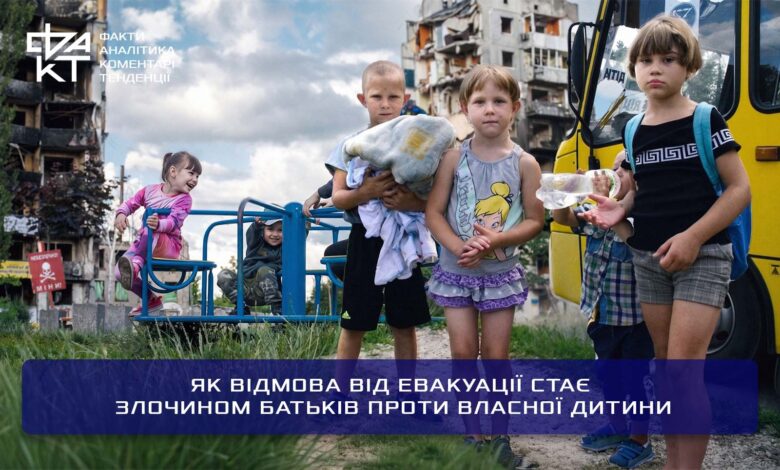
While some Ukrainians are fighting for every chance to save their children in the reality of war, taking them under fire into the unknown, others are consciously turning their own little ones into hostages of the front line. Behind the closed doors of half-destroyed houses in front-line zones, a tragedy unfolds every day, when parents, guided by fear of the unknown, stubbornness or everyday fatalism, refuse to evacuate, condemning their children to chronic psychological terror and a real risk of death. This paradox of wartime has long since outgrown the limits of parents’ personal choice and has become an acute social disease in which the state is forced to balance respect for private life with the duty to save those who cannot protect themselves.
A Crisis of Responsibility Under Shelling: How Law No. 12353 Overcomes Parental Sabotage of Evacuation
The practice of forcibly securing minors from frontline areas is increasingly encountering deaf, and sometimes aggressive, resistance from those who should be protecting the little ones first. Rescue missions that regularly travel to locations in Dnipropetrovsk and Donetsk regions note a systemic phenomenon where parents deliberately misinform the authorities, hide the actual place of residence of their children, or hide them in basements from evacuation crews.
This dangerous trend is not limited to the aforementioned regions, but also extends to other border and frontline regions of Ukraine, where civilians stubbornly ignore the threat of artillery and drone strikes. Instead of a rational desire to take children to the rear, law enforcement officers are faced with psychological barricades from adults who put their own lives or distorted perception of reality above the life of their own child.
A resonant reflection of this crisis of responsibility was the court trial in Kharkiv, where in March 2026 a verdict was handed down to a 23-year-old woman who cynically neglected the safety of her own family. The mother transported her six-year-old daughter to Kupyansk right at the time when legal regulations on the mandatory evacuation of the population were already in effect there, after which she left the girl under the supervision of her great-grandmother and drove back to the regional center. The result of this decision was an arrival, during which the child received extremely severe mine-explosive injuries to the face and head, which forced doctors to begin a long and complex course of rehabilitation. Now the girl faces lengthy plastic surgeries.
Additional confirmation of the constant danger in these zones was the incident, when on June 11 a Russian FPV strike drone hit a private yard, injuring another woman and her 15-year-old son while they were working in the garden. As reported by the head of the Borivka settlement military administration, Oleksandr Tertyshny, this family had previously been evacuated for security reasons from the village of Nizhle Solone. This settlement is located just 11 kilometers from the front line. Despite the high risks, the mother decided to return home with her minor child, bypassing the established checkpoints.
The victims were hospitalized in one of the Kharkiv hospitals, where doctors assess their condition as moderate. The woman is currently being prepared for surgery due to a serious eye injury. For neglecting safety measures and returning the child to the combat zone, the mother faces punishment in accordance with current legislation.
The state’s legal response to such threats was Law No. 12353, signed by the President of Ukraine in early March 2026, which gave law enforcement officers the authority to forcibly remove minors from areas of active combat. The new regulations clearly stipulate that the categorical refusal of parents or guardians to accompany a child during an announced evacuation automatically becomes a legal basis for the removal of the child, although this does not lead to immediate deprivation of parental rights. The legislative algorithm looks like there is no alternative, because after the official declaration of danger, adults are obliged to take children out on their own, and in the event of sabotage, the police carry out the operation themselves, handing over the evacuees to the guardianship and trusteeship authorities.
A prime example of the implementation of such harsh instruments is the Donetsk region, where during the entire period of the full-scale invasion, precedents of forced removal were recorded exclusively on the territory of the Pokrovska community. The local authorities developed official decisions on removal for five children, but the very fact of the appearance of law enforcement officers with signed papers forced the adults to immediately pack their things and leave voluntarily, so this mechanism did not actually have to be put into action then. The actual removal took place only in one case, when the child was initially placed in a foster family, and later the specialized children’s service found a biological aunt in the controlled and safe territory of Ukraine, where the child was transported, who has now reached adulthood.
Evacuation circle: where and why children still remain in front-line communities
The dynamics of the displacement of the civilian population from the front-line regions of Ukraine demonstrates the scale of security challenges, where the key marker of the effectiveness of state institutions is the rescue of minors. Calculations for the reporting period from June 2025 to January 2026 record the removal of more than 151 thousand people from dangerous zones. The share of children in this flow was almost 18.5 thousand, and the intensity of the process increased noticeably during the autumn of the previous year. If at the beginning of October 2025, statistics reported approximately 12 thousand evacuated minors, then by the end of the same month this figure had already crossed the 14 thousand mark.
The main burden of evacuation logistics fell on the Donetsk region, from where about 9,200 children were evacuated, while more than 4,000 people of this age category were evacuated from the frontline communities of the Dnipropetrovsk region. Other directions demonstrate significantly smaller, but critically important volumes: from Sumy region over 350 children left, from Kherson region — about 320, from Kharkiv region — over 290, and from Zaporizhia region it was possible to evacuate more than 80 minors.
The geographical specificity of the current stage of evacuation as of June 2026 indicates a deep disproportion between the regions, where Donetsk region continues to be the epicenter of humanitarian pressure. There are still 8,063 children in the Ukrainian-controlled territory of this region, and among them 629 minors from 474 families live in those points where mandatory evacuation has been announced. Trying to break this vicious circle, local authorities have launched the 34th stage of forced evacuation. Operational daily reports confirm the continuity of the process. For example, on May 30, 2026, 303 people were evacuated from the region, including 67 children, and on June 8, safer places were found for 546 citizens, including 70 minors.
Such daily activity is based on a strict regulatory basis, precisely after the legislative field underwent transformation. The new regulations allowed specialized services to carry out mandatory removal of minors from areas of direct combat even in the event of parental refusal, if the existing level of threat to the child’s life becomes critical. During the spring, this tool significantly changed the local picture, because at the beginning of spring, 117 children in 86 families were recorded in the zones of forced removal in the Donetsk region, of which the largest concentration was observed in the Mykolaiv community, where there were 57 minors, and in the Andriyiv community with its 26 children. The overall picture of the situation in this region is much broader, because as of February 2026, there were a total of more than 11.6 thousand children in the controlled territories of the region, although only 201 children remained within the immediate forced isolation at that time.
The analysis of the nationwide situation at the beginning of the summer of 2026 is complicated by the lack of final unified statistics for the country, but the coordination of data from regional administrations and the Ministry of Development allows us to clearly distribute the successes and problem areas of the regions. Zaporizhia region demonstrates maximum effectiveness in implementing security plans. The head of the local OVA Ivan Fedorov in May confirmed that in the previously identified communities, mandatory evacuation has been completely completed and not a single child remains there, although the front line is forcing the authorities to gradually expand these zones to new settlements. A similar model of total clearing of the dangerous space was implemented by Sumy region, where in a five-kilometer strip along the border, despite the presence of more than 4 thousand adults there, the number of children decreased to zero back in February.
In contrast to these examples, Kharkiv and Kherson regions are still overcoming internal resistance and logistical obstacles. In Kharkiv region, at least 20 children are still in the Bogodukhiv community under mandatory evacuation orders, while additional evacuation measures are being implemented in other regions. In addition, in the Kupyansk district, in the deoccupied territories under constant shelling, single families with children may still be hiding, although children have been evacuated from Kupyansk itself. Despite official reports of complete evacuation, the military and police are still discovering hidden families in border villages from the Vovchansk community, where children are being evacuated for the second time.
There is a lack of the most recent open statistics in the Kherson region, but the figure of 34 children inside the most dangerous “red zone” recorded in early April indicates that risks remain. Summarizing the available June data for the mentioned regions, we have about 680–700 children who are still under direct fire. However, the main conclusion is that about 90% of this number is concentrated in the Donetsk region, while in other regions the strict mechanism of forced evacuation has either completely eliminated the problem or reduced it to a controlled minimum.
Civil resistance: historical experience
The historical experience of world conflicts shows that the phenomenon of parents’ resistance to evacuation and attempts to hide children from state authorities is not a unique Ukrainian case. During the large-scale wars of the 20th century, governments of various countries faced similar psychological and logistical barricades, when the civilian population refused to believe in the reality of the threat or categorically did not want to break family ties for the sake of the illusory, in their opinion, security in the rear. Methods of combating this phenomenon evolved from mild social pressure and administrative isolation to the creation of no alternative conditions that made it physically or legally impossible for minors to be in the war zone.
The most extensive and documented precedent was the British government evacuation program Operation Pied Piper, which was launched in September 1939 due to the threat of German carpet bombing. Despite the fact that the removal of children from London and other industrial centers was declared voluntary, hundreds of thousands of families refused to give their children to strangers in the countryside, hid them during gatherings or took them back to the cities during periods of calm. The British authorities launched an unprecedented information campaign, using posters with slogans that leaving a child in the city was aiding Hitler, and also closed all urban schools in danger zones, depriving parents of the opportunity to provide their children with at least some social life or care. In addition, social services conducted strict audits of families, and if the mother refused to evacuate the baby, she could be deprived of state subsidies or accused of parental negligence under the country’s general criminal law.
A similar, but much stricter model was implemented in Finland during the Winter War (1939–1940) and the Continuation War, when the government organized the mass deportation of over 70,000 children to neighboring Sweden. There, the resistance of families was fought through the mechanisms of military-civilian administrations. In border areas exposed to artillery fire from the USSR, full commandant control was introduced, and civilian families were simply denied food rations for minors if they were not registered on evacuation lists. The Finnish state made the survival of families directly dependent on the implementation of security directives, which quickly nullified attempts to hide children in basements or forests.
In recent history, during the Balkan wars of the 1990s, in particular during the Bosnian conflict, international humanitarian organizations and local authorities were faced with the fact that parents used children as a “human shield” or a means of retaining the right to housing in front-line cities, since families with children were more willing to provide humanitarian aid. This had to be combated through UN instruments and the involvement of military police, who verified lists of residents in bomb shelters.
Foreign experience proves that in war conditions, voluntary evacuation never worked 100%, and every state that sought to preserve its future generation sooner or later resorted to harsh administrative coercion, the closure of civilian infrastructure and legal liability for adults.
When the front line approaches homes, familiar notions of privacy crumble under the pressure of the need to simply survive. The resistance of parents who refuse to evacuate has become a natural, albeit destructive, psychological reaction to stress, when clinging to a familiar life seems safer than the unknown in a foreign region. Since civilians often lose the ability to rationally assess risks under constant shelling, the state finds itself in a situation where coercion becomes the only tool of salvation.
World history and modern practice prove that humane appeals and persuasions in conditions of total war do not work. Ultimately, strict legal restrictions and the forced removal of children are not a manifestation of state pressure, but a sober, albeit painful, compromise that society is forced to make in order to protect the new generation from physical destruction. However, the state must ensure proper conditions for families with children to stay in relatively safe places and help parents find jobs, but this is often ignored.


