Fraudulent schemes surrounding the families of missing persons and prisoners: how a shadow industry turned into a multimillion-dollar business

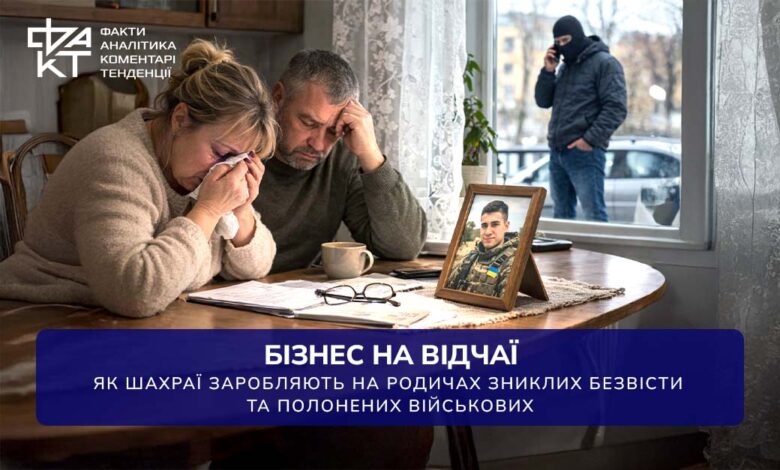
Over the years of the full-scale invasion, the “missing persons search” industry, built on desperation, has turned into one of the most profitable and cynical shadow markets, where tens of thousands of dollars are paid for the hope of rescuing the families of missing persons and prisoners of war. While society focuses on defending the country, scammers and professional manipulators turn the personal tragedy of Ukrainians into a tool for crime.
Conveyor of deception: scenarios by which scammers extort money from the families of missing soldiers
The gap between real crime, the quality of materials collected by law enforcement officers, and justice remains catastrophic, because with recorded at present 48,871 criminal proceedings for under Article 190 of the Criminal Code of Ukraine (“Fraud”), only 8,758 proceedings, or about 18% of proceedings, reached the court. At the same time, the largest number of such cases was recorded in Kyiv, Dnipropetrovsk and Kharkiv regions. Such statistics of impunity, where only every fifth defendant is suspected, turns the search for heroes into a safe field for criminals to profit, which forces us to ask an acute question about the effectiveness of state protection of those who have already given the country the most.
Professional manipulators have developed an extensive network of scenarios, among which the images of “informants” who are allegedly in the same cell or unit as the missing person, offering to organize a short call or hand over the phone for a reward. Along with this, pseudo-volunteers and fake lawyers are operating, promising to “push” the case through their own connections in the Ministry of Defense or the Red Cross structures, demanding payment for services that are by their nature free of charge or not at all provided for by the regulations of these organizations.
The cynicism of the attackers often reaches the point of absurdity when they try to trade visual evidence of life, providing families with old or edited photos for money, or even resorting to extorting money for the evacuation of bodies from occupied territories. One of the most dangerous is the “listing for exchange” scheme, where scammers, posing as SBU or GUR officers, demonstrate fake databases and demand transactions to private accounts to “speed up” the process. Often, such cases are recurrent, because after the first payment, criminals claim that tariffs have supposedly increased or new bureaucratic obstacles have arisen, trying to squeeze the last savings out of the deceived family before completely disappearing from communication.
The evolution of fraud is adapting to the digital realities of 2026, where the use of artificial intelligence and content manipulation allows the creation of fake confirmations of kidnappings based on open photos of loved ones on social networks. Criminals use emotional time pressure tactics, sending messages with threats and demands for immediate ransom, hoping that the victim will not have time to see the signs of forgery due to panic. In addition, the adapted “relative in the hospital” scheme does not lose its relevance, when fraudsters, posing as combat comrades or doctors, report the critical condition of a soldier in a remote hospital and demand urgent transfer for “life-saving” treatment.
A separate layer of crimes is aimed at families who have already received state payments or are faced with the extortion of non-existent debts of a serviceman, which is accompanied by intimidation and psychological pressure. No less dangerous are “spiritual” scammers, so-called fortune tellers and psychics, who establish long-term emotional contact with victims, regularly extorting money for “energy support” or false predictions about the fate of the prisoner. In such circumstances, it is critically important to remember that state structures, in particular the Coordination Headquarters for the Treatment of Prisoners of War, carry out all activities exclusively on a free basis, and any demand for money for release is direct evidence of a crime.
An effective algorithm of actions for families begins with a cold analysis of the situation: the lack of communication in combat zones is often due to the lack of electricity, so the first step should be communication with the military unit, battalion and comrades. In the event of official confirmation of the disappearance, it is necessary to immediately contact the National Police with a statement, prepare DNA samples and register in the “Personal Account” of the Coordination Headquarters and the National Information Bureau. Since May 2023, a Unified Register of Missing Persons has been operating in Ukraine under the auspices of the Ministry of Internal Affairs, and representatives of the Commissioner have been operating in the regions, coordinating search activities, which are stopped only after the person’s whereabouts or burial place is established.
Millions in Despair: Real Cases of Fraud on the Topic of Missing Soldiers
Exploiting the fragile line between desperate hope and the harsh reality of war, a significant group of cynical manipulators has formed in Ukrainian territory, who have turned the search for missing defenders into a tool for enrichment. The case in Lviv region, where law enforcement officers detained a suspect for embezzling over UAH 2.1 million, demonstrates the highest degree of moral degradation, as the perpetrator broke into the trust of a soldier’s family directly during the funeral of another soldier. Using fictitious connections in the Coordination Headquarters for the Treatment of Prisoners of War, this man created the illusion of intensive activity for 5 months, while being within the Lviv region. The final act of his deception was cynical misinformation about the military man’s stay in the Voronezh pre-trial detention center, which prompted the Galician District Prosecutor’s Office to declare suspicion under Part 5 of Article 190 of the Criminal Code of Ukraine, which provides for severe punishment for fraud on a particularly large scale.
Law enforcement officers of the Chernivtsi region exposed and detained a 42-year-old local resident who turned the tragedy of the families of missing defenders into a cynical source of her own enrichment. Prosecutors of the Chernivtsi District Prosecutor’s Office, together with police representatives, established that the attacker used the social network “Facebook” as a tool for hunting people in a state of critical psychological despair. Creating numerous fictitious accounts, she systematically monitored posts about the search for servicemen, after which she contacted relatives under the guise of a virtuous volunteer, whose help seemed to desperate people as the last hope.
The well-thought-out manipulation of the emotional state of the victims allowed the suspect to set up a scheme to extort money from a 50-year-old Bukovinian woman who was trying to find out the fate of her husband, who had disappeared directly on the front line. Having no connection to real volunteer movements, structures involved in the exchange of prisoners, or evacuation units, the suspect confidently assured the woman that her loved one had been found in critical condition. The attacker skillfully created the illusion of urgency, claiming that the soldier was in a “gray zone” and needed immediate evacuation, which was allegedly blocked only due to the lack of money for special evacuation transport.
The pressure on the victim was accompanied by constant fabrication of new circumstances that required additional financial injections for the alleged urgent closure of the collection, which in fact put the soldier’s life directly dependent on the speed of bank transfers. To hide her illegal activities and complicate the process of exposure, the Bukovynka distributed the money received between several bank accounts, from which she later promptly withdrew cash. The investigation documented that she received more than 11 thousand UAH from only one applicant, but the scope of her activities may be much wider, since the involvement of the detainee in 5 more similar criminal episodes is currently being verified.
The detention of the defendant took place in accordance with the norms of Article 208 of the Criminal Procedure Code of Ukraine, and her actions were officially qualified under Part 4 of Article 190 of the Criminal Code of Ukraine as fraud committed with the use of electronic computing equipment. This case once again emphasizes the need to be critical of any offers of help from private individuals online who demand money for services provided by official specialized institutions in the state. A pre-trial investigation is currently underway to identify all victims who could have fallen victim to this cynical scheme in Bukovina and beyond.
Along with methods of personal psychological influence, digital harassment schemes are actively developing, an example of which is the activity of a 34-year-old previously convicted resident of Ternopil region. This defendant, having learned about the tragedy through mutual acquaintances, created a network of fake accounts and, posing as a relative of the missing person, lured the sister of the serviceman out of more than 1 million UAH through 34 transactions. The technological savvy of such criminals allows them to quickly convert the stolen funds into cryptocurrency, trying to cover their tracks, but the efforts of the cyber police and the prosecutor’s office of the Chortkiv district allowed them to send the case to court, where the accused faces up to 12 years in prison with full confiscation of property.
An analysis of financial flows in these criminal proceedings reveals a disturbing pattern, where about 97% of the stolen funds through the labyrinths of cryptocurrency exchangers and anonymous platforms are taken directly to the territory of the aggressor country. This turns household fraud into an element of economic undermining of the state, where every hryvnia taken from the pocket of a devastated family actually becomes a resource for the enemy. That is why the immediate reaction of the victims must be critically important, so the first call to the bank’s hotline to block the transaction and contacting the police remain the only effective methods that allow freezing assets until they are finally withdrawn into the shadow sector.
How Ukrainian money through the “search for missing persons” finances Russian terror
The large-scale penetration of the Russian Federation into the digital space of Ukraine has transformed classic criminal fraud into a hybrid weapon, where financial profit is inseparable from the strategy of destabilizing society. Since the vast majority of stolen capital settles in accounts in the Russian Federation, we are observing a vicious circle of financing terrorism at the hands of Ukrainians themselves, whom the attackers force to pay for the illusion of saving their own children and husbands. The enemy deliberately supports these shadow markets, since each successful act of looting on the theme of captivity deepens the abyss of distrust between citizens and state institutions, creating the illusion of defenselessness in the face of adversity. The psychological terror that accompanies such schemes depletes the mobilization and moral resources of the nation, turning the rear into a vulnerable zone where emotional disorientation becomes the main commodity.
The lack of inevitable punishment for the thousands of suspects only fuels the appetites of new players in this market, who are becoming increasingly inventive in exploiting technical loopholes and psychological weaknesses. The use of cryptocurrency gateways and anonymous services allows criminals to feel elusive, while the families of the military find themselves in a double trap – between the uncertainty about the fate of their loved ones and the threat of financial collapse. At the same time, the systematic nature of these crimes requires not only strengthening the quality of cyberpolice work, but also a radical revision of approaches to digital security of vulnerable segments of the population, because in 2026, information hygiene has become a matter of survival. Each publication with a soldier’s personal data on Facebook or Telegram today is actually a “tip” for an enemy agent or a cynical looter waiting for the right moment to strike.
The state’s response to this challenge must go beyond dry statistics and bureaucratic explanations, transforming into a reliable shield capable of preventively stopping criminal transactions. Integration of the banking sector with the registers of the Ministry of Internal Affairs and a prompt response to suspicious activity regarding the accounts of military personnel’s families could become the barriers that will make this business economically inexpedient. While the law enforcement system is working its way from opening a case to an actual verdict, society must develop immunity to quick solutions offered by anonymous “benefactors.” This must happen through active outreach to the population, which is currently being carried out extremely sluggishly by state authorities.