
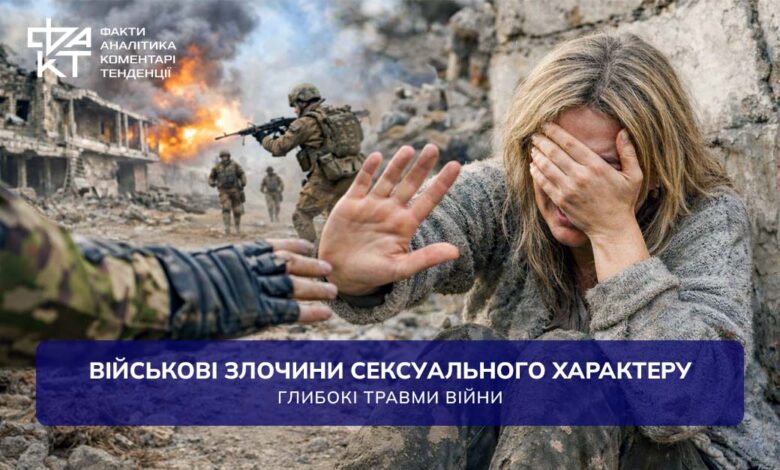
Historically, all wars have been accompanied by sexual violence. From ancient times to modern conflicts, women, children and men have been victims. The consequences of these crimes go far beyond individual tragedy: families, communities and social structures are destroyed. Rape, forced sexual acts and humiliation leave deep social and psychological trauma that is passed down through generations. The history of wars shows that regardless of time and place, war crimes of a sexual nature are repeated with stunning consistency, and the modern war in Ukraine demonstrates that the scale and methods of this violence remain shocking even in the 21st century.
Violence against women in war: What new UN report reveals about the scale of the problem
A new report by the United Nations Secretary-General on women’s and girls’ access to justice paints a disturbing picture that spans continents and political systems. According to the latest data, the number of recorded cases of sexual violence during war has increased by 87% in the past two years. This reflects a global trend where wars and local conflicts are becoming catalysts for widespread violations of the rights of women and girls.
Despite decades of international declarations, human rights programs and numerous legislative reforms, real legal equality between men and women has not become the universal norm. The study shows that in many countries, legal systems leave significant gaps in the protection of women, and sometimes even create conditions in which violence, economic dependence or coercion can exist without an adequate state response.
The document emphasizes that sexual violence continues to be used during wars as a way to influence the civilian population, when violent acts are directed not only against a specific person, but also against the community to which she belongs. Such crimes have consequences that go far beyond the personal tragedy, as the trauma experienced by the victim becomes part of a collective experience of fear that can destroy social ties, force people to leave their homes or lose trust in any institutions that are supposed to provide protection.
The increase in the number of recorded cases of sexual violence during wars occurs against the background of a much wider problem related to unequal rights and imperfect legislation. According to UN estimates, no country in the world has achieved full legal equality between women and men, and the average amount of rights enjoyed by women is only 64% of those enjoyed by men. This gap means that even outside of war, women often remain less protected in the legal field, which significantly complicates the ability to achieve justice after experiencing violence.
The situation with the definition of sexual crimes in the legislation of different countries is particularly telling – in 54% of the world’s states, rape is not defined on the basis of consent. This means that the mere fact of the woman’s lack of voluntary consent is not always a sufficient legal criterion for recognizing a crime. In such a legal system, a person may experience sexual violence, but the law does not always provide the opportunity to qualify this experience as a criminal offense, which creates a dangerous gap between reality and legal protection mechanisms.
However, even where relevant laws exist, women do not always turn to courts or law enforcement agencies. The reasons for this situation are quite diverse: fear of condemnation, stigmatization by society, pressure from the family or community, as well as distrust of state institutions that should ensure justice. Added to this are practical barriers that impede access to justice. Court proceedings often require significant financial costs, and language barriers or lack of time can make it difficult to defend one’s rights even where the law formally guarantees the appropriate opportunities.
Violence against women during the full-scale invasion of Ukraine by the Russian Federation
The full-scale invasion of Ukraine by the Russian Federation has raised the problem of sexual violence to the level of a strategic war crime aimed at destroying the identity and dignity of an entire people. A study by the European Agency for Fundamental Rights (FRA), published in 2026, reveals the scale of this tragedy, where one in four women seeking asylum in the EU reported having experienced physical or sexual abuse.
This experience is not limited to the war zone, but extends throughout the evacuation route and even the period of adaptation in new countries. More than half of the respondents faced aggression or harassment precisely because of their Ukrainian origin, while only a meager 3% dared to seek help from official services, which indicates a colossal layer of invisible pain that remains outside the scope of criminal statistics.
It is noteworthy that internal Ukrainian statistics, collected within the framework of pilot projects on the payment of reparations, destroy outdated stereotypes regarding the gender profile of victims. As of the end of 2025, officially recorded over 1,080 cases of SNPK, where the majority of applicants were men, which indicates the use of sexual humiliation as a method of torture in captivity and in the occupied territories. Data from mid-2025 detail the aggressor’s methods: among 366 documented cases, the following appear: forced exposure, genital mutilation and other forms of sexual torture, the victims of which were 231 women, 134 men and 19 children. The geography of these crimes covers all deoccupied and frontline regions from Kherson to Kyiv, confirming the systemic nature of the violence. Reports from the Prosecutor General’s Office only reinforce this picture, recording hundreds of cases of abuse, which are not random excesses of the perpetrators, but part of a targeted policy of terror.
It is worth noting that the modern tragedy of forced migration reveals another painful layer of reality, where the war for millions of Ukrainian women did not end with the crossing of the border, but was transformed into new forms of vulnerability. Life in the diaspora often becomes an arena of invisible struggle with the risks of exploitation and harassment, which are layered on top of the language barrier, economic insecurity and the total absence of familiar social ties.
This multidimensional space of violence requires the international community not just to dryly record statistical data, but to create viable mechanisms for rehabilitation. Despite the efforts of global institutions in developing legal instruments, the path to restoring each mutilated fate remains an extremely difficult challenge, where legal procedures often break down against the wall of social isolation and long-term psychological trauma of the victims.
It is important to realize that the figures that human rights activists operate with in 2026 are only the tip of the iceberg, breaking through the ice of silence and trauma. The real scale of the catastrophe remains hidden behind the veil of official statistics and the physical impossibility of reporting a crime under conditions of occupation or active fighting. This gap between statistics and reality remains one of the greatest challenges for the international community, which is trying to find effective mechanisms for punishing crimes that have no statute of limitations and strike at the very essence of human nature.
The Systemic Nature of Violence During Wars: A Historical Excursus
The historical retrospective of wars and armed conflicts shows that the female body has always become an invisible front, where victory over the enemy was measured by the degree of humiliation of his women. Sexual violence in wartime has long since transcended the occasional excesses of perpetrators, becoming a full-fledged instrument of genocide, where rape and forced pregnancy are used as a method of final destruction of an ethnic or social group.
The tragedy of the situation is exacerbated by the fact that victims often find themselves in a double trap, when aggression from the invader and violence from members of their own community become the most painful and silenced aspect of wartime reality. The weakening of state control and the destruction of moral institutions create a vacuum in which women become vulnerable targets for exploitation, slavery and systemic terror, which aims to destabilize society by demonstrating absolute power over the least protected.
The archaic civilizations of Mesopotamia and Ancient Egypt laid the cruel foundation for the perception of women as war trophies, where captives became the unrightful property of rulers or replenished the harems of conquerors. Herodotus described in detail how the Persian campaigns were accompanied by the appropriation of the women of the conquered peoples, which served not only to satisfy the needs of the army, but also as an act of intimidation of entire families. Ancient Greece and Rome continued this practice, legitimizing sexual slavery as an inalienable right of the victor, which for centuries consolidated the status of women as objects, deprived of subjectivity during the redrawing of the world map.
The Middle Ages, with its Crusades and Mongol conquests, only scaled up these practices, using mass violence to force the population into submission, which was also clearly manifested in Europe during the Thirty Years’ War, when robbery and rape became part of a conscious tactic of demoralization.
The scale of the 20th century gave this problem industrial dimensions, turning sexual violence into state policy, as was the case with the Japanese system of “comfort women”, where hundreds of thousands of Korean and Chinese women were forcibly involved in military prostitution. The tragedy of the “rape of Nanjing” in 1937, when more than 20,000 people of all ages became victims in just six weeks, demonstrated the depth of dehumanization inherent in the aggressive ideologies of the time. Nazi Germany integrated sexual terror into the system of occupation of Eastern Europe, where, according to historians, up to 80% of women of certain age groups experienced violence. At the same time, the advance of the Red Army in 1945 was accompanied by almost 2 million rapes in Germany, and these facts were carefully hushed up by the Soviet command. Even in the armies of democratic countries such as the United States, thousands of such crimes were recorded, but they were subject to strict disciplinary investigations.
The experience of the Vietnam War, which lasted from 1955 to 1975, remains one of the most controversial episodes in modern military history, because along with combat operations and large-scale human losses, researchers record numerous cases of violence against the civilian population. Among such crimes, sexual violence occupies a special place, which, according to eyewitness accounts, journalistic investigations and materials from human rights organizations, sometimes accompanied punitive operations by American military units in Vietnamese villages.
The context of this war largely explains why such crimes could occur. The fighting took place mainly in rural areas of South Vietnam, where the civilian population found itself between the two sides of the conflict. American units often conducted so-called “search and destroy” operations, during which soldiers combed settlements in search of Viet Cong fighters. In such conditions, the boundaries between military targets and civilians were often blurred, and an atmosphere of suspicion and fear contributed to the growth of cruelty.
One of the most famous episodes that drew attention to crimes against civilians was the massacre in the village of My Lai in March 1968. During this operation, American soldiers killed hundreds of unarmed villagers. Later investigations and eyewitness accounts showed that some of the women and girls were sexually assaulted before the killings. This event became a symbol of war crimes in Vietnam and caused an international scandal after information about the tragedy appeared in the world press.
Modern conflicts from the Balkans to Ukraine demonstrate that the methods of intimidation remain unchanged, despite the development of international law and technology. The war in Bosnia in the 1990s left behind the memory of special “women’s camps” where ethnic cleansing was carried out through systematic sexual humiliation, and events in Syria, Iraq and Ethiopia confirm that violence is still used as a weapon against identity.
The full-scale war of the Russian Federation against Ukraine has once again brought to the surface the facts of the use of sexual torture by occupying forces to control territories and destabilize the civilian population. The sociological consequences of such actions are extremely destructive, as they provoke demographic crises, the spread of diseases and deep social stigma, often transmitted across generations, demanding that modern legal institutions recognize sexual violence as a separate and most serious crime against humanity.
Conflict-Related Sexual Violence: The International Legal Architecture
The international legal architecture of prosecuting conflict-related sexual violence (CRSV) is based on a complex system of international instruments and national law aimed at ensuring that anyone who uses the body as a weapon is held accountable. The International Criminal Court in The Hague, the ad hoc tribunals and the Ukrainian judicial system form a single front for justice, where the key to success is the careful recording of evidence and the preservation of every detail of the crime committed. The modern legal framework allows us to view all these atrocities through the prism of the 1949 Geneva Conventions, where Article 14 requires respect for the honour of prisoners of war, and Article 27 guarantees that civilian women are protected from any attacks on their dignity, including forced prostitution and rape.
The expansion of the legal field was achieved thanks to the Additional Protocols of 1977, which strictly prohibited any forms of indecent assault and degrading treatment not only against women but also against children, creating a multi-layered barrier against impunity. An important aspect that the experts of the Association of Women Lawyers of Ukraine emphasize is the principle of command responsibility, enshrined in Article 28 of the Rome Statute, according to which not only the direct perpetrator is responsible for crimes of a sexual nature, but also the military command that allowed or ignored such actions in its unit. This turns sexual violence from an individual soldier’s fault into a systemic problem of the entire military structure of the aggressor, allowing the prosecution of the leadership for war crimes and crimes against humanity.
Ukraine’s domestic legislation mirrors these international standards, in particular through Article 438 of the Criminal Code, which provides for strict liability for violations of the laws and customs of war. Cruel treatment of civilians or prisoners of war is punishable by imprisonment for a term of 8 to 12 years, and in cases combined with murder, the sanction increases to life imprisonment, which demonstrates the seriousness of the state’s intentions in protecting its citizens. Moreover, Article 442 of the Criminal Code allows for the qualification of systemic sexual violence as an element of genocide if it is aimed at the complete or partial destruction of a national or religious group, in particular through the forcible prevention of childbirth or the creation of intolerable living conditions.
The spectrum of legal qualification of such acts is extremely broad, allowing investigative bodies not to limit themselves to sexual offences, but to incriminate torture, inhuman treatment or intentional infliction of physical suffering. Any violation of personal dignity under the control of an enemy party is considered a grave war crime, seriously threatening the health and life of the victims. The integrity of this analytical approach lies in the fact that the legal system of 2026 no longer considers sexual violence as an accidental consequence of chaos, but identifies it as a purposeful tactic of warfare, for which one will have to answer to the entire world community.
Analysis of the deep layers of this tragedy leads to the painful conclusion that humanity, over millennia of evolution, has never been able to guarantee the inviolability of the most intimate boundary – human flesh. What we see in the 2026 reports is a fundamental challenge to our civilizational ability to protect the very essence of humanity. While global institutions collect statistics and seek legal formulations, the bodily autonomy of thousands of people continues to be a bargaining chip in large geopolitical games, where the aggressor consciously chooses the path of dehumanization.


