
From courts in Ukraine to PACE: pension debt to security forces has reached international level

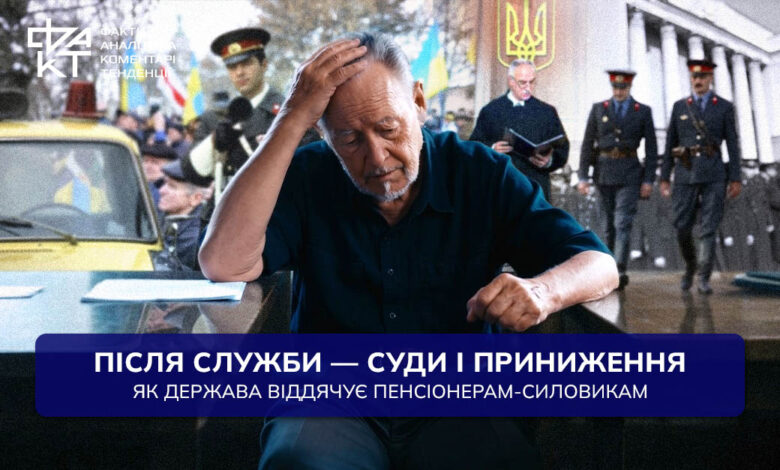
The problem of pension provision for former security forces, who served the state for decades, has become one of the longest and most acute socio-legal crises in Ukraine. What was supposed to be a guaranteed guarantee for service has turned into humiliation, exhausting legal proceedings and years of fruitless waiting for hundreds of thousands of people. Despite the fact that the law defines the rights of retired security forces, in practice they are systematically narrowed, and the mechanisms for implementing these rights are constantly blocked or postponed. Even court decisions that should restore justice have not been implemented for years, turning the right to a pension into a subject of endless struggle.
How the pensions of former security forces became the state’s debt to those who served it
In the state’s obligation to protect those who worked for its security for years, a deep gap has long appeared between the rights defined in the law and what people receive in real life. At the beginning of 2026, the total debt under court decisions on pension payments reached approximately UAH 85.6 billion. Behind the dry figures is a long-standing history in which people who once served the state are forced to defend the payments guaranteed to them in the courts, go to rallies and even block roads to remind the authorities of their direct duty.
Against this background, another figure looks especially telling: over the past five years, the number of decisions made in favor of pensioners has increased 26 times. Such dynamics indicate that more and more pensioners-security officers are no longer putting up with the deferred right and are beginning to demand it through the court.
From a budgetary point of view, the situation looks almost hopeless, because the funds that the government allocates each year to repay such debts do not even remotely correspond to the volume of accumulated obligations. At the same time, the flow of new court decisions does not weaken: in 2023, pensioners won 240 thousand cases, in 2024 – over 100 thousand, and in the first months of 2025 alone – over 18 thousand. With such a rapid accumulation of new obligations, the system does not have time to settle even the old ones, and each new case won increases the debt faster than budget allocations allow it to be reduced.
Because of this, the judicial system has actually turned into a permanent platform where pensioners are demanding what, in a normal legal structure, should not become the subject of a separate dispute. Only the Cassation Administrative Court within the Supreme Court considered over 56 thousand cases during 2025, with a significant part of these proceedings related specifically to pension provision and recalculation of payments to the military. So, we are not talking about individual court cases between a pensioner and the state, but a large-scale array of cases in which a court decision increasingly fixes the right, but does not guarantee its actual implementation.
A separate array of court cases occurred in 2025, when a new wave of lawsuits appeared due to government resolution No. 1 of January 3, 2025, which limited the payment of special pensions. After its adoption, pensioners began to massively challenge the established limits, and the courts, in particular the Supreme Court, recognized these restrictions as illegal.
In cases regarding the recalculation of military pensions based on updated certificates of financial support, the effectiveness of claims in favor of pensioners is approaching 90–95%, since the legal position of the Supreme Court on these issues has already become stable. When the vast majority of such cases end in favor of the plaintiffs, the discussion about the disputability of their claims virtually disappears: the dispute is no longer about the existence of a right, but about the unwillingness or inability of the state to fulfill what its institutions recognize as legal.
It should be noted that almost three-quarters of all pensions, or 72.8%, are old-age payments; approximately 14.7% are disability pensions; 7% are survivor’s pensions; and another 5.02% are retirement pensions. If we take 5.02% of the total number of pensioners, which is 10.2 million people, we get approximately 512 thousand people who receive retirement pensions. However, this figure alone does not answer the question of how many military pensioners there are in Ukraine, since the group of pensioners by years of service includes employees of various fields – from civil servants to employees of industrial enterprises, as well as some military personnel who are entitled to early retirement due to long service.
It is because of this confusion that information was widely disseminated in the media last year that the number of military pensioners allegedly reaches 635.8 thousand, and the average retirement age is 51 years. At the same time, the Pension Fund’s response to a journalist’s request provides other data: as of 2025, 160,859 people aged 45 to 60 actually received pensions by years of service. Of these, 47,091 people continued to work, although no longer in the military sphere, 98,120 were unemployed, and 15,544 people were military pensioners who retired due to years of service.
Despite the barrage of court decisions and established judicial practice, the government does not abandon the approach in which the restoration of violated rights depends not so much on the binding nature of the court decision as on the method of its financing. Resolution of the Cabinet of Ministers No. 821 of July 14, 2025 established a new procedure for the implementation of Pension Fund expenditures for the payment of pensions assigned or transferred to fulfill court decisions. Formally, it was about streamlining the payment mechanism, but in fact the document established a phased and time-stretched procedure for repaying debt, which leaves room for further delays.
The resolution stipulates that funds for the execution of court decisions will be distributed depending on the source of funding – separately from the state budget and separately from insurance revenues. In practical terms, this means that the payment of each specific amount is tied to the availability of money in the corresponding budget line, and not to the very fact of the existence of a binding court decision.
As a result, a system is emerging in which the right of military pensioners to due payments is confirmed by law, massively recognized by the courts, and at the same time postponed in time by administrative and budgetary mechanisms. Hundreds of thousands of decisions are accumulating, the debt is calculated in tens of billions, the number of new cases is growing, and each new government attempt to streamline the process turns into new filters, queues, and dependence on the available financial resources.
With such a design, the court ceases to be the end of the dispute, and the pension, which was supposed to be guaranteed by the state, increasingly resembles a long and exhausting process of collecting debt from the very state that these people once served.
From Ukrainian courts to PACE: how the case of military pensioners reached the international level
Non-enforcement of a court decision in Ukraine is a basis for criminal liability, however, in cases concerning pension payments to former security forces, this norm exists only on paper. Court decisions remain unenforced for years, and officials avoid personal liability. Against this background, the problem of non-enforcement of decisions acquires another, no less painful dimension – obtaining certificates of the amount of monetary security, without which former security forces and especially tax police pensioners often cannot even start legal proceedings or initiate a pension recalculation.
It is the certificate of monetary security that is the document without which the right to recalculation is actually hanging in the air, since it confirms the amount of official salary, allowances and bonuses that must be taken into account when calculating the pension. What should have remained a technical procedure — contacting the archive, working with the personnel department, issuing a document in accordance with the established procedure — turned into a long-term ordeal and humiliation.
This problem hit former tax police officers especially hard, because after the liquidation of this body, the newly created structure — the Bureau of Economic Security of Ukraine — was supposed to become the legal successor, but the mechanism for transferring personnel archives and powers was never properly regulated. As a result, thousands of former tax police officers found themselves in a legal vacuum: without an institution that could issue them the necessary certificates, and without an effective mechanism to force the state to fulfill this obligation.
Officials respond to numerous appeals by tax police pensioners to the Cabinet of Ministers, the Ministry of Finance, and the Bureau of Economic Security itself in the usual way for Ukrainian bureaucracy — not by solving the problem, but by endlessly moving it between institutions. Instead of a clear answer, people receive letters with references to the lack of competence, uncertainty of procedures, or lack of direct authority. The Bureau of Economic Security is considered the successor to the tax police, but it does not recognize its responsibility for archives, while the commission for the reorganization of the State Fiscal Service, which has been in the process of liquidation since 2021, does not issue certificates. Thus, a document that should confirm an existing right becomes virtually inaccessible to thousands of people.
The absence of a certificate does not mean the absence of the right to a pension or grounds for its recalculation. In most such cases, pensioners do not demand any privileges or new benefits, but only try to confirm the amount of what is already theirs by law. However, the system has built a mechanism in which a person is forced to fight at two levels at once: first for the opportunity to obtain a document, and then for the right that this document should confirm. This is a real mockery of people, and the state shifts the responsibility to the pensioner to prove again and again that this right exists.
In the system of the Ministry of Internal Affairs, the situation is somewhat different, although it cannot be called fair either. There, certificates are issued, the courts recognize them as proper evidence, and pensioners receive decisions in their favor. However, even with the availability of documents and positive court decisions, the payment mechanism continues to stall, because the state actually puts people in a long-term queue to receive the amounts already awarded. This creates a double injustice: those who can still get the necessary documents do not receive money for years, and those who are deprived of access to certificates often cannot even fully begin the procedure of legal protection.
Having exhausted all possibilities to achieve the fulfillment of the requirements of the law in Ukraine and having encountered the long-term inaction of the authorities, the pensioners of the security forces were forced to take their problem to the international level and turn to the Parliamentary Assembly of the Council of Europe (PACE) – a consultative body consisting of representatives of the parliaments of 46 member states.
The pensioners, together with public organizations, prepared and sent a package of documents to PACE and its specialized Committee on Legal Affairs, setting out their assessment of the events as a systemic destruction of the rule of law in Ukraine. The appeal refers to 758 thousand unenforced court decisions, which they describe not as statistics, but as an indicator of the state’s large-scale and long-term refusal to fulfill its own legal obligations. Separately, they pointed to the debt of over 86 billion UAH to veterans, while emphasizing that over 143 billion UAH of reserves are hidden in the State Budget.
Along with the international appeal, the pensioners reported on the official notification of nine key institutions of Ukraine — from the President to the NABU and the State Bureau of Investigation, combining internal and external pressure. In this initiative, they formed a coherent legal and financial argumentation, which they called the classification of systemic violations of pension rights of pensioners in the security and defense sector as of 2026.
In the section devoted to violations of pension legislation and legal nihilism on the part of the Verkhovna Rada and the Cabinet of Ministers, the authors of the appeal describe the legislative reduction of the percentage of the pension. They emphasize that despite the decision of the Constitutional Court of Ukraine, which recognized such actions as unlawful, amendments were made to Law No. 2262, which reduced the pension amount initially from 90% to 80%, and later to 70%. In their opinion, the decisions of the Constitutional Court are binding, but the Pension Fund bodies continue to ignore them, applying the abolished norms during recalculations.
In addition, the authors of the appeal describe the actions of the Cabinet of Ministers and the Pension Fund as a manifestation of legal nihilism and executive sabotage, referring to the deliberate adoption by the government of identical resolutions – No. 1 of January 3, 2025 and No. 1778 of December 31, 2025. In their opinion, these acts continue the practice of unlawfully restricting pension payments, which they call partial confiscation. The specified regulatory acts have already been declared unlawful by the courts, and the re-issue of identical norms after their abolition is regarded as a deliberate circumvention of court decisions. In addition, it is indicated that, despite the official abolition of these resolutions by the courts, the Pension Fund bodies continue to apply them in practice, limiting payments.
A separate block of arguments in the appeal concerns the cynical Resolution No. 821, which is seen as an attempt to legalize non-payment of debt through a by-law. The appeal states that the Cabinet of Ministers adopted Resolution No. 821, which, according to them, was also declared illegal by the Kyiv District Administrative Court, and established a procedure for repaying debt that stretches payments for a period of 100 to 1,000 years. They further argue that the Pension Fund bodies, referring to this resolution, arbitrarily divide the debt into retrospective and current, which, in their opinion, is a gross violation of Article 129-1 of the Constitution of Ukraine, since a by-law cannot have a higher legal force than the Fundamental Law.
In the financial section, which is dedicated to the Pension Fund budget for 2026, the authors of the appeal set out their version of how, in their opinion, a deficit of funds for payments to veterans is artificially created. They indicate that income from past periods amounts to UAH 71.17 billion, the reserve of funds is UAH 71.93 billion, and in general, the Pension Fund, according to their calculations, operates with a free resource of more than UAH 143 billion. With a debt of UAH 86 billion, they note, only UAH 1 billion is allocated for its repayment per year. It is on the basis of this ratio that the authors of the document conclude that this is not a purely economic difficulty, but a purposeful strategy of delaying payments, which they call the strategy of financial exhaustion of collectors.
Another section of their appeal concerns the Ministry of Defense and the Ministry of Internal Affairs and is devoted to what they call the reference blockade. The initiators of the appeal claim that for years these ministries have refused to issue updated certificates of financial support under resolutions No. 988 and No. 704 without a separate court decision, forcing thousands of people to go to court just to get documents that should have been issued automatically. Along with this, the authors of the document draw a broader conclusion and note that over the ten years of struggle, the Ministry of Defense and the Ministry of Internal Affairs have not taken any steps to systematically protect the rights of their former employees before the government.
In the section on procedural cynicism and concealment of data by the Pension Fund bodies, they separately highlight several practices that, in their opinion, systematically worsen the situation of pensioners. One of them concerns indexation: the authors of the appeal claim that the Pension Fund formally calculates it, but does not pay it, referring to the maximum pension amount. Another is related to electronic accounts, where, according to them, the sections “My Court Cases” intentionally do not display reliable data on existing debt, monthly payment amounts and the remaining debt, which deprives veterans of the opportunity to control the implementation of decisions.
They also claim that the refund of court fees is blocked, since the regional main departments of the Pension Fund, according to them, sabotage the opening of accounts with the Treasury, which is why pensioners cannot return UAH 11 billion in court costs. Separately, the amount of UAH 201.9 million is given, which, according to the authors, the Pension Fund spends on paying court fees for knowingly losing appeals instead of directing these funds to repay debts. This block concludes with the statement that, despite the decision of the Constitutional Court and the Supreme Court, the Pension Fund continues to illegally limit the maximum amount of pensions and each time reduces the percentage from 90% to 70% during new recalculations.
Thus, a situation has developed in which pensioners of the security and defense sector have gone beyond the purely national dispute about the amount of payments and have tried to present their problem at the international level as a matter of the rule of law, the binding nature of court decisions, and the state’s responsibility for its own actions.
What the collective appeal of pensioners-security officers to state authorities contains
At the same time, pensioners-security officers, together with public organizations, have collectively appealed to the President of Ukraine, the Chairman of the Verkhovna Rada, the Prime Minister, and the Verkhovna Rada Commissioner for Human Rights. The authors of this appeal state that they are moving from a purely judicial defense to a comprehensive offensive strategy that covers legal, economic, political, international-legal, informational, organizational-management and protest directions.
At the heart of this appeal is the assertion that the problem has long gone beyond the dispute over specific amounts of payments. This is a situation in which the government systematically ignores court decisions, hiding behind by-laws, budget restrictions and procedural mechanisms of delay. The veterans emphasize that the state has actually put them in a position where they have to constantly fight for their rights, even after final court decisions. Because of this, they describe this situation as a matter of constitutional order, the binding nature of justice and national security, and not just as a social dispute over pensions.
A separate place in this appeal, as in the appeal to PACE, is occupied by the assessment of the Cabinet of Ministers Resolution No. 821, which veterans call not a way to settle payments, but a mechanism for their actual blocking. They indicate that by the decision of the Kyiv District Administrative Court, this resolution was declared illegal and canceled, since it did not solve the problem of debt, but created a scheme for its postponement for an indefinite and unacceptable period. The appeal emphasizes that the further appeal by the government of this resolution in the appeal procedure is perceived by the authors as a way of deliberately delaying time and procedural exhaustion of veterans, among whom are the elderly, persons with disabilities as a result of the war, and liquidators of the Chernobyl accident.
This leads to one of the key requirements of the appeal: the debt under court decisions must be fulfilled in full and in reality, and not scheduled for years through formal budget procedures. The authors of the document demand that the government urgently create a real financial mechanism for repaying the debt, which has reached over 85 billion UAH, while the number of unenforced court decisions has exceeded 700 thousand.
At the same time, they call the allocation of only 1 billion UAH for these needs in the budget of the Pension Fund of Ukraine for 2026 a blatant imitation of the fulfillment of the state’s duty. The appeal separately states that, according to the assessment of veterans’ organizations, about 97 billion UAH have been accumulated in the reserves of state institutions, and it is these funds, in their opinion, that could be directed to the full repayment of the debt without an additional burden on the budget.
Another fundamental requirement in the appeal concerns the terms of payments with full repayment of the debt, while veterans insist on establishing a clear monthly payment schedule by the end of 2026. This requirement is explained by the age of the collectors themselves, since we are talking mainly about people over sixty years old, for whom a long wait means the actual deprivation of the opportunity to receive what was awarded during their lifetime. For this reason, any further postponement in the appeal is considered an actual denial of the very content of the right to payment.
In the part addressed to the Verkhovna Rada, the collective appeal takes on an even harsher meaning, since its authors are already talking about a systematic and conscious attack by the executive branch on the constitutional principles of justice. They argue that the government has actually appropriated the right to decide which court decisions to execute and which to leave without consequences. Veterans see this as contempt for the Constitution of Ukraine as a norm of direct action, as well as for the law “On the Judiciary and the Status of Judges.” Separately, they emphasize the inadmissibility of the practice when the Cabinet of Ministers, through subordinate legislation, in particular Resolutions No. 1, No. 1778 and No. 821, as well as through manipulation of the norms of the law on the state budget, actually narrows the content of social guarantees provided for by special law No. 2262-XII.
It is in this part of the appeal that one of the most urgent demands is formulated – to introduce personal criminal liability of the Prime Minister of Ukraine for signing and putting into effect regulatory legal acts that directly violate the Constitution and laws of Ukraine. This is, in particular, about responsibility for signing acts aimed at artificially avoiding, blocking or postponing the execution of court decisions, for knowingly putting into effect norms that contradict the Constitution as a norm of direct action, as well as for intentional non-enforcement of court decisions adopted in the name of Ukraine. Thus, the authors of the appeal are trying to transfer the problem from the plane of the government’s blurred collective responsibility to the plane of the specific personal responsibility of officials.
It is also important that in the appeal, the veterans link the state’s failure to fulfill its obligations to former military personnel and law enforcement officers with the issue of national security. The logic of this argument is that the systematic failure to fulfill court decisions and social guarantees undermines trust in the state not only among those who have already completed their service, but also among current military personnel and employees of law enforcement agencies.
The collective appeal ends with the statement that the veterans intend to act exclusively by legal methods, but reserve the right to use all protection mechanisms, including holding all-Ukrainian protests. The tone of the document itself is important in this formulation: it combines a demand for the state to return to the limits of the Constitution and the law with a warning that further delay will no longer be perceived as a problem of administration. Therefore, this collective appeal should be seen as an attempt to turn the scattered legal struggle of individual pensioners into a coherent campaign of influence — legal, political, international and social — with the demand to force the state to do what it has long been obliged to do.
In a country that has lost billions for decades due to corruption, misuse of budget resources and the shadow economy, the attempt to shift the burden of this mess onto those who once served in the army and law enforcement system looks especially cynical. If the fight against financial losses, schemes and managerial irresponsibility were the same priority for the government as finding reasons for delaying payments, the issue of enforcing court decisions regarding military pensioners would not have seemed an insoluble problem for years.
The most alarming thing in this situation is the signal that the state is sending to everyone who serves it today. Current military, law enforcement and security personnel see how the country treats people who have given it years of service, and from this they inevitably draw conclusions about their own future. This leads to demotivation, personnel shortages, distrust of state institutions and a very dangerous feeling that after service a person will be useless to their state. This situation inevitably has consequences that go far beyond the pension issue. It undermines the authority of the legislation, devalues court decisions, and also erodes trust in state guarantees.
What is most striking is that the problem has not been solved for years by those who are obliged to do so: the Ministry of Internal Affairs, the Ministry of Defense, the Ministry of Veterans Affairs, the Ministry of Social Policy, Family and Unity of Ukraine, as well as the Committee of the Verkhovna Rada of Ukraine on Social Policy and Protection of Veterans’ Rights. All these structures have powers, apparatuses, budgets and public promises, but this does not give any results for people. In fact, pensioners were left alone with the state, which is good at demanding, but has not been able to fulfill its own obligations for years.
In general, the situation itself, when pensioners are forced to seek through the courts what the law guarantees them, looks absolutely absurd. There is no such practice in any European country, the standards of which we are constantly urged to move towards. The state should calculate and pay pensions to security officers automatically, without lawsuits and artificial delays. Once it relied on these people in matters of ensuring security, public order and the fight against crime, and now it has actually turned them into indignant plaintiffs against itself.
Oksana Ishchenko


