
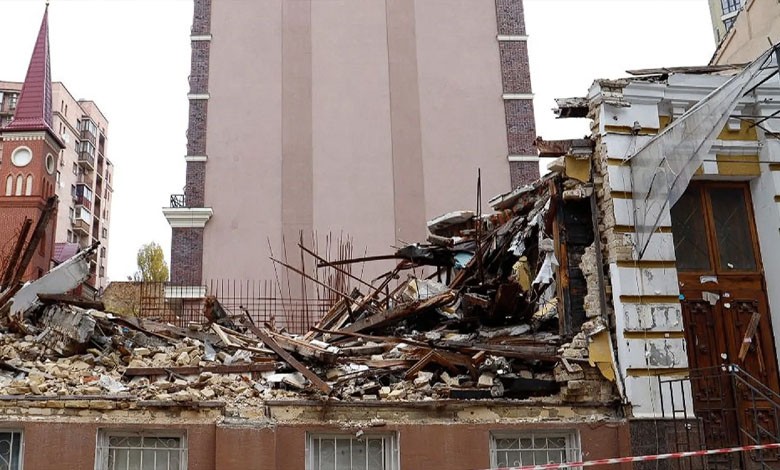
The war greatly affected construction. More than two million structures were destroyed, and the volume of construction decreased by half. The need for housing has increased, and social housing is possible only with the cooperation of developers and authorities. Due to the lack of project financing and unaffordable mortgages, construction companies are dependent on investors. But high risks and legal uncertainty deter international partners and banks. Construction is very important for the economy: every hryvnia invested in housing projects brings four in other industries. But legislative instability makes the market opaque and hinders the development of the industry. Stable regulations are needed to protect the rights of businesses, investors and the community. A transparent legal framework will restore the confidence of investors and create conditions for the recovery of the industry.
What infuriates developers
Ukrainian Association of Developers stated about the critical situation in the construction industry due to the pressure of politicians, officials and pseudo-activists, as well as connivance on the part of the authorities. In their opinion, ignoring the problems will lead to higher housing prices, housing shortages, loss of billions for the economy and the shutdown of the industry. It’s going about such objects as the Guest House, Postal Square, “Flowers of Ukraine”, Zelenskyi and Barban manors, Chinaivske Gorodishche, etc.
Yevhen Favorov, head of the developers’ association, notes that these places were either blocked earlier or frozen. Protesters, whom he called “pseudo-activists”, are becoming more active around them. Although these sites are not related to the housing shortage due to the war, they are important for preserving cultural heritage and bringing communities together.
Developers are outraged by the blocking of projects and bureaucratic obstacles, which, in their opinion, lead to higher housing prices and economic losses. The community and activists, for their part, demand the preservation of cultural heritage and ecological zones, criticizing developers for neglecting public interests. It is possible to achieve a constructive approach through a transparent legal framework, updating urban planning documentation and dialogue between all parties. Unfortunately, developers and activists have different views on the construction market and cannot agree. The lack of dialogue turns conflicts into a systemic problem affecting the city.
Sometimes the reasons for stopping construction can be legitimate, and sometimes subjective. For example, the physical blocking of works causes significant losses, which must be compensated by those who create these conditions.
Activism is sometimes used as a tool for pressure or money. Even after obtaining permits, uncertainty and business risks remain high. Officials who issue permits with violations exceed their authority, but they hardly bear any real punishment for this. All consequences translate to business. The authorization process has several levels of checks.
Difficulties often arise due to outdated regulations. If the document is valid, it is legally binding and the business should not suffer because of system flaws. Dmytro Perov, a lawyer and preservationist, explains that granting an old building protected status only after construction has begun is manipulation. In order to grant a protected status to an architectural structure, complex preparation of documents, including historical references, is required. The Kyiv City Council proposed automatic protection for buildings older than 100 years, but this has not yet been implemented.
What is the weakness of Ukrainian legislation regarding the protection of cultural heritage
Currently, the situation is as follows: if the historical value of the building is not proven by activists or heritage protection authorities, the building may be demolished. Evidence must be collected by activists or city authorities, which complicates the process. In Europe, in particular, in Poland, historic buildings are protected automatically, and the owner must prove that the building is not a monument. In Ukraine, protection often begins too late, already after the destruction has begun. This is what happened with the Zelensky Estate: activists prepared documents for more than two years, but the status was granted only when the building began to be destroyed.
In order for a historical building to receive protected status, public pressure is needed: actions, petitions and media resonance. Without public attention, the problem is often ignored.
Developers say that the protection statuses are used to put pressure on businesses, but they themselves bypass them through the courts. Many historic buildings purchased by developers have been abandoned and decaying for years. Activists are trying to stimulate the restoration and preservation of such objects.
Developers often do not take into account the interests of the community, offering small compensations instead of preserving historic buildings, for example, playgrounds. They appeal to their contribution as taxpayers, but activists point out that the overall contribution of the community is often greater.
In Europe, developers work according to clear rules, and natural areas and historical sites are protected by law. In Ukraine, the legal imperfection allows developers to ignore cultural heritage.
During the years of its independence, Ukraine only partially created protection mechanisms that are inferior to European ones. Developers often ignore local specifics, using weak laws for their own purposes.
How domestic activists are changing the real estate market
Activists are concerned about the importance of heritage preservation, nature protection and urban planning. People are becoming more active, forming local communities and wanting to influence change in their neighborhoods. If the interests of communities are ignored, and protests are useless, trust in the authorities and the system will disappear.
Developers who used to rely on corruption are finding that this approach no longer works. One of the representatives of the industry notes: previously you could pay and solve the problem, but now money does not guarantee the result. Although corruption has decreased, work has become more difficult due to increased pressure on business.
Activists point to violations, forcing developers to invest in quality projects and not rely on underground agreements. Developers are beginning to realize that the optimal strategy is to follow the law and follow all the necessary procedures. This will take more time, but will ensure a fair result.
Dmytro Perov explains that officials cancel illegal permits not because of fear of activists, but because of public publicity. Such attention stimulates law enforcement officers to check objects, permit documentation and actions of officials. Thus, activism becomes an effective mechanism of control.
The face of corruption in domestic construction
A corrupt system creates obstacles for honest developers and allows violations for those who pay bribes. And even such initiatives as draft law No. 5655, which seeks to simplify the bureaucracy through an electronic system, create new risks. After all, automation checks only the availability of documents, not their quality, and this makes it possible to legalize violations. Private controllers working for developers create a conflict of interest. Opportunities for corruption are created through weak accountability mechanisms for professionals and an uncertain complaint system. The law solves some problems, but creates others.
The public will have only a symbolic role in construction control. Without clear rules, corruption risks such as “buying off” may arise. The electronic system will only suggest objects for inspections, and officials will decide who to inspect and when, which could lead to abuse.
In the construction industry, there is a lot of corruption and connections between business and the government, so it is difficult to expect a perfect law. It is important that when finalizing draft law 5655, the authors take into account the criticism of specialists and do not ignore other opinions.
Another nuance limits the access to the market of new participants. After all, urban planning control specialists must have insurance: 3 million euros for objects of medium risk and 5 million euros for high risk. This limits the choice of insurance companies, as not all can provide such large payouts. Because of this, only a few companies will be able to work on the market.
…It is obvious that the sustainable development of the industry requires the cooperation of developers, officials and the community. Activism is already changing the marketplace, reducing corruption and increasing rule of law. Only the joint responsibility of all parties will help to create cities where the balance between the past and the future will be preserved.
Tetyana Viktorova


