
Humanism under scrutiny: under what conditions will Israeli hostages return, and Palestinians emigrate from Gaza (continued)

Israeli hostage tragedy turned into to a political theater where Netanyahu plays the role of savior and the relatives of the prisoners are extras in his scenario. When Israeli citizens turn to Trump instead of their own government, this is not diplomacy, but a breach of the social contract. The state that swore “never again” is betraying again today – not for the first time, but perhaps for the last time.
And in Gaza, under the guise of humanism, the old scheme of “new Tunnel“: evict everyone, clear the territory, build resorts. This is not evacuation, this is ethnic displacement with a glossy facade. And if the world is silent again, then after 1948 it will finally lose the right to say “never again”. To name escaping from hell with a “humanitarian option” is like calling a catastrophe “population mobility”.
Figures that do not forgive: the humanitarian situation in Gaza as a sentence to the world
That is why international institutions, which have long maintained a restrained diplomatic tone, are now appealing to the categories of law. The UN warns: the forced displacement of the civilian population is a direct violation of international humanitarian law. Amnesty International states: it is not about voluntary migration, but about forcing people to leave their land under the pressure of armed forces.
A separate element of this rhetoric became thesis about “overpopulation of Gaza”. 2.3 million people on a narrow strip of land became an argument for justifying the migration initiative. But these conversations are not being held in order to rebuild. And in order to change the ethnic structure of the territory, which Israel does not plan to return to Hamas or the Palestinian Authority.
And here it is worth mentioning not only the responsibility of Israel, but also the silence of the Arab countries. Egypt and Jordan have already made it clear that will not accept not a single Palestinian “selected for evacuation”. Why? Because they understand: this is a final waiver of any right to return. Because they know: today it is a humanitarian zone, and tomorrow it will be the political end of the Palestinian issue.
Modern politics has an art of hiding tragedies behind numbers. It failed in Gaza. Because the numbers there have ceased to be abstract, having become a document of accusation. Against those who kill and against those who are silent.
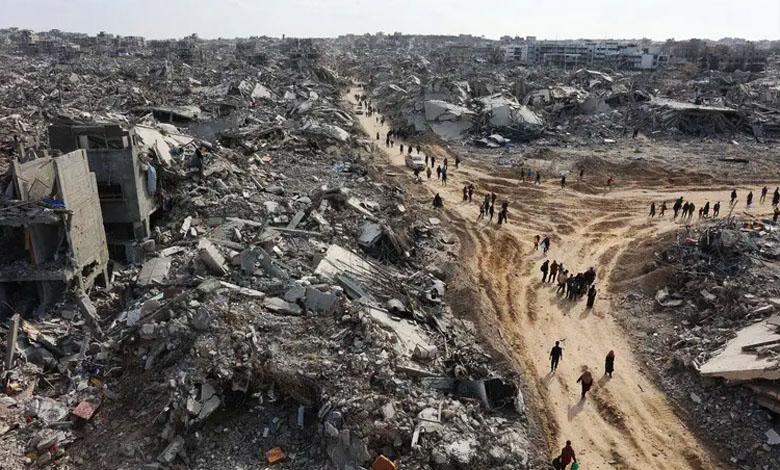
At the time of the latest statements about the “choice for the residents of Gaza”, more than 50,000 Palestinians have officially died in the sector. Half of them are women and children. More than 115,000 were injured. But in fact, these numbers are not final. Because under rubble remain entire families — unrecognizable, unrecorded, forgotten even before burial.
90% of Gaza residents have become internally displaced persons. But this is not an evacuation, but wandering through broken neighborhoods in search of leftover food, fresh water, and shelter. Hundreds of thousands live in shelters without sanitation. Children are born in the dark, without midwives, without antiseptics, without a guarantee that they will live for at least a day.
The infrastructure is completely destroyed. According to the World Bank and the United Nations, 84% of medical facilities are either destroyed or seriously damaged damaged. Electricity is out of reach. There is no water or fuel. But there are wounded who scream in the dark. Today, every hospital in Gaza is like a trial of humanity. Because there every day someone does not live to live because the other is afraid of losing his political balance.
Help does not come because it is not there. And because it is not missed. Israel blocks most humanitarian shipments. At the same time, the IDF bombed the roads along which the trucks were supposed to travel. The UN and dozens of non-governmental organizations are begging – not for a ceasefire, but at least for a corridor. They are answered with silence or, at best, with a briefing. “If the situation does not change, we will lose a whole generation,” UN coordinator Thor Vennesland said.
New negotiations with Hamas are a mirror of hopelessness
In diplomacy, it is important not only who negotiates, but also what is considered an agreement. And in this year’s negotiations between Israel and Hamas, every “agreement” is not a step towards peace, but a pause between shots. Negotiations do not take place between Israel and Hamas, because these parties do not even recognize each other.
They take place between Dosi, Cairo and Washington. It is these capitals today draw outlines of the so-called “agreement”. This year, in January, the parties agreed to a six-week truce: 33 hostages from the Israeli side — in exchange for 1,650 Palestinian prisoners. The conditions are shockingly technocratic: “categories”, “stages”, “guarantees”. But behind each number there are human eyes.
Everything seems simple: hostages in exchange for Palestinian prisoners. But Hamas requires complete cessation of operations in Gaza, lifting of the blockade, restoration of humanitarian access, that is, a political change in the balance. And this is more than they are willing to give in Tel Aviv. Because every concession is not a compromise, but recognition of Hamas as a player. And the players are shaken by the hand, even if it is covered in blood.
Negotiations, as always, are conducted under conditions of blackmail of time. Or rather, its lack. Because every day without an agreement there are new attacks. And another discrediting of the very concept of “negotiations”. In January, Israel postponed a vote on a new deal because Hamas allegedly broke promises. But who believes in words when everything is on fire?
Netanyahu, Trump and the End of Illusions: Why the Arab World Fears Not Only War, but Peace
There is a form of diplomacy that is better called installation. This is a meeting between Netanyahu and Trump. It is not on the White House calendar, it does not have a mandate from the UN, but it is influential. Because when two politicians who have long owed no one but themselves discuss the fate of hundreds of thousands, the world tenses up because of the risk of catastrophe.
The reaction of Egypt, Jordan, Saudi Arabia is not just cautious. All three countries categorically rejected the idea of forced or even “voluntary” resettlement of Palestinians from Gaza, which Netanyahu allegedly “brought for consultation” to Trump. And if yesterday these capitals were busy searching for a formula for coexistence, today they are formulating red lines.
Jordan more I won’t a spare airfield for other people’s disasters. She already is gave shelters for more than two million Palestinian refugees — and this, according to its leaders, is enough. Amman unequivocally warns: there will be no “second Nakba”.
This is not just diplomatic rhetoric – it is the cry of a country that feels the earth shaking beneath it again. Nakba means “catastrophe” in Arabic. This is what Palestinians call the year 1948, when hundreds of thousands of people were driven from their homes after the creation of Israel. Now the ghosts of that disaster threaten to become a reality again. But Jordan no longer wants and cannot be a party to this tragedy.
Today’s “no“Jordan is a protest not only against the possible new resettlement of Palestinians, but also against the very logic according to which the problems of one side can be solved at the expense of another. This is a warning to Israel: do not expect that by pushing people out of Gaza or the West Bank, you will be able to escape responsibility. This is an appeal to the world: do not repeat the mistakes of 1948, when the silence of the international community turned the catastrophe into a historical norm.
Jordan demands justice, not another wave of refugees. She will not allow another tragedy to rewrite the map of the Middle East — this time permanently and irreversibly. And behind these words is not only political will, but also the fear that another wave of Nakba could be the last straw for the entire region.
Egypt made it clear: the demographic imbalance in Sinai is a casus belli. Saudi Arabia, which is still yesterday spoke about normalization with Israel, is now silent — and this silence is more eloquent than statements
Brussels is showing restraint. London is a statement written in the Latin of diplomatic caution. EU and Great Britain emphasized the need to comply with international law, but no one was named guilty. What scares them more is not the plan itself, but its implementation. Because Europe understands: one more million refugees from Gaza – a new wave of political collapse is already within them.
The UN emphasizes that forced resettlement is a war crime. But who listens to the UN in a world where diplomats have become smaller than former presidents?
How the meeting between Trump and Netanyahu affected the balance of power in the Middle East
In March, the silence of the Biden administration became a loud signal. After the informal meeting between Benjamin Netanyahu and Donald Trump, which took place in Florida, the White House did not support any of the ideas expressed, including the most toxic idea – the idea of ”voluntary” migration Palestinians from Gaza. Refusal to comment is also a comment.
Because the Biden administration knows that supporting such initiatives is not just a diplomatic miscalculation, but political suicide against the background of the growing protest electorate among the youth, the Muslim community, and liberal-minded US Jews. But even more clearly than in Washington, the shift in emphasis is noticeable in the region.
After the meeting in Florida, Turkey sharply intensified its rhetoric. President Erdogan, who in recent months has been balancing between the role of mediator and ally of Hamas, has publicly condemned the ideas voiced by Netanyahu and Trump. In particular, the Turkish Ministry of Foreign Affairs called it their “crossing the red line of humanitarian law” and emphasized that no initiative that involves the demographic transformation of Gaza is acceptable for the region. Turkey seeks to maintain control over the media narrative in the Muslim world by positioning itself as the last guarantor of Palestinian interests.
Qatar, the main mediator in the negotiations between Hamas and Western countries, has not fundamentally changed its position, but pond more careful in wording. If in February there were statements about the possibility of achieving a long-term truce, then in March Qatari officials emphasized “deep differences in the approaches of the parties” and “decreased trust in the West.”
Iran, for its part, took advantage of moment Supreme Leader Ali Khamenei’s April speech stated: “Israel has proved its right to isolation, and those who speak to it – to suspicion.” Tehran said it was ready to provide “maximum support to the Palestinian resistance” and effectively delegitimized any initiatives proposed in the Trump-Netanyahu narratives.
A historical retrospective: how the strategy of the Arab states has changed since 1948
To understand the current reaction of the Arab world, it is worth looking back. In 1948, when Israel was created, the position of most Arab states was uncompromising: the immediate destruction of the new entity. Five countries became participants in the Arab-Israeli war, and their rhetoric was purely military.
In 1967, after the Six-Day War, in the Khartoum Declaration sounded the famous “no” three times: “No peace with Israel, no recognition of Israel, no negotiations with Israel.” It was a period of pan-Arabism, and the strategy was based on direct confrontation.
Today everything is different. In response to the idea of deporting Palestinians from Gaza, voiced in private conversations between Netanyahu and Trump, the Arab states speak in unison, but in the language of international law. Egypt, Jordan and Saudi Arabia in the joint March statement not only denied the possibility of accepting refugees, but also emphasized: “resettlement, even for humanitarian reasons, is a crime against humanityThis is no longer the rhetoric of war, but the rhetoric of The Hague.
In 1948, the Arab states united against Israel, but without a unified strategy. In 1967, he renounced diplomacy. In 2025, there is a consensus on the inadmissibility of radical initiatives and the rejection of populist gestures. This does not mean that the region is unified. But for the first time in a decade, the biggest players in the region — Cairo, Amman, Riyadh — are acting not out of emotion or ideology, but out of international legitimacy.
In this context, Trump’s meeting with Netanyahu did not just stir up the international press. It activated tectonic shifts in the perception of Israel in the Arab world. And as Biden’s silence shows, these shifts have already reached American shores.
…What today is called “peace” in Gaza is very similar to what tomorrow may be called “peace” for Ukraine. These are not agreements, but compromises at the expense of those who were destroyed. Both there and here the victim is asked to accept new boundaries, a new reality, new faces above the ruins. The whole world talks about truce, but is silent about justice. And peace without justice is a pause, not an end. This is a trap. This is not peace, but an illusion written in the language of cynicism. And if Ukraine is forced to an “agreement”, like Gaza – to “evacuate”, then this is not diplomacy, but the registration of defeat. For everyone.
Tetyana Viktorova


