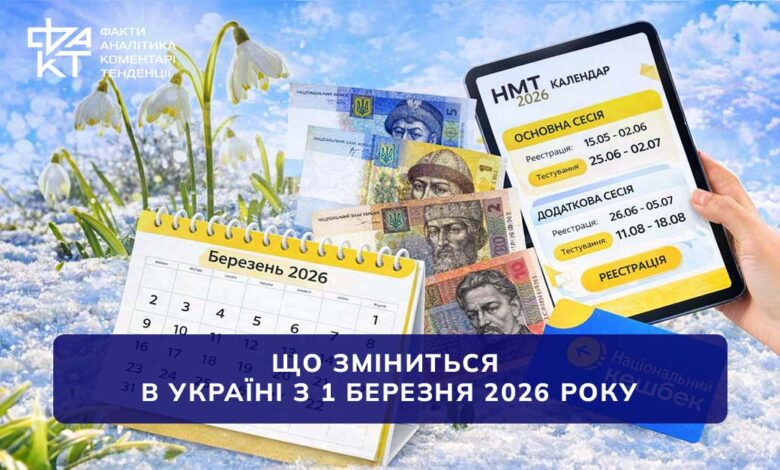
From March 1, Ukrainians will face a number of important changes in the social, financial and educational spheres, which will affect millions of citizens. Among the main innovations are an increase in targeted assistance for families of military personnel, indexation of pensions, an increase in salaries, an update of the National Cashback program, as well as the start of registration for the National Multi-Subject Test.
Payments for families of military personnel
From March 1, 2026, a new procedure for increasing targeted financial assistance for family members of killed, deceased or missing military personnel comes into effect in Ukraine. This decision is aimed at significantly improving the material security of families who have lost their breadwinners as a result of military operations and is intended to reduce the social vulnerability of such families.
Previously, the minimum targeted assistance provided to family members of deceased servicemen was 7,800 hryvnias. The new rules provide that if the pension in case of loss of breadwinner or state social assistance to children of deceased servicemen does not reach 12,810 hryvnias, the state will compensate for the difference in the form of targeted assistance. In this case, the calculation will include all allowances and increases received by a family member, except for pensions awarded for special services to Ukraine.
Targeted assistance will be provided to each disabled family member – parents, wife or husband of a deceased, deceased or missing serviceman. For families in which two or more members receive a pension or state social assistance, a new minimum payment amount has been established – 10,020 hryvnias per person, instead of the previous 6,100 hryvnias. This decision significantly increases the level of support for large families, where several members simultaneously need financial support.
A key innovation is also the government’s promise to annually index these payments from March 1, starting in 2027. This practice will allow taking into account inflationary changes and price increases, ensuring a stable level of material support for families that have suffered losses as a result of the war.
This decision demonstrates the state’s comprehensive approach to social protection of veterans and their families. Increasing payments and establishing a minimum threshold for many families allows not only to compensate for losses, but also stimulates a systemic review of social assistance mechanisms in the face of constant military challenges. This step reduces the risks of poverty among those who have lost their breadwinners, while at the same time providing predictable support, which is critically important in the context of the country’s post-war reconstruction.
Pension indexation
From March 1, more than ten million Ukrainian pensioners will receive pension indexation of 12.1 percent. According to the words of Prime Minister of Ukraine Yulia Svyrydenko, this recalculation will be carried out automatically and will cover almost all main types of pensions, in particular:
In addition, minimum pensions for people with disabilities resulting from war, for participants in hostilities, as well as insurance payments for citizens who suffered from accidents will be indexed. From April 1, pensioners who continue to work will receive automatic recalculation of pensions taking into account the updated length of service and/or earnings.
As a result, pensioners will receive additional payments ranging from 100 to 2,595 hryvnias compared to the previous pension amount.
Salary supplement
In March, the payment of bonuses will continue for workers involved in the restoration of critical infrastructure after the attacks by the Russian Federation, as well as for energy workers. This was announced by Prime Minister Yulia Svyrydenko following a meeting of the Cabinet of Ministers of Ukraine.
All employees participating in emergency and recovery work will receive an additional bonus of 20 thousand hryvnias for each month – January, February and March 2026.
This program covers employees of enterprises of various forms of ownership in the following key areas:
-
fuel and energy complex, including power plants, electricity supply networks, gas and oil pipelines;
-
housing and communal services, including heat, water and gas supply systems for the population;
-
railway industry, in particular employees of Ukrzaliznytsia, who ensure the restoration and functioning of the transport system infrastructure.
The bonus is provided to every employee who directly participates in the work to eliminate the consequences of destruction or ensures the restoration of critical systems. The payment is intended to stimulate personnel working in conditions of increased risk and compensate for additional efforts during work in emergency conditions caused by military aggression.
Thus, in March, energy, utility and railway workers who are actively involved in emergency and restoration work will receive their well-deserved financial support in the form of an allowance of 20 thousand hryvnias.
Updated “National Cashback”
From March 1, 2026 in Ukraine The updated version of the National Cashback program comes into force, which changes the principles of returning part of the money spent to buyers. The main change is the differentiation of the cashback percentage depending on the category of the product and the level of import, which allows stimulating the purchase of domestic products and certain groups of goods.
Now, for Ukrainian goods, the share of imports of which exceeds 35%, a refund of 15% of the purchase amount is provided. This category includes non-food products: clothing, footwear, cosmetics, household chemicals, household and repair goods, animal care products, as well as stationery. In addition, the category includes some food products, including hard and soft cheeses, as well as certain types of pasta and cereals.
If the share of imports of the product is less than 35%, buyers will receive 5% cashback. This applies to the following groups of goods: medicines and garden products, bread, meat, dairy products (except cheeses), eggs, oil, vegetables and fruits, fish, canned goods, sweets, snacks, drinks and sauces.
In order to check which category a specific product belongs to, the buyer can use the barcode scanner in the “Diya” mobile application. This approach allows you to clearly determine the amount of the refund and makes the program mechanism transparent and convenient for users, while simultaneously stimulating demand for domestic products and a controlled imported group of goods.
The cashback accrued within the “National Cashback” program can now be used for a wide range of purposes, allowing citizens to effectively manage the returned funds. Among the main areas of use:
-
Payment of utility services – citizens can partially or fully cover bills for heat, water, gas and electricity by paying them with accrued cashback.
-
Transfers to support the Armed Forces of Ukraine – funds can be directed to help the army, which provides citizens with the opportunity to join in supporting the country’s defense capabilities.
-
Postal services – cashback can be used to pay for postal items, which is convenient for sending letters and parcels.
-
Purchase of Ukrainian-made products, medicines and books – part of the cashback can be used to purchase food products and medicines made in Ukraine, as well as to purchase books, which contributes to the development of the cultural and educational level of the population.
Such a mechanism for using cashback not only stimulates domestic production, but also creates a system of encouraging citizens to make socially significant expenditures and support critical areas of the country’s economy and security.
In general, changes in the “National Cashback” program demonstrate the state’s desire to combine economic stimulation of domestic production with social support for the population, while simultaneously creating a tool for increasing financial literacy and controlling spending among citizens.
New reporting rules for excisable goods
In Ukraine, from March 1, 2026, new reporting rules for excisable goods will come into force, affecting both manufacturers and sellers of the relevant products. The corresponding changes were approved by the order of the Ministry of Finance dated December 22, 2025 No. 641, which determines the updated reporting forms and the detailed procedure for filling them out.
Monthly reporting will be sent to the territorial bodies of the State Tax Service in new forms:
-
Form No. 1-VP – for producers of alcohol, bioethanol, alcoholic beverages, tobacco products, liquids for electronic cigarettes, as well as for entities engaged in the import, export or fermentation of tobacco raw materials.
-
Form No. 1-OP — for entities engaged in wholesale trade in alcohol, tobacco products, tobacco raw materials, tobacco substitutes and liquids for electronic cigarettes, as well as for operations on the import and export of these products.
In addition to the monthly form, an annual form No. 1-VP is also being introduced, which is required to be submitted by:
-
small production beer, distillates and wine products;
-
entities engaged in tobacco cultivation, indicating the volumes of grown and sown areas.
Order No. 641 also provides for an updated procedure for accounting for products in responsible storage and regulates new rules for reflecting the circulation of tobacco waste and product residues. In addition, new product and raw material codes are being introduced, which should be used to record purchased, manufactured, and sold tobacco products.
These changes are aimed at strengthening control over the circulation of excisable goods, ensuring transparency of production and trade, and optimizing tax administration in this area.
National Multi-Subject Test
Registration for the National Multi-Subject Test (NMT), the main form of entrance exams to higher education institutions in Ukraine, will begin in 2026. Registration will last from March 5 to April 2. Participants can apply both to take the test in Ukraine and abroad.
The list of countries and cities abroad will be published by March 3, so the Ministry of Education and Science urges participants to plan their participation in advance and regularly check their personal accounts on the registration platform.
The 2026 NMT includes three mandatory subjects — Ukrainian language, mathematics, and history of Ukraine, as well as one subject of the applicant’s choice. The test is computerized in one day, the duration of testing is 240 minutes with a break, and will be held from May 20 to June 25.
This format remains key for admission to Ukrainian universities and allows for standardization of the assessment of applicants’ knowledge, while simultaneously providing the opportunity for students abroad to participate.
Removal of old banknotes and introduction of patriotic 200 hryvnias
From March 2, 2026, Ukraine will officially withdraw some paper banknotes from circulation and replace them with corresponding circulating coins. These are banknotes in denominations of 1, 2, 5, and 10 hryvnias, issued in 2003–2007. After this date, these banknotes will not be used for payments and will not be accepted in retail chains, banks and other financial institutions.
Exchanging withdrawn banknotes for coins will be free of charge and will be carried out under the following conditions:
-
Exchanging banknotes is possible in all branches of banks in Ukraine within one year from the date of withdrawal, i.e. until February 26, 2027 inclusive.
-
In authorized banks, such as Oschadbank, PrivatBank, Raiffeisen Bank and FUIB, the exchange will be carried out for three years, until February 28, 2029 inclusive.
-
At the National Bank of Ukraine, the exchange of banknotes is available indefinitely.
In addition, from February 25, 2026, the National Bank introduced modified banknotes in denominations of 200 hryvnias into cash circulation. The main innovation is the patriotic slogan on the back of the banknote: “GLORY TO UKRAINE! GLORY TO THE HEROES! All other design elements and security features remain the same as on the 200-hryvnia banknote of the 2019 model.
Old 200-hryvnia banknotes remain valid, so it is not necessary to exchange them for new ones – they will be in circulation along with the new banknotes.
These changes are aimed at gradually updating cash circulation and introducing more durable coins instead of small banknotes.
Increasing mobile operator tariffs
Since the beginning of March 2026, mobile operators in Ukraine have been reviewing the cost of their services. Kyivstar is updating the tariff for SIM cards intended for devices: the daily fee increases from 1 hryvnia to 2 hryvnia. At the same time, subscribers will receive extended service packages – 50 MB of Internet, 50 SMS and 50 minutes of calls per day.
At the same time, Vodafone Ukraine is increasing tariffs for the popular Joice and SuperNet lines. The average monthly fee for these tariffs will increase by approximately 60–80 hryvnias per month.
The operators cite the reason for the changes as an increase in electricity costs, network maintenance, and backup power, which is necessary for the uninterrupted operation of mobile services.
These updates reflect the trend of adapting tariffs to economic conditions and operators’ costs, while simultaneously expanding the scope of services for subscribers.
Utility tariffs
At this time, it is unknown whether there will be an increase in tariffs for housing and communal services for the population. The moratorium on increasing prices for gas, heat and hot water continues to operate for the period of martial law and for six months after its end, which allows Ukrainians to maintain stability in paying for utility services.
As for electricity, in 2026 it is planned to increase tariffs only for businesses, not for the population. At the same time, experts note that this may lead to an indirect increase in the cost of goods in Ukraine due to increased costs for enterprises. As of the end of 2025, electricity tariffs remain fixed: for most consumers – 4.32 hryvnias per kWh until April 30, 2026; for households with electric heating up to 2,000 kWh, a preferential tariff of 2.64 hryvnias per kWh is provided; The night tariff, valid from 23:00 to 07:00, is 2.16 hryvnia per kWh.
The cost of gas distribution for both the population and business will also change, however, the moratorium on tariff increases for Ukrainians continues to operate, which preserves the financial stability of households.
In addition, in March, Ukrainians will traditionally switch to daylight saving time: on the night of the 29th, the clocks will be moved forward one hour – from 03:00 to 04:00. On modern electronic devices, this transition will occur automatically, so no additional actions will be required from users.
Therefore, March 2026 in Ukraine will be a month of complex economic, social and administrative changes that will affect millions of citizens. The government and state institutions are trying to adapt social and financial instruments to the current needs of the population. These steps form a wide range of measures that will affect the daily lives of millions of citizens and the financial planning of families. At the same time, they reflect the state’s desire to ensure stability and predictability during a period of economic and social challenges.