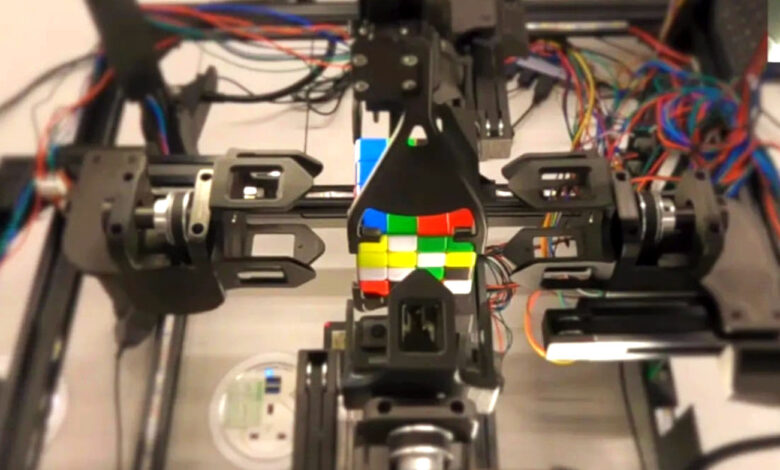
In the UK, a robot set a new world record for solving a 4×4 Rubik’s Cube, solving the puzzle in 45.3 seconds. This result surpassed the previous achievement, which stood for over a decade, and was officially entered into the Guinness Book of Records.
The record-breaking robot was created by brothers Matthew and Thomas Pidden. The basis of the design was a central frame that securely holds the cube, and around it are four mechanical arms that can quickly and accurately rotate individual layers of the puzzle.
Before starting the assembly, the system scans the cube and determines its configuration. After that, an algorithm calculates the most efficient sequence of moves, which the robot performs in a series of rapid rotations. The previous record was set in 2014, when the robot solved a 4×4 Rubik’s Cube in 1 minute 18.68 seconds.
Matthew Pidden was responsible for the software and control system. It was he who developed the algorithms that allow the device to analyze the position of the cube’s elements and choose the correct sequence of actions. Thomas Pidden was involved in the mechanical part of the development, and a significant part of the parts for the design were manufactured using 3D printing.
“I decided to break the record as part of my graduation project. Since childhood, I have always loved Rubik’s Cubes and computer science. Combining these two things seemed to me to be a completely logical step and a great project,” said Matthew Pidden.
The record was not achieved on the first attempt. The first two runs were unsuccessful, and the third attempt yielded a result of 55 seconds. The developers decided to continue the test, although the fourth and fifth starts also did not give the desired result. The robot showed its best result during the sixth attempt, when it collected the cube in 45.3 seconds.
The brothers believe that this project demonstrates the potential of modern robotics and can encourage young engineers and programmers to work on complex technological solutions. Earlier, England also reported the successful implementation of the Hugo robotic system for operations to remove colon cancer, which became another example of the active development of high technology in the country.