Independent upbringing of a child as a basis for a postponement: legal requirements and the court’s position

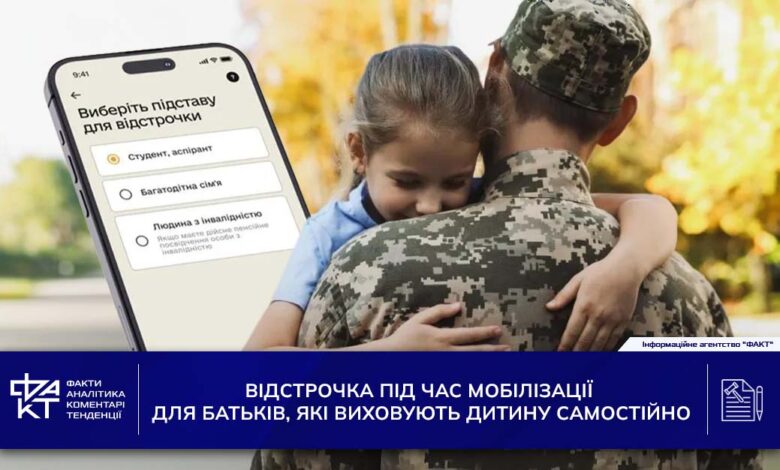
The issue of deferment from conscription during mobilization for parents who are raising a child on their own is increasingly becoming a subject of disputes between conscripts and territorial recruitment centers. Independent raising of a child is defined by law as one of the grounds for non-conscription during mobilization, provided that there is a child under the age of 18 and a corresponding court decision or other prescribed circumstances. Practice shows that not only the fact of the child living with the father or mother is of key importance, but also the wording of the court decision on independent upbringing and maintenance. However, disputes often arise, in particular, around the procedure for applying to the CCC and the SP, in particular regarding the method of submitting an application and evaluating the documents provided.
The lawyers of the law firm “Repeshko and Partners”, to whom our editorial office contacted, commented on the application of the rule on independent upbringing of a child as a basis for deferment from mobilization, and also gave an example from judicial practice.
Since martial law in the country is still ongoing, as are mobilization measures, the issue of granting deferment to men does not lose its relevance. Now we want to consider one of the most interesting and controversial grounds – independent upbringing of a child.
First, we want to tell you about a striking event. This week, a 43-year-old man was mobilized in Kryvyi Rih, who is raising his 14-year-old son on his own after his wife left the family and went abroad, retaining parental rights. The man came to the CCC and SP with a summons to clarify his personal data, after which he no longer contacted the child, who was in need of care due to a broken arm.
At the same time, the father’s phone was confiscated, and he was kept in the basement of the CCC. The 14-year-old boy, left without contact with his father and the necessary support, independently contacted the police, reporting his absence. Due to the lack of contact with his father and the inability to provide proper care for the child, social services decided to place the boy in a children’s institution. In fact, the child was left unattended in a state of psychological trauma, he needed medical care due to a broken arm, as well as support in everyday life and education.
A court hearing was to be held on February 18, at which the mobilized father was to be recognized as a sole guardian, which could consolidate his responsibility for the child and provide a legal basis for supporting his son. However, the hearing did not take place, since representatives of the guardianship authorities did not arrive, which further complicated the situation and left the child without proper legal protection.
Current legislation provides that women and men who have a child or children under the age of 18 are not subject to conscription during mobilization under certain circumstances. These include cases where the other parent has died, been deprived of parental rights by a court decision, has been declared missing or missing, has been declared dead, is serving a sentence in a place of imprisonment. Another reason is a situation where a person independently raises and supports a child on the basis of a court decision or when the father is recorded in the birth certificate in accordance with part one of Article 135 of the Family Code of Ukraine.
Thus, to obtain a deferral on this basis, the mere fact of having a child under the age of 18 is not enough. It is necessary that one of the following circumstances be confirmed: the death of the other parent; deprivation of his parental rights by a court decision; recognition as missing; declaration of death; serving a sentence in a place of imprisonment; the presence of a court decision on independent upbringing and support of the child; or entering information about the father into the birth certificate from the mother’s words.
In practice, the most questions arise precisely regarding the grounds related to the presence of a court decision on the independent upbringing and maintenance of the child. It is the wording of such a decision, its content and the scope of the obligations specified in it that become key when considering the issue of granting a deferral.
That is why judicial practice follows the path that the decision to determine the place of residence of the child should not sound like “To determine the place of residence of the daughter of Sidorenko Maria Sergiyevna, born on October 25, 2019, together with her father – Sidorenko Sergey Ivanovich at his place of residence”, but “To determine the place of residence of the daughter of Sidorenko Maria Sergiyevna, born on October 25, 2019, together with her father – Sidorenko Sergey Ivanovich at his place of residence with full support by the latter”.
The right to receive a deferral on this basis was again confirmed by the court. On December 8, 2025, the Chernivtsi District Administrative Court adopted a decision in case No. 600/1077/25-a, in which it assessed the refusal to grant a deferral in connection with the independent upbringing of a child.
In this case, a man filed a lawsuit against the territorial recruitment and social support center. He requested to recognize as unlawful and cancel the decision of the commission, formalized by protocol No. 6 dated January 23, 2025, by which he was denied a deferral from conscription during mobilization for a special period. In addition, the plaintiff requested to oblige the relevant commission to reconsider the issue and issue him a deferral on the basis of paragraph 4 of part 1 of article 23 of the Law of Ukraine “On mobilization training and mobilization”.
Substantiating his claims, the plaintiff noted that by the decision of the Pershotravnevy District Court of Chernivtsi dated October 29, 2024, his marriage was dissolved, and his minor daughter was determined to live with him and be independently raised and supported by him. Based on this decision, he submitted an application to the territorial recruitment center for a deferral. However, he received a refusal with the motivation of non-compliance with the procedure for applying, stipulated by the Resolution of the Cabinet of Ministers of Ukraine No. 560, namely, due to the lack of personal submission of the application.
We draw your attention once again that the basis for granting a deferral was the court decision, by which the minor daughter was left to live and be independently raised and supported by her father.
Having examined the written evidence, the court established that on 16.01.2025 the plaintiff applied to the territorial recruitment and social support center with an application for issuing a certificate of deferment from conscription for military service during mobilization. In the application, he referred to paragraph 4 of part 1 of article 23 of the Law of Ukraine “On mobilization training and mobilization” and noted that he belonged to the category of persons not subject to conscription.
The application was accompanied by notarized copies of the passport, an extract from the register of the territorial community, a child’s birth certificate, the decision of the Pershotravnevy District Court of Chernivtsi dated 29.10.2024 in case No. 725/9282/24, as well as a military registration document generated through the “Reserve +” application.
According to an extract from the protocol, the commission at the CCC and the SP refused to grant the man a deferment from conscription during mobilization for a special period. The reason for the refusal was failure to comply with the procedure for applying, specified in the first paragraph of paragraph 58 of the Resolution of the Cabinet of Ministers of Ukraine No. 560, in particular regarding the personal submission of the application. At the same time, the plaintiff was informed by notice of the decision to refuse. Considering such a refusal unlawful, he applied to the court with an administrative claim for its cancellation.
The court drew attention to the fact that the plaintiff had already been granted a deferment from conscription before. This means that his status as a father raising a child on his own was not disputed. The subject of the dispute was not the right as such, but the procedure for exercising this right. Assessing the situation, the court applied Article 23 of the Law of Ukraine No. 3543-XII, which contains an exhaustive list of grounds for deferment during mobilization. In this case, the body that makes the decision must verify whether such grounds are confirmed by appropriate documents. The conscript, in turn, must provide documents proving the existence of circumstances stipulated by law.
In particular, paragraph 4 of part 1 of article 23 of this Law provides that women and men who have a child under 18 years of age are not subject to conscription if the other parent has died, been deprived of parental rights, has been declared missing or missing, has been declared dead, is serving a sentence in a prison, and also if a person independently raises and supports a child on the basis of a court decision or if an entry about the father is made in the birth certificate in accordance with part one of article 135 of the Family Code of Ukraine.
The court established that the plaintiff filed an application for a deferment by mail, referring to this provision of the law. Together with the application, he provided a package of documents that, in his opinion, confirmed the existence of grounds for non-conscription. Cabinet Resolution No. 560 provides that the decision to grant or refuse a deferral is made by a specially established commission at the district or city territorial center for recruitment and social support.
According to paragraphs 56–57 of this Procedure, a deferral is granted exclusively on the grounds specified in Article 23 of Law No. 3543-XII. At the same time, paragraph 58 of Resolution No. 560 establishes that, if there are grounds, a conscript submits an application of the established form to the head of the commission and attaches documents or their duly certified copies. Such an application is subject to mandatory registration. It was the failure to comply with the requirement to submit the application in person that the commission indicated as the basis for refusing to grant a deferral.
It should be noted that a deferral from military service during mobilization can be issued using the Unified State Register of Conscripts, Conscripts and Reservists on the basis of data obtained from other state registers or databases confirming that the conscript has the right to a deferral on the grounds specified in Article 23 of the Law of Ukraine “On Mobilization Training and Mobilization”.
In accordance with paragraph 60 of Resolution No. 560, the commission studies the received application and supporting documents, assesses the legality of the grounds for granting a deferral, if necessary, prepares requests to the relevant state authorities to obtain information confirming the applicant’s right to a deferral, or uses information from public electronic registers. In this case, the commission is obliged to consider the application and documents confirming the right to a deferral received for consideration within seven days from the date of receipt, but no later than the next day from the date of receipt of information on requests to state authorities. Based on the consideration of the received documents, the commission adopts a decision to grant or refuse to grant a deferral. The commission’s decision is recorded in a protocol.
The applicant is notified of the decision made by the commission by telephone, electronic communication or by mail no later than the day after the adoption of such a decision. In the event of a positive decision, the conscript is provided with a certificate indicating the deferral period in a specially established form. In the event of a refusal to grant a deferral, the conscript is notified in writing indicating the reasons for the refusal. Such a decision may be appealed in court.
Until the commission adopts a decision, the conscript is not subject to conscription for military service during mobilization for a special period.
In this case, the subject of the dispute was the decision of the commission at the territorial center of recruitment and social support, by which the plaintiff was refused a deferment. The commission cited as the reason for the refusal the failure to comply with the procedure for applying, specified in the first paragraph of paragraph 58 of the resolution of the Cabinet of Ministers of Ukraine No. 560, regarding the personal submission of the application.
The court noted that the provisions of Part 11 of Article 38 of Law No. 2232-ХІІ determine the obligation, in particular, of those liable for military service to personally notify the bodies where they are registered in the event of changes in their marital status, state of health, address of residence or stay, education, place of work, position. However, neither the provisions of Law No. 2232-ХІІ, nor Law No. 3543-ХІІ, nor Resolution No. 560 provide for the obligation of a person to personally visit the CCC and the SP to submit an application and documents for a deferral. The obligation to notify in person does not mean arriving in person.
In view of the above, the court concluded that the plaintiff, having personally sent by mail an application and documents to resolve the issue of granting a deferral from military service during mobilization, complied with the procedure for their personal submission (sending). At the same time, the court noted that the plaintiff’s application, regardless of the method of its submission, was subject to consideration on the merits of the issue raised in it.
The court established and is confirmed by the case materials that the plaintiff submitted an application to the defendant by mail with a request to consider his application and issue, in accordance with the procedure specified by resolution No. 560, a certificate of deferral from military service during mobilization. To the specified application, the plaintiff provided a list of documents sufficient, in his opinion, to grant a deferral from military service during mobilization on the basis of clause 4 part 1 of article 23 of Law No. 3543-XII.
Thus, the plaintiff followed the procedure for submitting (sending) documents to the authorized district CCC and SP, which, in his opinion, confirm the presence of grounds for granting him a deferral from military service during mobilization.
Based on the results of the case, the court satisfied the husband’s administrative claim. The decision of the commission at the CCC and SP regarding the refusal to grant a deferral was recognized as unlawful and canceled. In addition, the court ordered the territorial recruitment and social support center to re-examine the husband’s application for a deferment from conscription during mobilization and to adopt a new decision – on granting or refusing to grant a deferment – taking into account the legal conclusions set out in the motivational part of the court decision.
In fact, the court confirmed that the court’s decision on the independent upbringing and maintenance of a child is an appropriate legal basis for applying Clause 4, Part 1, Article 23 of the Law of Ukraine “On Mobilization Training and Mobilization” and can serve as a basis for granting a deferment to a conscript.
Therefore, we advise that in the event of a refusal to grant a deferment, such a decision should not be taken as final. The presence of a court decision on the independent upbringing and maintenance of a child is subject to mandatory consideration by the commission at the CCC and the SP as a basis for a deferment from conscription during mobilization provided for by law. Refusal to grant a deferral cannot be based solely on formal approaches to the application procedure if the person has provided documents confirming his/her right in accordance with the Law of Ukraine “On Mobilization Training and Mobilization”. Case law confirms that such decisions are subject to review and may be overturned if the content and legal nature of the submitted documents are not taken into account.