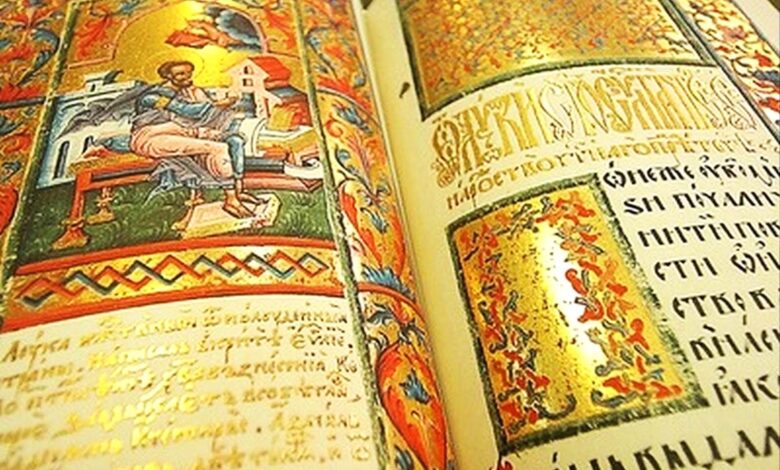
May 24 is the Day of Slavic Writing and Culture, as well as International Women’s Day for Peace and Disarmament, World Video Game Day, International Tiara Day and Aviation Technician Day. On this day in history, events took place, in which medieval coronations, uprisings, technical discoveries, sports tragedies, cultural debuts and decisions that changed states stand side by side.
Day of Slavic Writing and Culture
This holiday is associated with the history of Slavic languages, book tradition and the development of education. It is dedicated to the memory of the brothers Cyril and Methodius, who are considered the creators of Slavic writing and Christian educators. It was their activities in the 9th century that became important for the spread of writing, the translation of religious texts and the development of culture among Slavic peoples.
Cyril and Methodius created the first Slavic alphabet for translating liturgical books into a language understandable to the local population. Their work influenced the development of the Old Slavonic language, chronicles, education, and book culture in the countries of Eastern and Southern Europe. Later, based on the early Slavic writing systems, the Cyrillic alphabet emerged, which is used today by many peoples, including Ukrainians.
Interesting facts
Cyril and Methodius were born in the city of Thessaloniki, where Greeks and Slavs lived side by side. Thanks to this, the brothers knew the Slavic language well from childhood.
The first Slavic alphabet is considered to be the Glagolitic alphabet. Its letters had a complex and unusual shape, not similar to modern Cyrillic.
Cyrillic appeared later on the basis of Greek writing and elements of the Glagolitic alphabet. It was created by the students of Cyril and Methodius after the death of the brothers.
In medieval Europe, religious services were mostly conducted in Latin, Greek, or Hebrew. The use of Slavic in the church caused controversy and resistance from some clergy.
The oldest Slavic manuscripts were written on parchment, a specially treated animal skin. The creation of a single book could take years.
Literacy was more widespread in Kievan Rus than is often believed. Archaeologists have found inscriptions on the walls of churches, household items, and birch bark documents.
The Ostromyr Gospel, created in the 11th century, is one of the oldest dated books of Kievan Rus that has survived to this day.
In the era of printing, books remained very expensive. One handwritten volume could cost as much as a large house or several dozen heads of cattle.
The first Ukrainian printer Ivan Fedorov published “Apostol” and “Bukvar” in Lviv in the 16th century, which became important monuments of the development of printing and education in Ukrainian lands.
International Women’s Day for Peace and Disarmament
This day is dedicated to women who oppose wars, violence, the arms race and the use of nuclear weapons. It was initiated by women’s peacekeeping organizations, and the initiative was supported by representatives of more than forty countries. The day recalls the role of women in protecting peace, humanitarian work and helping victims of armed conflicts.
The topic of disarmament is especially acute during major wars and international crises, when the world is faced with the consequences of mass violence, destruction and death of civilians. Women in different countries participated in peace movements, demanded a ban on nuclear tests, helped refugees, worked as doctors, journalists, human rights activists and volunteers. Today, this day is also associated with support for people who have suffered from wars, occupations and humanitarian disasters.
Interesting facts
The day was created at the height of the Cold War during protests against the deployment of nuclear missiles in Europe in order to recognize the important role of women in peacekeeping processes, countering militarism and the nuclear threat.
One of the most famous women’s anti-war movements of the 20th century was the Women Strike for Peace organization in the United States. Its members opposed nuclear tests and weapons of mass destruction during the Cold War.
After the atomic bombings of Hiroshima and Nagasaki, many Japanese women became active participants in international campaigns against nuclear weapons and testing.
In 1981, women staged a months-long peaceful protest near the British military base Greenham Common, where American nuclear missiles were planned to be deployed. The protest camp lasted for almost twenty years.
During World War I, some women’s organizations in Europe called for negotiations and a cessation of hostilities even when most countries continued to fight.
Ukrainian writer and human rights activist Olena Teliga wrote in her texts about a person’s responsibility to society and the danger of losing humanity in times of war and dictatorship.
In Liberia, the women’s peace movement in the early 2000s played an important role in ending the civil war. Thousands of women took to peaceful rallies, demanding negotiations between the parties to the conflict.
The Nobel Peace Prize has repeatedly been awarded to women who were engaged in protecting human rights, fighting violence, and helping victims of wars.
World Video Game Day
This is a holiday dedicated to one of the most popular forms of modern entertainment. The date was chosen in honor of the presentation of the first home video game console, the Magnavox Odyssey, which was introduced in 1972 by engineer Ralph Baer and his team. It was this device that initiated the development of home video games and became an important step in the formation of an entire industry.
Video games have long become part of world culture and a large technological market. Games are created not only for entertainment, but also for education, training, medicine and modeling complex processes. The modern gaming industry brings together programmers, artists, screenwriters, composers and designers, and major releases sometimes surpass movies and music projects in terms of revenue.
Interesting facts
Ralph Baer is often called the “father of video games”. It was he who proposed the idea of a device that could be connected to a TV for interactive games.
The Magnavox Odyssey did not have modern graphics. Players saw simple bright dots and lines on the screen, and special transparent overlays on the TV were used to design the image.
One of the first extremely popular arcade games was Pong, an electronic version of table tennis, which was released in 1972.
The most successful video game in history in terms of the number of copies sold is Minecraft. The game allows you to build entire cities, mechanisms and worlds from blocks.
The first video games were created not for sale, but as technical experiments in universities and scientific laboratories.
In the 1980s, huge arcade halls with machines appeared in Japan and the USA, where people spent hours playing Space Invaders, Pac-Man and Donkey Kong.
The character Mario was originally supposed to be a carpenter, not a plumber. His profession was changed after the game appeared, where the action took place in underground pipes.
In South Korea, eSports has become so popular that professional players’ matches are broadcast on television, and the best teams have an audience of millions.
Some modern video games take longer and cost more to create than major Hollywood films. Thousands of people from different countries around the world can work on large-scale projects.
International Tiara Day
This holiday is dedicated to one of the most famous pieces of jewelry in world history. The tiara is traditionally associated with monarchs, aristocracy, ceremonial events and high fashion. It is worn as a symbol of status, power, wealth or festive solemnity. Modern tiaras are made of precious metals, pearls, diamonds and other precious stones.
The history of tiaras goes back to ancient times. Similar jewelry was worn by rulers of Ancient Egypt, Greece and Persia. Over time, tiaras became an important part of the royal collections of Europe, and many of them have become famous historical relics. Today, tiaras can most often be seen during coronations, royal weddings, state receptions and museum exhibitions.
Interesting facts
In ancient Persia, the tiara was a symbol of the ruler’s power. The word “tiara” itself comes from the Old Persian language.
In the 19th century, European tiaras became extremely popular among the aristocracy. Wealthy families ordered unique jewelry from jewelers for balls and official receptions.
The British royal family owns one of the largest collections of tiaras in the world. Some of the jewelry has been passed down between generations for over a hundred years.
Some tiaras can be transformed into a necklace or brooch. Such jewelry was specially created so that it could be worn in different ways.
The Cambridge Lover’s Knot tiara, often worn by Princess Diana, was created in 1914 by order of the British Queen Mary.
Empress Elisabeth of Austria, known as Sissi, became famous for her luxurious hairstyles with diamond stars, which became one of the most famous images of European monarchs of the 19th century.
In some countries, tiaras were only allowed to be worn by married women of aristocratic origin during official evening events.
During the French Revolution, many royal tiaras and jewels were destroyed, melted down or sold off, as a result of which some of the historical jewelry was lost forever.
In Hollywood, tiaras became a symbol of fabulous luxury after the popularity of historical films and cartoons about princesses, queens and fictional kingdoms.
Aviation Technician Day
This is a professional holiday for specialists responsible for the maintenance, inspection and repair of aircraft and helicopters. Flight safety, the serviceability of engines, electronic systems, landing gear, navigation equipment and all the main mechanisms of the aircraft depend on the work of aviation technicians. This is one of the most responsible professions in the aviation industry, where even a minor mistake can have serious consequences.
The date is associated with the birthday of Charles Edward Taylor, a mechanic who created the engine for the Wright brothers’ first successful airplane. It was his work that helped make the historic flight in 1903. Modern aviation technicians work with extremely complex equipment, are constantly trained and checked, and servicing one aircraft can last hundreds of hours even after a short flight.
Interesting Facts
Charles Taylor built the engine for the Wright brothers’ airplane in just six weeks, even though the aviation industry didn’t really exist at the time.
The Wright brothers’ first engine was lighter and more powerful than most car engines of its time, which was a key requirement for flight.
Before each flight, the airplane undergoes a technical inspection. Some of the checks are performed before takeoff, and more complex work is carried out after a certain number of hours in the air.
A modern passenger airplane has millions of individual parts, and its systems are controlled by thousands of sensors and computers.
Aviation mechanics work not only in hangars. Often, repairs or maintenance have to be carried out right on the airfield in difficult weather conditions.
In many countries, aviation mechanics receive separate state licenses, without which they are not allowed to sign documents stating that the airplane is ready for flight.
After each flight, pilots and technicians analyze the condition of the aircraft using special logs and electronic systems that record even minor malfunctions.
During World War II, technical teams sometimes repaired combat aircraft in a matter of hours so that they could return to the sky again.
On large airliners, there are backup systems for almost everything: electronics, hydraulics, navigation and control. Aviation technicians regularly check the operability of each redundant mechanism.
Historical events on this day
1276 – Magnus Ladulos was crowned king of Sweden in Uppsala Cathedral. His reign is associated with strengthening royal power and regulating relations between the nobility, church and peasantry.
1571 – the troops of the Crimean Khan Devlet-Gerai burned Moscow during a campaign against the Moscow Kingdom. The fire was one of the most severe defeats of the Muscovite state of the 16th century and demonstrated the power of the Crimean Khanate in the region.
1626 – Peter Minuit purchased Manhattan from the local population for the Dutch colony of New Netherland. This area later became the core of the future New York City, one of the most famous cities in the world.
1683 – The Ashmolean Museum opened in Oxford. It is considered the first university museum in the world, where collections were available not only for storage, but also for teaching and scientific research.
1798 – The Society of United Irishmen began an uprising against British rule. The participants sought to create an independent Irish republic, but the uprising was brutally suppressed.
1822 – Ecuador gained independence from Spain. The decisive role in this process was played by the victory of the patriotic forces in the Battle of Pichincha, after which Spanish power in the region was effectively broken.
1844 – the first telegram in Morse code was sent from Washington to Baltimore. The message marked the beginning of a new era of communication, when information began to be transmitted over long distances almost instantly for the first time.
1861 – during the American Civil War, Union troops occupied Alexandria, Virginia. The city was of strategic importance due to its proximity to Washington and transport routes.
1936 – the Shakhtar football club was created. The team, founded in Donetsk, later became one of the most successful Ukrainian clubs and repeatedly represented Ukraine in European tournaments.
1940 – in Washington, the Ukrainian Congressional Committee of America was created at the First Congress of Ukrainian Americans. The organization became an important representative of the Ukrainian community in the United States and supported Ukrainian interests internationally.
1940 – Igor Sikorsky made the first successful flight in a single-rotor helicopter. His developments became the basis for the further development of modern helicopter aviation.
1956 – the first Eurovision Song Contest was held in Lugano. Representatives from seven countries took part in it, and the contest itself later became one of the most famous musical events in Europe.
1964 – a large fire broke out in the State Public Library of the Academy of Sciences of the Ukrainian SSR. The fire destroyed and damaged a significant number of books, archival materials, and valuable publications.
1964 – riots and a stampede broke out at the stadium in Lima during a Peru-Argentina football match. About 300 people died, making the tragedy one of the worst in the history of football.
1980 – The New York Islanders defeated the Philadelphia Flyers and won the Stanley Cup for the first time. This victory opened a series of four consecutive championship titles for the club.
1993 – Eritrea gained independence from Ethiopia. After a long war and a referendum, the country became a separate state on the Red Sea coast.
1999 – an explosion occurred at the Zasyadko mine in Donetsk, killing 39 people. The tragedy became one of the painful episodes in the history of the Ukrainian coal industry.
2002 – the presidents of Russia and the United States signed the Moscow Treaty on the Reduction of Strategic Offensive Potentials. The document concerned the limitation of nuclear weapons and was part of the arms control negotiations.
2003 – Ukraine performed for the first time at the Eurovision Song Contest in Riga. Oleksandr Ponomarev performed the song “Asta la vista” and took 14th place, opening the history of Ukrainian participation in the contest.
2014 – a 6.4 magnitude earthquake occurred in the Aegean Sea between Greece and Turkey. The tremors were felt in both countries, and more than three hundred people were injured.
2018 – the New Beskydy Tunnel was opened. It became an important infrastructure facility for rail communication between Ukraine and the countries of the European Union.
2019 – twenty-two students died in a fire in the city of Surat, India. The tragedy was the result of a fire at a training center and sparked a wide-ranging discussion of fire safety rules.
2019 – British Prime Minister Theresa May announced her resignation as leader of the Conservative Party. Her decision was related to the political crisis surrounding the UK’s exit from the European Union.
2022 – A mass shooting occurred at Robb Elementary School in Uvalde, Texas. 21 people died, including 19 children, and the tragedy reignited the debate about school safety and gun control in the United States.
2023 – The Bishops’ Council of the Orthodox Church of Ukraine approved the transition to the New Julian church calendar from September 2023. This decision changed the dates of some fixed church holidays for the faithful of the OCU.