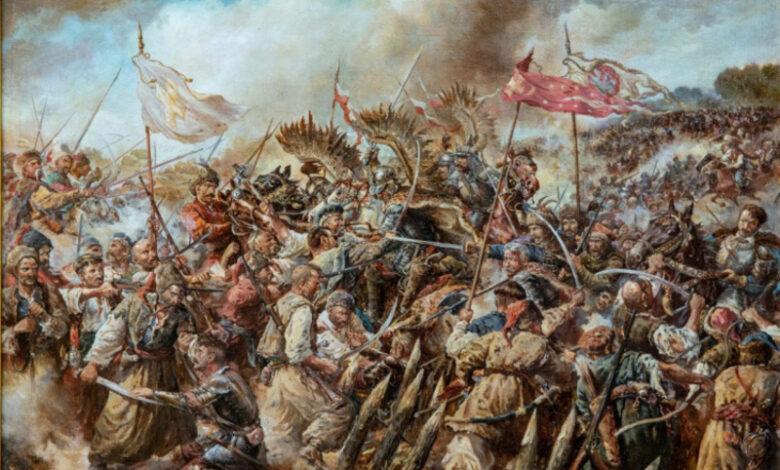
On May 26, the anniversary of the Battle of Korsun is celebrated in Ukraine. In different years of this day in history, events took place that reflect different aspects of the European, Ukrainian and world past — from medieval battles to geopolitical agreements of the 20th century.
Anniversary of the Battle of Korsun
May 26 is marked in the historical calendar of Ukraine as the day when the Battle of Korsun is remembered – one of the key events of the initial stage of the national liberation war of the Ukrainian people in the middle of the 17th century. In 1648, it was on this day that the troops of Bohdan Khmelnytsky met in a confrontation with the army of the Polish-Lithuanian Commonwealth led by Crown Hetman Mykola Pototsky.
The battle was the second major victory of the Cossack army after the Zhovtovod campaign. The importance of this event lies not only in military success, but also in political influence: the defeat of the Polish army near Korsun strengthened the authority of Khmelnytskyi, intensified anti-noble sentiments among the population and contributed to the growth of the scale of the uprising.
The battle of Korsun took place against the background of the general aggravation of the conflict between the Cossacks and the nobility, caused by social and national oppression. The successful operation of the Ukrainian forces, in particular the successful use of an ambush in a swampy area, made it possible to surround and defeat the main forces of the Polish army. Pototsky himself, together with other commanders, was captured, which had a significant moral and political effect.
Today, the anniversary of the Battle of Korsun is an opportunity to remember not only the military event itself, but also the broader context of the struggle for the autonomy and rights of the Ukrainian people in the 17th century. It reminds of the complex historical processes that shaped political consciousness and influenced the further development of Ukrainian statehood.
Historical events on this day
1093 — On Ascension Day, May 26, 1093, one of the tragic battles of princely Rus with the Polovtsy took place on the Stugna River. The united Russian army under the command of princes Svyatopolk Izyaslavych, Rostyslav Vsevolodovych and Volodymyr Monomakh was defeated. The Polovtsy, taking advantage of the lack of unity among the Russian princes, imposed a battle near Vasylkov. The battle ended with the defeat of the Russian forces: Rostislav died by drowning in the river, and the defeat affected the further political weakness of Kyiv.
1648 — On May 26, 1648, the battle of Korsun took place — the second major confrontation between the Ukrainian army led by Bohdan Khmelnytskyi and the army of the Polish-Lithuanian Commonwealth. After the victory at Yellow Waters, the Cossack army numbering about 15,000 people organized an ambush in a marshy area near Korsun. The Polish army numbering about 18,000, which was commanded by Crown Hetman Mykolay Potocki, fell into a trap. As a result of the battle, the Polish forces were defeated, Pototsky and other commanders were captured. This victory cemented Khmelnytskyi’s authority and unleashed the national liberation war in full force.
1924 — On this day in 1924, regular passenger air transportation began in Ukraine. This became part of a wider program of development of civil aviation in the USSR. Initially, it was about domestic flights between large cities, using adapted military aircraft. The purpose of the opening of the airlines was not only transportation, but also the confirmation of the technical progress of the Soviet government on the territory of Ukraine.
1938 — It was on May 26, 1938 in the German city of Wolfsburg that Adolf Hitler personally laid the foundation stone for the construction of the Volkswagen car factory. This gesture had a propagandistic meaning: it was about the implementation of the “people’s car” project, accessible to the broad sections of the population. The new enterprise was to become a symbol of the industrial modernization of the Third Reich. Later, the plant played a key role in the automobile industry after the Second World War.
1953 — On May 26, the Norilsk Uprising began — the most massive demonstration of prisoners in the Gulag system. Its initiators were Ukrainian political prisoners who, after Stalin’s death, demanded a review of terms, improvement of detention conditions, and an end to abuse. The protest lasted several weeks, covered several camp zones and became the first signal for the Soviet leadership that the Stalinist repressive machine could no longer operate without resistance. The uprising was suppressed, but it influenced further camp politics.
1972 — On May 26, 1972, the Soviet Union and the United States signed the Treaty on the Limitation of Strategic Arms (САО-1) in Moscow. This document was the first step towards control over the nuclear arsenals of both superpowers. The agreement fixed the number of intercontinental ballistic missiles, launchers and anti-missile defense systems. It was signed at the height of the Cold War and opened a phase of negotiating policy between the two blocs.
1995 — On May 26, 1995, Russia and Belarus solemnly announced the removal of the borders between the two states. This was another step towards the formation of the Union State. The agreement on the simplification of movement and pooling of economic resources was beneficial to the Kremlin as a tool to control the political course of Belarus. At the same time, it became a source of stable access to Russian energy resources and the market for Minsk.
2014 — It was on this day that Ukrainian special forces began the first battle for the Donetsk International Airport. After a lightning operation, the militants were defeated and pushed out of the airport. Although further Ukrainian troops could develop success, the offensive was stopped. Instead, a long defense began – 242 days of continuous fighting, ending on January 22, 2015, when the airport buildings were completely destroyed. The last defense object of the Ukrainian military was blown up by Russian mercenaries under the guise of a humanitarian truce. It became one of the symbols of the stability of the Armed Forces of Ukraine.
The beginning of the evacuation from Dunkirk – operation “Dynamo”
On May 26, 1940, Great Britain officially launched the mass evacuation operation of its and allied troops from the surrounded French port city of Dunkirk. The situation at that time was critical: after the lightning breakthrough of the German army through the Ardennes, the Anglo-French forces were trapped between the sea and the advance of the Wehrmacht.
Guderian’s German tank divisions reached the English Channel and isolated more than 300,000 soldiers, mainly British, French and Belgian. However, on May 24, the German command suddenly stopped the offensive – Hitler allowed the Luftwaffe to complete the operation with airstrikes without involving tank units. This pause, which continues in the historical debate as the “fatal error of the Wehrmacht”, gave the Allies a valuable two days to prepare for the evacuation.
On May 26, at 19:00, the British Naval Staff gave the order to start Operation Dynamo. The evacuation was carried out in extremely difficult conditions – under constant fire from aircraft, artillery and even from ships approaching the coast. Not only warships were involved in the operation, but also civilian vessels: yachts, ferries, fishing boats, which were mobilized en masse from the southern coast of England.
A total of 338,226 people were evacuated from May 26 to June 4, of which approximately 198,000 were British, the rest French and Belgian. French units remained in Dunkirk until the last, covering the retreat. At the same time, the Allies lost almost all heavy weapons — tanks, artillery, trucks — leaving it on the shore.
Operation “Dynamo” was not a victory, but it became a saving pause: it allowed to preserve the personnel core of the British Expeditionary Army, which later formed the basis of the armed forces that continued the struggle.
The beginning of the Norilsk Uprising of Gulag prisoners
On the night of May 25-26, 1953, a prisoner uprising began in camp No. 6 of the Mining Department of Norilha, which gradually spread to other camps of the Norilha correctional system. The uprising became the largest in the history of the Gulag both in terms of the number of participants and in terms of duration. Its initiators were mainly political prisoners, among whom a significant part was Ukrainians convicted after the war years — participants of the liberation movement, former members of the OUN and UPA.
The initial reason was the beating of prisoners by the camp administration after Stalin’s death (which occurred on March 5, 1953) amid the general expectation of amnesty and easing of the regime. The uprising broke out shortly after the arrival of the newly appointed commander in the camp – instead of negotiations, he ordered the use of force, which provoked an open refusal to work and demands for leadership.
In the course of the protest, the prisoners created strike committees, stopped production, demanded the release of particularly cruel supervisors, a review of cases, the admission of commissions from Moscow, and the elimination of torture. The organization and peaceful nature of the uprising impressed even representatives of the MGB (the future KGB). Prisoners drafted appeals to the union leadership, and in some cases held open meetings.
The Norilsk uprising lasted almost two months — from the end of May to the beginning of August 1953. It covered more than 16,000 prisoners in several camp units. Suppression took place gradually: special forces of the NKVD cleared the zones one by one, using firearms. Some of the organizers were shot, many were sent to solitary confinement or transferred to other camps.
The uprising, although it was brutally suppressed, had a long-lasting effect: its results were studied by special commissions of the Central Committee of the CPSU, which later became the basis for the reform of the penitentiary system and a partial review of the cases of political prisoners in the second half of the 1950s.