Measles outbreaks in Europe: how Ukrainian refugees can protect themselves from one of the most dangerous infections

During 2025, Europe faced a large-scale outbreak of measles. According to the World Health Organization, more than 127,000 cases of the disease have been registered in the European region – this is twice the number in 2023 and the highest incidence rate in the last 27 years. The situation is not improving: only in the first months of 2025, more than 4,500 new cases were detected in the countries of the European Union. For Ukrainians temporarily residing in EU countries as refugees, this statistic is of particular importance. Most of the infected are children, and infection often occurs in kindergartens, schools, accommodation centers, as well as during trips in public transport.
What is the situation in the countries where most Ukrainians live
Among the countries with the highest rates of measles are Romania, Italy, Germany, Belgium and Austria. Since 2024, more than 30,000 cases have been recorded in Romania, of which 22 were fatal. Most of the dead are unvaccinated children. More than 1,000 cases have been detected in Italy, more than 600 in Germany, 500 or more each in Belgium and Austria.
In more than 40% of cases, the disease is recorded in children under the age of five, and most of these children have not had any vaccination or only one vaccination. Half of all cases required hospitalization, which indicates a severe course of the infection even at an early age.
In the conditions of mass displacement, overcrowding in temporary accommodation centers, limited access to medical services and violations of the scheduled vaccination schedule during the war, the risk of infection for Ukrainian children and adults is much higher.
How to protect yourself from measles
Measles is one of the most contagious viral infections. It is transmitted by airborne droplets, even with short contact with an infected person. In closed rooms, the infection can be transmitted even through ventilation or surfaces. The only reliable method of protection is complete vaccination.
What is recommended for Ukrainians in EU countries:
- Check vaccinations. Ukrainian refugees have the right to basic medical services in most EU countries. The first thing to do is to contact your local family doctor or pediatrician (in Germany – Hausarzt/Kinderarzt, in Poland – lekarz rodzinny, in France – médecin généraliste) and check whether there is a record of two doses of the MMR (measles, mumps, rubella) vaccine.
- If the data is lost, undergo revaccination. If there is no record or there is only one dose, the doctor will recommend re-vaccination. Re-vaccination is safe even if both doses have already been administered – the body will simply strengthen its immunity.
- Vaccination of children. In the absence or loss of children’s vaccination data, it is recommended to undergo vaccination according to age. In many EU countries (in particular, Poland, the Czech Republic, Germany), Ukrainian children are vaccinated for free, at the expense of the state program.
- Avoid mass gatherings. In regions where outbreaks have been recorded (mainly Bucharest, Naples, Brussels, Berlin), it is better to limit being in places with large crowds, especially with small children.
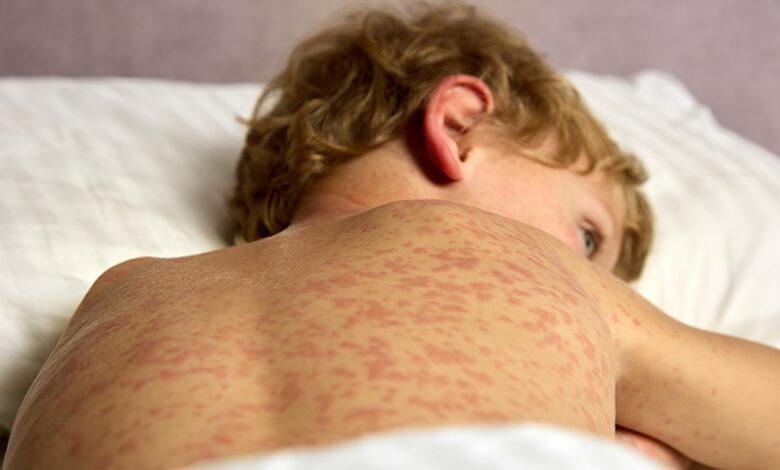
- In case of symptoms, consult a doctor immediately. The first signs of measles are similar to SARS: high fever, cough, conjunctivitis. Then a characteristic rash appears, starting on the face and spreading over the body. If measles is suspected, you should not go to school, kindergarten or public places – you should isolate yourself and call a doctor.
Peculiarities in the context of war and migration
Because of the war in Ukraine, many children missed scheduled vaccinations. Parents do not always have access to the documents or may not remember when the child was vaccinated. In EU countries, doctors usually do not require written confirmations — it is enough to explain the situation. The MMR vaccine is included in the basic calendar of most countries of the European Union, and if necessary, it can be given free of charge to refugee children and adults.
In Poland, Germany, France and the Czech Republic, there are special instructions for medical institutions that work with refugees. There, doctors usually clarify the vaccination data themselves and offer to make up for it. Some centers work according to a simplified mechanism: they vaccinate immediately if the refugee is in a risk group.
The European outbreak of measles in 2024-2025 is not a local problem of individual countries, but a threat affecting the most vulnerable categories of the population. Ukrainians who are temporarily staying in EU countries should be especially attentive to the health of children, because babies are the main risk group. Full vaccination, attention to symptoms, avoiding crowds during outbreaks are measures that can really save lives. Measles is not just a “children’s disease”, but a threatening infection with serious complications. And in conditions of prolonged war and forced migration, disease prevention is the responsibility of both parents and the receiving state.