MES recommendations on safety before the new school year: how the ministry shifted responsibility for it to schools

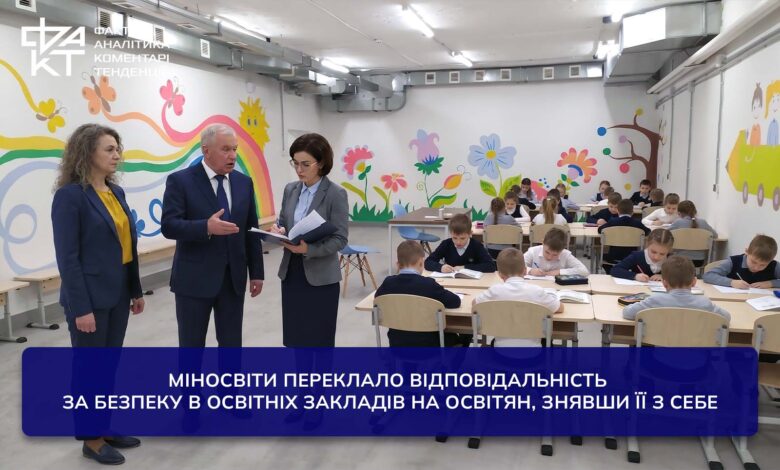
Each new academic year for Ukrainian schoolchildren has long ceased to be a holiday, turning into a monthly survival test. In modern realities, the safety of participants in the educational process should be a priority for the state, so the Ministry of Education and Science of Ukraine has traditionally set out a long list of requirements and recommendations for preparing educational institutions for the new 2026/27 academic year and the heating season.
Moreover, the responsibility for this again falls on the shoulders of school principals and teachers. The Ministry of Education and Science is once again limited to instructions, reserving the right to report on successes and exhaust educators with endless checks. They only create additional problems and independent search for resources by educators (often at their own expense), but in no way help to purchase a generator or build a reliable shelter.
New recommendations of the Ministry of Education and Science: what a school should be like during war and blackouts
New recommendations of the Ministry of Education and Science put forward strict requirements for the leadership of educational institutions, aimed at transforming each academic location into an autonomous and safe node in the conditions of a protracted energy crisis. Against the backdrop of predicted fan outages or even long system blackouts, the primary task is the comprehensive modernization of internal power networks.
Government officials place special emphasis on critical infrastructure facilities in the education sector and boarding schools, where students are kept 24/7. For such institutions, it is critically important not only to have backup generators available, but also to form a reliable autonomous circuit, provided with an uninterrupted supply of fuel, solid fuel, in particular coal, and firewood, which will allow them to survive winter peaks without attracting external resources.
Along with energy autonomy, a large-scale campaign is being launched to expand and qualitatively reformat the fund of protective structures, because the presence of reliable storage remains the main capital for the restoration or continuation of the full-time educational process. Modern shelter, in the opinion of specialists from the Ministry of Education and Science, can no longer be an ordinary damp basement, but must strictly comply with the current State Building Standards (DBN), offering a barrier-free space for low-mobility groups of the population, as well as stable engineering communications – from forced ventilation and heating systems to uninterrupted drinking water supply and high-quality Internet connection. At the same time, a specialized platform My Fortress has been identified as a procedural assistant and digital reference for the correct modernization and certification of such premises, which accumulates standards and best practices for the arrangement of protective structures.
When the destruction of an educational institution as a result of hostilities is too deep and makes it impossible for people to stay safely within its walls, the administration is obliged to immediately launch an algorithm for the conservation of damaged structures in order to preserve the remains of the material and technical base. In such crisis scenarios, the legal and actual way out of the situation becomes the unalternative transfer of students and schoolchildren to a distance learning form, which allows maintaining the continuity of lessons outside of physical classrooms.
Control over all these processes is entrusted to a regular monitoring system, where managers are obliged to report on civil defense measures and the state of labor protection without delay and within clearly defined deadlines. All necessary data, ranging from the real level of readiness of heating networks for winter and the availability of alternative power sources to the dynamics of recording destruction, must be promptly entered and constantly updated in electronic registers and databases of the Ministry of Education and Science, turning paper reporting into a dynamic tool for management control.
Billions for shelter, but without guarantees: how the Ministry of Education and Science is transferring education to survival mode
Analysis of the educational policy of the Ministry of Education and Science during the 2025–2026 academic year indicates a fundamental change in priorities, where classical academic reforms have completely given way to the concepts of physical survival and maintaining a security perimeter. The Ministry of Education and Science of Ukraine has taken on the role of strategic coordinator, shifting the focus of its activities to capital construction, expanding the full-time education network, and strict management of infrastructure subventions. At the same time, the executive branch deliberately avoided publishing consolidated data on the exact number of buildings completely built from scratch, operating instead with intermediate financial indicators: the volume of allocated tranches, the pool of approved applications, and the dynamics of modernization of existing areas. Such secrecy emphasizes the deep gap between office reporting and the real pace of work on the ground, where initial capital construction plans often transformed into banal patching of holes, cosmetic adaptation of abandoned basements, or hastily carried out ventilation.
The centralized distribution of financial resources this year demonstrated a pragmatic, but necessarily uneven approach to the modernization of educational space. Having accumulated significant funds, the state laid out UAH 6.2 billion in subventions for the arrangement of safe conditions in educational institutions, to which another UAH 5 billion in targeted allocations were later added to finance part of the 315 comprehensive regional applications. A key feature of this financial cycle was Ukraine’s integration into the World Bank-funded Program “Enhancing Access to and Resilience of Education in Crisis Ukraine” (LEARN). This mechanism increased pressure on local governments, as the government rigidly tied the receipt of international support and compensation to the general fund of the state budget to the ability of communities themselves to provide a high share of co-financing of projects on the ground.
Despite the large numbers, the government applied the tactic of selective selection, directing the operational tranche of UAH 231.1 million exclusively to the completion of 22 transitional facilities in 11 regions, including Dnipropetrovsk, Zaporizhia, Kirovohrad, Lviv, Mykolaiv, Odesa, Poltava, Rivne, Sumy, Kherson, and Khmelnytskyi. However, the main and uncompromising filter for receiving this money was the readiness of facilities at a level of not less than 60%, recorded according to the results of work in 2023–2025, and a categorical ban on any increase in the cost of estimates.
Along with the government’s desire to demonstrate quick results and return more than 10 thousand students and cadets of military lyceums to classes through point investments, the approved methodology contains a hidden sentence for the Ukrainian province. The introduced strict standard, which requires at least 200 students for project approval, automatically cut off from funding small-numbered rural schools in front-line and de-occupied areas. Even the status of the only educational center in the community does not save such institutions from being forced to switch to online mode, which triggers an irreversible chain reaction. After all, without funding, schools are closing, depriving sparsely populated villages of any prospects for the return of families with children.
Along with destructive trends on the periphery, in large cities in the spring of 2025, due to obtaining the lion’s share of approvals for the implementation of initially 60, and later 144 infrastructure facilities, the crisis of managerial responsibility has intensified. New strict sanitary standards and requirements for protective structures are increasingly becoming an instrument of systemic pressure on school principals, whom law enforcement and regulatory authorities are trying to make extreme for any technical shortcomings. The professional community of educators rightly emphasizes the absurdity of such accusations, since the teacher is not a certified civil engineer or an expert in extensive ventilation systems.
Full responsibility for compliance with architectural parameters, transparency of public procurement and direct quality of work should be placed on specialized contracting organizations and education management bodies, which dispose of billions of subventions, otherwise the teaching staff will simply refuse to take on knowingly criminal risks. Pedagogical workers, instead of preparing for classes and rest, are forced to take full responsibility for outsiders and the technical condition of buildings during off-hours. Such practice not only violates labor legislation, but also demonstrates a systemic crisis of management, where the ministry is trying to close gaps in the security infrastructure by exhausting the internal resources of the educators themselves.
Safe Education or a Dangerous Experiment: Why the MES Strategy Is Getting More and More Criticism
The activities of the MES in the context of a full-scale war have repeatedly found themselves at the center of heated public debates, provoking serious criticism from the parent community, educators, human rights organizations, and specialized experts. The main criticism of it is that the security priorities declared on paper have in practice transformed into a number of contradictory decisions that, instead of providing real protection, deepen the crisis in the education sector. The dissatisfaction of opponents of the government’s course is concentrated around several interrelated problems: from the forceful promotion of full-time education to the actual ignoring of the needs of those schoolchildren who are in the most vulnerable position.
The implementation of the government’s “Offline School” strategy has demonstrated an obvious gap between office plans and the dangerous reality of front-line regions. The ministry’s efforts to get students back to school at any cost in Kharkiv, Zaporizhia, Mykolaiv, or Dnipro run into the iron logic of military risks, as these cities are under daily threat from S-300 anti-aircraft missiles, guided aerial bombs, and artillery. In such conditions, the time from the moment a shell is launched to its explosion is measured in tens of seconds or, at best, 2-3 minutes, which turns an attempt to organize the evacuation of hundreds of children to the basement into a deadly lottery.
The situation is complicated by the fact that officials have decided to eliminate distance learning in those institutions that are switching to a full-time or mixed format. As a result, parents are deprived of the right to compromise and are faced with a tough choice: either to send their child to school under the threat of shelling, or to completely break ties with their family and look for another educational institution where the online form is still preserved.
Along with the compulsion to return to classes, the chronic inability to provide the necessary infrastructure for this has been exposed. Projects to build underground schools and major anti-radiation shelters are progressing too slowly, which is why the actual state of protective structures in most regions is catastrophically lagging behind the real needs of the time. Instead of reliable bunkers, children and teachers are often offered ordinary basements that can protect only from debris, but are completely powerless in the event of a direct hit from heavy weapons.
A particularly painful aspect of the new education policy has been the hidden pressure on children who are in forced emigration or remain under occupation. In an effort to optimize budget expenditures, the relevant department initiated the closure or merger of those distance learning schools in the deoccupied territories that provided a stable educational process exclusively through the network. Such a step not only left many local teachers without a means of livelihood, but also destroyed the last bridge connecting students with their native cities and villages.
The consequences for schoolchildren in the temporarily occupied lands, where the invaders equate receiving a Ukrainian education with a criminal offense, turned out to be much more dangerous. The strict standards for online lessons introduced by the ministry, which require the mandatory inclusion of video cameras and strict adherence to time schedules, turn regular learning into a mortal threat, as they simplify the expulsion of such children by the occupation special services and collaborators.
The internal climate within the educational process, where the basic needs of psycho-emotional security are chronically ignored, is no less destructive. During prolonged air raids, which can last for 4-6 hours at a time, students are forced to stay in unadapted damp rooms without adequate ventilation, proper bathrooms or places to rest, which undermines their physical condition. Returning from shelters does not bring relief, because due to constant disruptions to classes and power outages, subject study schedules are completely destroyed. Since the state has not offered systematic and centralized tools to make up for these educational losses, teachers have to catch up on the program during weekends or late at night, which drives both adults and children into a dead end of chronic stress and overwork.
As we can see, the desire of the Ministry of Education and Science to turn each school into an autonomous fortress in crisis conditions looks like a conscious shift of responsibility to the least protected link, that is, to the principal, teachers and the community. When an educator is forced to choose between criminal liability for the quality of engineering networks and the threat to the lives of children during a few-second missile approach, the system signs a sentence on its own viability.