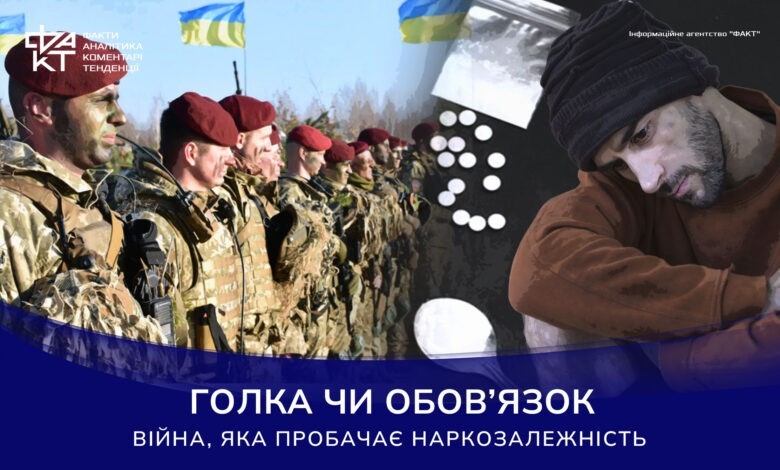
In a country where every day is decided by the weight of blood and sweat, there are those who manage to stay aloof. While some boys go to the front with a sense of duty, and others hide behind medical certificates, drug addicts find an unexpected “protection”. It turns out that the needle in their arm not only gives a dose of high, but also becomes an armor against mobilization. Today, the situation is such that the state not only does not force those who choose to live in the shadows to fight, but sometimes even protects them like a crystal vase. Drug addicts seem to have a paradoxical immunity. Let’s try to figure out who created such privileges for them – the system, society or themselves.
Terrible addiction in numbers
Drug addiction is a terrible addiction of the modern world. As a rule, it accompanies various forms of crime. Drug addicts commit crimes to get a dose, or under the influence of the same dose. The relationship between drug addiction and crime is also manifested in the commission of illegal actions related to illegal drug transactions.
According to experts, there are now approximately 200 million drug addicts in the world, which is 3% of the entire population of the planet or about 12% of the population aged 15 to 30 years. According to the Ministry of Internal Affairs, there are officially about 600,000 drug addicts in Ukraine, of which 173,600 use drugs regularly. At the same time, about 6,000 drug addicts are not even 18 years old. Experts emphasize that, as evidenced by the experience of other countries that experienced war, we should expect an increase in the number of people using drugs.
As of 2023, there were 62,511 people with mental and behavioral disorders due to the use of psychoactive substances (SPDs) under supervision in the dispensary group in Ukraine. Among them, the largest share (66.5%) was people with mental and behavioral disorders due to the use of opioids. The share of such persons remains stable from year to year.
For data online survey conducted by the Institute of Psychiatry, Forensic Psychiatry and Drug Monitoring Ministry of Health of Ukraine, 63.7% of respondents reported that they used drugs at least once in their life. Moreover, men are more likely to use drugs than women, as evidenced by 81.2% of men versus 50.3% of women. The age group prone to drug use is mainly people from 25 to 34 years old. Among the reasons that led to the use of the drug, the respondents named:
- for the sake of experiment or entertainment – people aged 25 to 34 (52.5%);
- for stress relief – people aged 35 to 44 (48.9%).
The full-scale invasion of Ukraine became an obstacle to tracking this data in the following years. And in general, it is almost impossible to trace the victims of the distribution of “black market” products. According to independent experts, the number of drug addicts in Ukraine is 1.5-2 million people, which is ten times higher than various official figures. The rate of drug addiction increases annually by an average of 8-10%, rapidly replenishing the army of drug addicts.
It is obvious how dangerous drug addiction is for society. At the same time, drug addicts are not summoned to military commissariats, are not accused of desertion, and are not even required to pay any duty to the state. They hold in their hands not a weapon, but a needle, and surprisingly, it is this needle that turns them into untouchables.
Drug addicts are the taboo of war. On paper, the state puts them on the list of “sick” people who need treatment, not mobilization. But where does the disease end and the convenient opportunity to hide from the front begins? While the streets of the cities are emptied of men of military age, and mothers send their sons off to war, these people stay at home. Some are being treated, others are looking for a new dose and at any moment, losing control over themselves, can become a threat to society. But all of them are out of military service.
The reason is simple and complex at the same time. On the one hand, drug addiction is truly recognized as a disease that requires rehabilitation, not the stress of frontline life. And even in the trenches, such “soldiers” are not needed, because they only cause problems. On the other hand, it is a convenient loophole for those looking for a way to avoid military service. Doctors confirm the diagnoses, lawyers draw up the necessary documents, and now the person is out of the risk zone.
The state seems to understand the problem, but does not try to solve it at all. In many cases, drug addicts use the system, remaining unpunished and protected. Moreover, they are provided with free drugs, behind which there are long queues at pharmacies, and even free rehabilitation programs abroad. Rehabilitation centers become hiding places for them, and in some places – new platforms for drug exchange. Of course there are those who are really trying to heal. But there are many who are only looking for a way to avoid responsibility and immerse themselves even more in the world of drugs.
This is not only a problem of war, but also of society as a whole. We are used to closing our eyes to what is convenient and does not affect us directly. But it is hardly fair that those who were ready to take on the duty die on the front line, while others, behind the screen of the “needle”, live without fear of mobilization.
Attitude towards drug addicts in foreign countries
In many European countries, drug addiction is perceived as a disease. People with this addiction are supported through rehabilitation programs, substitution therapy (methadone or buprenorphine) and social projects. In Portugal, for example, drug use is decriminalized, and instead of punishment, a person receives help.
In the United States, there is a mixed approach. On the one hand, there are serious treatment and support programs, on the other hand, some states still punish drug use. Addicts are offered participation in rehabilitation programs instead of prison terms. The US has revised its drug policy, moving from a tough approach to the fight against drugs by criminalizing and imprisoning people involved in drug use or distribution to treatment and rehabilitation. Some US states have decriminalized the use of marijuana or even completely legalized it. This made it possible to reduce the burden on the judicial system and focus resources on more dangerous drugs. The federal government is also actively involved in the fight against drugs by funding various treatment and prevention programs and supporting research into new drug addiction treatments. Special attention is paid to informing the younger generation about the risks of drug addiction. Schools and community organizations run drug prevention education programs, such as the D.A.R.E. (Drug Abuse Resistance Education). They focus on educating young people about the risks of drug use and developing life skills that help them avoid drugs.
Canada is actively implementing harm reduction programs: free access to treatment, safe injection sites, and the legalization of some narcotic substances for medical purposes.
Countries like Norway and Denmark emphasize the integration of drug addicts into society. Norway even has a program that helps addicts find work and return to a normal life.
Depending on the country, drug addiction can be a barrier to military service because it is considered a medical condition that affects physical and psychological stability.
Military medical commissions strictly check the health of conscripts. Drug addiction (even in the past) is usually a reason for disqualification, as addiction can negatively affect performance. For example, the Israeli army has a strict medical examination. People with addiction, as a rule, are not drafted. However, if a drug addict has undergone successful rehabilitation, he may be considered as a potential conscript.
Most countries recognize that drug addicts are unfit for military service due to health conditions, but some allow them to return to a normal life through rehabilitation. In countries where drug addiction is criminalized or stigmatized, military service is often unavailable, while it can be a convenient way to avoid service.
The fight against drug addiction is primarily carried out at the legislative level. Practically all countries have strict criminal sanctions for the production, transportation and distribution of narcotic drugs. The popularization and approval of a healthy and safe lifestyle, a life without drugs, is of great importance. It is very important to realize that drug addiction is more likely a disease of society than of an individual. Therefore, most researchers of the problem are inclined to the opinion that such conditions should be created in society that would not contribute to the abuse of narcotic substances. For example: popularization of physical culture and sports among the relevant age groups and strata of the population, especially among children and youth; creation of a network of sports grounds and facilities with unlimited access to physical education.
The situation with drug addicts is a litmus test that reveals the diseases not only of individual people, but also of the entire system. The war sharpened the question of justice and duty, but at the same time it showed how easily certain categories could avoid responsibility by taking advantage of loopholes in the law.
The problem of drug addiction during wartime is a complex task that requires immediate action. First of all, it is necessary to provide psychological support for drug addicts. Creation of psychological assistance centers, support lines and rehabilitation programs should become a priority.
It is also important to develop prevention and education programs aimed at informing about the risks of drug addiction and ways to deal with stress. People need to know that there are other ways to overcome difficulties besides drugs.
The state must finally decide who these people are: patients who need to be treated, or tricksters who need to be involved in a common struggle? Because while someone is risking his life at the front, someone hides behind the “document” and continues his life, having fun and putting himself and others in danger, as if the war is just someone else’s trouble. A country that consciously or unconsciously becomes a haven for drug addiction is doomed to a multifaceted crisis – moral, economic, social. When addiction becomes the norm, and the fight against it is just a screen for statistics, it signals a deep degradation of society.
The more people find salvation in substances, the less faith in the future. The economy is suffering due to the loss of labor potential, budgets are stretched to maintain rehabilitation centers, and criminal gangs are strengthening their influence, because the drug trade is their lifeblood.
The social fabric is tearing under the weight of crime, violence and broken families. Children grow up in a world where “shut down from pain” becomes a habit, not a struggle. And this is no longer a problem of individual individuals – it is a sentence for the society that allowed this to happen.
The future of such a state is a cornered generation with lost landmarks. If this wave is not stopped, only one prospect will remain: the slow but inexorable destruction of the very basis of social life. And there is a way out – but it requires not just laws or programs, but real political will, changes in culture and education, and total intolerance to self-destruction.