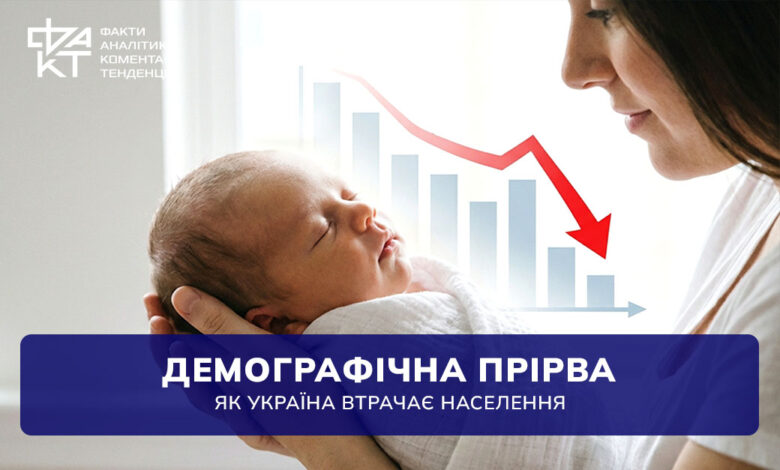
Modern Ukraine is experiencing a real demographic collapse that cannot be ignored. In 2025, only 168 thousand newborns were born for 485 thousand deaths – a ratio of 1:3. At the same time, the critical fertility rate of 0.8 children per woman indicates that national reproduction has practically stopped. Each new generation becomes smaller than the previous one, and the economy and social systems are entering a phase of inevitable labor shortage and aging of the nation. These indicators are a sentence for the state! What previously seemed like a distant threat has now become an obvious demographic catastrophe: a nation that loses hundreds of thousands of people and has few children risks disappearing due to the lack of a future generation.
The scissors effect: how the gap between mortality and fertility is killing the state
Estimates of the United Nations structures recorded an unprecedented decline in the birth rate in Ukraine. According to data provided by CNBC, citing United Nations estimates, in 2021 the total fertility rate in Ukraine was 1.22 children per woman. In 2025, this figure decreased to 1.00, which means an average of one child per woman of reproductive age. However, the actual fertility rate now fluctuates between 0.8–0.9.
It should be noted that to maintain the population size without taking into account migration, a coefficient of 2.1 is required, which is considered the threshold for population reproduction. Deviation from this level by more than half creates a situation in which each subsequent generation becomes numerically smaller than the previous one, and the age pyramid gradually loses balance between younger and older groups.
According to the forecasts of the Center for Economic Strategy, Ukraine is rapidly approaching the point where the burden on the social system will become critical. Tax revenues will fall in parallel with the outflow of working-age personnel from the country. Those who work today will simply have no one to replace them in ten years, so the question inevitably arises whether Ukraine will remain a viable state or turn into a territory of pensioners, where social guarantees will become mathematically impossible.
The current demographic map of Ukraine demonstrates a rapid decline in human capital, where over the past two years mortality rates have almost tripled the rate of new lives. Last year’s statistical results record a deep gap between 485,300 deaths and only 168,800 births, turning the generation gap into a systemic challenge to the nation’s existence.
Table 1. Demographic balance of Ukraine (by 2025)
| Indicator | Statistical data | Context and meaning |
| Birth rate | 168.8 thousand children | Historical minimum (3.7 times decrease compared to 1991) |
| Mortality | 485.3 thousand people | Exceeds birth rate 2.87 times |
| Fertility rate | < 0.8 | Critically below the reproduction level (norm — 2.1) |
| Ratio | 1 : 3 | For every birth, there are three deaths |
The data presented in this table pass a demographic verdict on the current state of the social system. To understand the scale of the catastrophe, it is worth paying attention to three key aspects:
- The “scissors” effect: the gap between birth and death rates has become so deep that the natural reproduction of the nation has actually stopped. When there are three deaths for every newborn, the country loses an entire generation every 20–25 years.
- The fertility point of no return: the rate of 0.8 children per woman is one of the lowest in the world, which means that each subsequent generation of Ukrainians will be half the size of the previous one. For a simple restoration of the nation, without growth, but only to maintain the number, this rate should be 2.1, while we have only a third of the so-called survival rate.
- Economic echo: these figures predict an inevitable labor shortage in the near future. Statistics for 2025 show that we are entering an era where the number of pensioners will rapidly exceed the number of workers, making the current model of solidarity pensions mathematically impossible.
The trajectory of fading: from the baby boom of the 1990s to a historic low
If we compare these figures with the beginning of the restoration of state independence, the scale of regression becomes obvious: in 1990–1991, the country welcomed more than 630–650 thousand babies each year, while by 2025 this flow had narrowed by 3.7 times. Infant mortality statistics often fall victim to superficial interpretations, although these figures contain a real diagnosis for the state healthcare system.
Analyzing the data for 2022, when the indicator was recorded at 7.33 per 1,000 live births, and comparing them with forecasts for the beginning of 2026, we see Ukraine in the second hundred of the global list – approximately between 150th and 160th places among almost 220 territories. In this ranking, the “leadership” belongs to countries with humanitarian catastrophes such as Afghanistan or Somalia (with indicators over 100), Ukraine’s presence closer to the end of the list indicates the preservation of basic medical capacity.
The dynamics of the birth rate over the past three and a half decades resembles a complex curve, which after a sharp decline in the 1990s to 376.5 thousand in 2001 demonstrated a temporary ability to recover. The first decade of the new millennium was marked by a gradual rise, when the numbers confidently stepped up from 390 thousand in 2002 to a peak of 512.5 thousand in 2009. A short-term decline in 2010 was replaced by another surge in 2012, when more than 520 thousand children were born, but this period became the last stage of relative well-being before a long peak.
It should be noted that the events of 2014 and the occupation of the territories of the Russian Federation launched an irreversible process of a steady decline in reproductive activity, which is reflected in the annual reports of the Ministry of Justice. From 465,900 babies in the year of the beginning of the aggression, the figures fell to 273,800 on the eve of the full-scale invasion, and during the years of the great war the situation deteriorated even more radically. Official data, which now exclude Crimea and four partially occupied regions, indicate a consistent decrease in the number of births: from 206,000 in 2022 to a historical minimum of 168,800 last year, which lowered the fertility rate below the critical mark of 0.8 children per woman.
The mortality trajectory in the country has its own specific nature, since the most difficult period lasted from 1993 to 2009, when annual population losses consistently exceeded 700,000 people. The next decade brought some relief, allowing the number of deaths to decrease to below 600 thousand, but the coronavirus pandemic in 2020–2021 again provoked an anomalous jump in mortality to 714.3 thousand people. The last four years show figures in the range of 485–541 thousand people in the controlled territories, which, given the catastrophic shortage of newborns, creates a critical situation.
The deep crisis that unfolded after 2022 is due to the direct impact of the war on the physical survival and psychological health of the population, which directly affects the desire and ability to plan for the future. The combination of high mortality with unprecedentedly low birth rates forms a vicious circle of demographic depletion, where the lack of generational replacement becomes as much a threat as direct hostilities.
Economic echo of demography
Analysis of the current demographic gap is impossible without assessing its devastating impact on the economic architecture of the state, where the catastrophic decline in the birth rate is already laying the foundation for an unprecedented shortage of labor resources. A 3.7-fold decrease in the number of newborns compared to the early nineties means that in two decades the labor market will lack hundreds of thousands of specialists capable of ensuring innovative development and supporting the vital activity of critical infrastructure. When there are three deaths per baby, as recorded in 2025, the natural balance of generational replacement is disrupted, which inevitably leads to the aging of the nation and excessive pressure on the pension system.
The situation with filling the solidarity pension fund is becoming critical, since each working person will be forced to support an increasing number of pensioners, which creates the risk of social collapse. High mortality combined with record low birth rates is washing out the most productive segments of the population, forcing the state to seek radical ways to reform social guarantees. The loss of reproductive potential below the level of 0.8 children per woman actually means that without large-scale programs to return migrants and stimulate parenthood, the economy will find itself in a state of permanent recession due to a lack of consumer demand and labor.
Further washing out of human capital as a result of the war and demographic decline requires Ukraine to completely reassess its state strategy, in which every saved life should become a matter of national security. The fight for human resources should become a priority task for the state, because the threefold excess of mortality over birth rates for the second year in a row leaves no room for inertial development.
The combination of modern demographic and migration processes is shaping a trajectory whose consequences will unfold over decades. If fertility rates remain close to one birth per woman and a significant portion of young citizens continue to live outside the country, Ukraine will face a steady population decline and catastrophic changes in the economy.