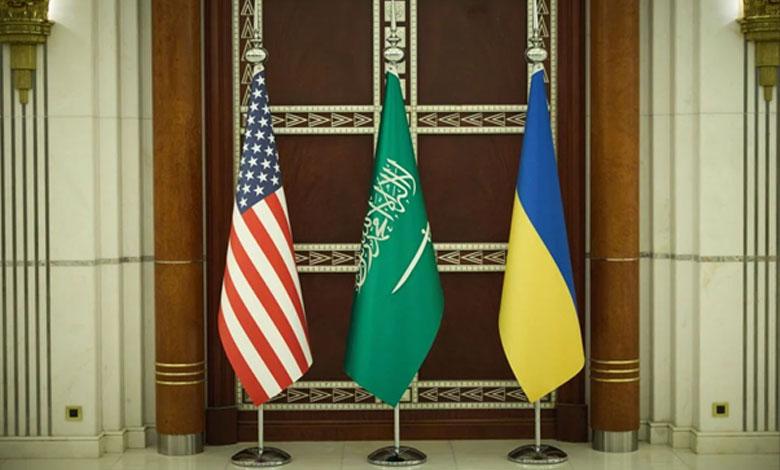
Negotiations with the participation of the American and Ukrainian sides have ended in Jeddah. The world establishment and ordinary citizens give assessments that range from “nothing groundbreaking at the meeting” to “everything is going according to the Ukrainian proactive plan.” Some call the most important achievements of the meeting the resumption of the supply of military aid and the provision of intelligence. Some believe that the most important thing was that Ukraine declared its commitment to peace and now there is no reason to blame us for the desire for endless war. One way or another, the general picture of the results of the negotiations looks encouraging. However, it is incomplete. It lacks completeness due to the incomprehensibility and unpredictability of the Russian position. “The ball is on Russia’s field“, – this is how the President of the European Commission, Ursula von der Leyen, assessed the outcome of the negotiations in Saudi Arabia, actually repeating words US Secretary of State Mark Rubio.
According to Reuters, on the eve of the meeting, the United States urged Ukraine to abandon the term “just peace” and move on to the discussion of “realistic peace.” This is due to the desire of the US to adapt the approach to peace negotiations, taking into account the current military situation and opportunities for reaching a compromise. So the main intrigue now is how Russia will react to the results of the talks in Jeddah.
What does Russia want and what does it not want?
As written The Economist, reports of recent days indicate that Putin is open to a truce, but under certain conditions. Citing a high-ranking source close to the Kremlin, the publication suggests that Russia plans to demand that Ukraine declare neutrality and bar foreign peacekeepers. As reported Radio Svoboda, during a press conference, the Minister of Foreign Affairs of Russia, Sergey Lavrov, confirmed that Moscow is categorically against the placement of the European peacekeeping contingent on the territory of Ukraine. According to his assessment, this is “direct, official, undisguised involvement of NATO countries in the war against Russia”, which is unacceptable for Moscow.
During a visit to the Moscow branch of the Defenders of the Fatherland Foundation on March 6, 2025, Putin emphasizedthat Russia has no intention of “giving in to anyone” or making any compromises in future peace negotiations. He emphasized that Russia should choose the option of a peaceful settlement that would “best suit” it and ensure long-term peace.
Kurt Volker, who was a special representative for Ukraine in Mr. Trump’s first administration, suggested that Russia would reject any truce offer. However, instead of a clear refusal, Moscow can offer an alternative that will further erode Ukraine’s position. An unnamed edition The Economist the former Ukrainian diplomat believes that the USA and Russia are using the tactic of “slicing salami” in relation to Ukraine. In politics and diplomacy, this expression means a method where a party gradually, step by step, achieves beneficial changes for itself, without causing immediate opposition. In particular, in the context of Russia’s war against Ukraine, this may mean that the Kremlin is trying to force Kyiv to agree to certain concessions, which will collectively lead to Russia’s strategic advantage.
The Economist worries that all further negotiations will be aimed at crossing Ukrainian “red” lines.
Negotiations – only after the liberation of Kurshchyna
Russia will refuse any meaningful negotiations as long as Ukrainian troops remain on the territory of the Kursk region. This approach allows the Kremlin to maneuver, using different arguments depending on the audience. Back in November last year, the publication The Washington Post reported that Russia will not sit down at the negotiating table until its military forces are pushed out of the territory of the Kurshchyna Armed Forces. According to the publication The Guardian, the Kremlin also rejects the possibility of exchanging the occupied Ukrainian territories for parts of the Kursk region under Ukrainian control.
In the political dimension, the “liberation” of the Kursk region is critically important on the eve of May 9. Military successes on this part of the front will allow Putin to maintain the image of a “strong leader” before the domestic audience and the international public. This is especially important given the possible presence of Chinese leader Xi Jinping and other foreign guests at the celebration – for the Kremlin, this is a moment when it needs to show strength, not vulnerability. For the Russian audience, the Kremlin can present the retreat of Ukrainian forces as a “great victory” that opens the way to negotiations. At the same time, communication can be two-fold: for those who seek the end of war: “We regained control over our territory, now we can talk about peace.” And for those who support the continuation of hostilities: “This is only a tactical stage that will allow us to better prepare for further offensive actions“.
Thus, keeping Ukraine in the Kursk region puts Russia in an extremely uncomfortable position. If the Kremlin manages to regain control over this territory, it will use it as a pressure tool in the information war and a basis for further diplomatic games.
According to the latest reports, the Ukrainian military is facing serious difficulties at the front in the Kursk region due to the increase in the number of Russian forces and the blocking of logistics.
Will representatives of the Kremlin meet with Trump?
The spokeswoman of the Ministry of Foreign Affairs of the Russian Federation, Maria Zakharova, stated that the position of the Kremlin is formed within Russia, and not under the influence of international agreements. She urged to follow the news from the Russian Federation, stressing that the “main news” will come from the Russian side. Press Secretary of the President of Russia Dmytro Peskov reported, that Moscow is carefully analyzing the results of the recent negotiations between Ukraine and the USA, which took place in Saudi Arabia. He noted that the Kremlin draws conclusions from the statements of US Secretary of State Marco Rubio and National Security Advisor Michael Waltz. Peskov confirmed that certain contacts are planned in the coming days, which the Kremlin will inform about in addition. However, he did not specify whether it was a telephone conversation between US President Donald Trump and Russia’s Vladimir Putin. At the same time, Peskov did not rule out such a possibility, noting that it is possible to organize a telephone conversation quickly, but currently there are no relevant agreements.
We will remind that on February 12, 2025, a telephone conversation between Donald Trump and Vladimir Putin took place, which lasted for an hour and a half. It was the first direct communication between the leaders of the United States and Russia since February 2022. According to the results of the conversation, Trump announced his intention to start immediate negotiations on the cessation of hostilities in Ukraine. Both sides expressed their readiness to cooperate closely to achieve a diplomatic settlement of the conflict. The US President has tasked Secretary of State Marco Rubio, CIA Director John Ratcliffe, National Security Adviser Michael Waltz and Middle East Special Envoy Stephen Wittkoff to lead the peace talks.
Peskov also noted that the Kremlin is waiting for additional information from the US on the details of negotiations with Ukraine before making a decision on the 30-day truce proposal. He stressed the need to obtain concrete data on the talks held in Jeddah, Saudi Arabia, before Russia formulates its position.
“We don’t want to play with narratives about unwillingness to stop the war”
At the briefing, President Volodymyr Zelenskyi commented on the achievements of the meeting in Jeddah. He stated that Ukraine is ready to agree to a 30-day regime of silence in the format proposed by the United States. At the same time, he emphasized that no one has any illusions about Russia’s intentions, because Ukraine has already faced violations of agreements more than once. However, Kyiv does not want to “play with narratives about unwillingness to end the war.”
Zelensky emphasized that he wants the war to end as soon as possible and expects that the United States and European partners will be united in putting pressure on Russia. He also noted that hostilities are ongoing in Kurshchyna, the enemy is trying to increase pressure, and the Ukrainian command is doing everything possible to preserve the lives of the soldiers as much as possible.
According to him, the issue of further sanctions or other measures against Russia will largely depend on the American side and its dialogue with Moscow. If Russia demonstrates readiness to accept the proposed conditions, appropriate decisions can be made. If the Kremlin refuses, Ukraine expects the US to stick to its “peace through strength” strategy.
So, the official statement of the USA after negotiations with Ukraine confirmed that Kyiv expressed readiness to accept Washington’s proposed 30-day ceasefire, which can be extended by mutual agreement of the parties. At the same time, the text emphasizes that achieving peace will directly depend on Russia’s position. The US promised to convey these proposals to the Kremlin, as well as to involve European partners in the peace process.
However, if we look at the situation more broadly, it becomes obvious that Kyiv is operating within a more complex strategy. Its essence is that Ukraine not only supports the format of the negotiations, but actually delegates responsibility for their possible failure to Trump. Thus, the US president finds himself in a trap: if he tries to promote the idea of a truce, he will have to interact with Putin and clearly articulate Moscow’s position to the Western community.
Edition The Washington Post recalls that in July 2024, Putin rejected the idea of a temporary ceasefire, insisting on the need for a complete end to the conflict on terms that include the demilitarization of Ukraine and its neutrality. Russian politicians and far-right ideologues such as Oleksandr Dugin have opposed the truce, saying it runs counter to Russia’s ambitions for global influence. However, in Ukraine, despite the constant attacks, cautious optimism remains, especially after the positive results of the meeting in Jeddah, which raised hopes for a possible ceasefire by Easter. Putin is faced with a difficult choice: the choice between continuing the war or the possibility of reaching a truce through negotiations, particularly with Trump, which creates additional political tension for the Kremlin.