Withdrawal from the Ottawa Convention: a loud political statement or a real change in the rules of warfare

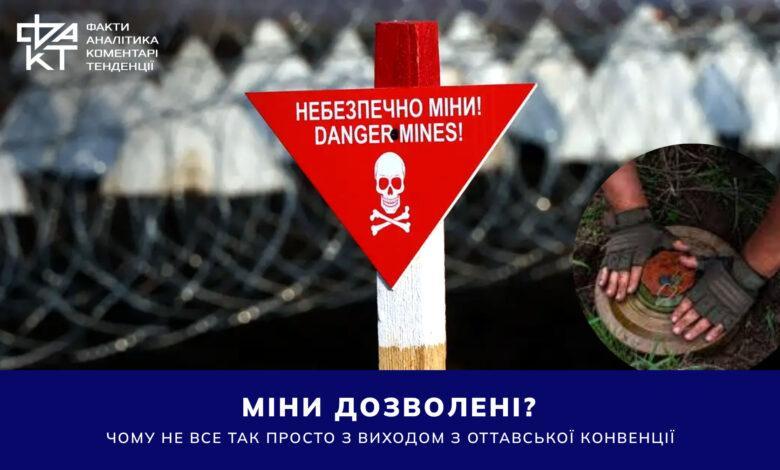
Ukraine officially stated on the intention to withdraw from the Ottawa Convention – an international treaty prohibiting the use, production, stockpiling and transfer of anti-personnel mines. This decision became another example of the revision of humanitarian obligations in response to the rapid deterioration of the security situation in Europe caused by Russia’s full-scale aggression. But Ukraine is not the first: in the last year about Entrance Poland, Lithuania, Latvia, Estonia, and earlier – Finland, declared their withdrawal from the Convention. Why is this process gaining momentum right now? And what does this mean for international humanitarian law?
What is the Ottawa Convention?
Adopted in 1997 with the active participation of humanitarian organizations, Ottawa Convention became a symbol of the era after the Cold War – a period when the world believed in the possibility of “humanizing” armed conflicts. The treaty prohibits participating countries not only from using anti-personnel mines, but also obliges them to destroy existing stockpiles and clear mined areas. At the time of its passage, it was considered a major achievement: a target-independent gun restriction violates the principle of distinction and kills civilians years after the war.
Legal exit mechanism: not treason, but the right
However, the Convention provided for the possibility of denunciation from the very beginning. Article 20 allows a member state to withdraw from the treaty by giving appropriate notice and explaining the reasons. However, the exit does not enter into force while the state is in an active phase of armed conflict. Therefore, legally, even after the presidential decree, Ukraine remains a party to the treaty until the end of the war with Russia.
Between defense and humanitarian norms: the motivation of neighboring countries
The decision to withdraw from the Convention of the countries of the Eastern flank of NATO is explained in the same way: in a confrontation with an aggressor who disregards any norms, they cannot remain “bound” by obligations that reduce defense capability.
Anti-personnel mines are not only a means of inflicting casualties, but also a tool for deterring and slowing down the enemy’s advance. In modern warfare, minefields are used as part of a complex defense system, allowing critical time to be gained for regrouping or retaliating. As the Polish Minister of Defense noted: “We cannot afford to be in a straitjacket that prevents us from protecting the Motherland.”
The case of Ukraine: a legal and tactical dilemma
Ukraine signed the Ottawa Convention in 1999 and ratified it in 2005, at a time when the risk of a full-scale invasion seemed remote. Today, Russia, a state that has never acceded to the Convention, actively uses landmines against both the military and civilians.
In addition, the occupation of part of the territories, in particular the warehouses with mines, made it technically impossible to fully fulfill the obligation to destroy the stockpiles. Although Ukraine declares compliance with the Convention, in practice cases of the use of anti-personnel mines have been recorded, in particular delivered USA with self-neutralization. This puts Kyiv in a difficult situation – between legal responsibility and military expediency.
Criticism and support: what do international actors say?
Human rights organizations, including Human Rights Watch and the International Committee of the Red Cross, criticized the mass withdrawal from the Convention, calling it a “dangerous precedent” and a “violation of the spirit of humanitarian law.” However, a number of countries, in particular, the USA or China, have never been its participants, and new security challenges force states to review established approaches.
At the same time, countries like the Marshall Islands – without regular armed forces and under the protection of the US – are joining the Convention, which only emphasizes its ambiguity and dependence on a specific security context.
Convention and modern war: conflict of ideals and realities
The idea of gradual “humanization” of war remains important. However, as Ukrainian Defense Minister Umerov rightly noted in the “Voluntary Report on the Implementation of International Humanitarian Law”, war is “the last test for norms adopted in peacetime.” Changing realities, new types of threats, the need for rapid adaptation – all this forces us to review not only the technical aspects of waging war, but also the understanding of humanitarian limitations.
War as a test of international law
Ukraine’s withdrawal from the Ottawa Convention is not a betrayal of humanitarian law, but rather a manifestation of its flexibility and adaptability. Between the hope for peaceful regulation and the need for self-defense is the chasm into which every country faces the threat of invasion. This is not an easy choice, but a conscious one. In the modern world, the law of war is not a set of abstract principles, but a system that must withstand the toughest tests. And sometimes – to change under their pressure.
Conflict of Laws: What Withdrawal from the Ottawa Convention Means in Wartime
Despite loud political slogans about withdrawing from the Ottawa Convention, some key legal restrictions make this move much less urgent than it might seem at first glance. According to Article 20(2) of the Convention, a state party may not withdraw from the treaty during an armed conflict. Even after a formal notification of withdrawal, the Convention remains in force for another six months, and only on the condition that the state concerned does not take part in hostilities.
Let’s quote the Convention: “If a participating state takes part in an armed conflict, withdrawal from the Convention does not enter into force until such conflict ceases.” (para. 20(2), text Conventions).
This provision was specifically included in the Convention to prevent the abuse of the norms of humanitarian law at a time when it is most convenient for a state to renounce its obligations, that is, in wartime. That is why, even if Ukraine officially announces its intention to denounce the treaty, it remains legally bound by its norms until the actual cessation of hostilities.
The legal irreversibility of this principle is confirmed by numerous international comments. For example, Professor Stuart Casey-Maslen in his work “The Anti-Personnel Mine Ban Convention: A Commentary” explains that:
“Despite the simplified requirement to provide a reason for withdrawal, the very fact of waging war freezes the denunciation process. This is a fundamental safeguard designed to prevent states from situationally withdrawing under the pressure of combat losses.”(Casey-Maslen, 2019, p. 372).
It was also repeatedly emphasized in the official documents of the participating countries, in particular at the annual meetings of the parties to the Convention. In particular, in 2023, the then president of the conference, German Ambassador Thomas Goebel, stated:
“No state can legally withdraw from the Convention while it is in a state of war. This is a cornerstone of the reliability of our humanitarian regime.” (21st Meeting of States Parties to the APMBC, Geneva, Dec. 2023, official shorthand report).
Conclusion: frozen rejection
Thus, in conditions of war with Russia, Ukraine can initiate the process of withdrawing from the Ottawa Convention, but this process is legally blocked until the end of the conflict. Such a construction not only complicates the adoption of practical decisions, but also forces the state to balance between the needs of the front and humanitarian obligations, which still have formal force.
This is a vivid example of how international law, written in a relatively peaceful era, faces the challenges of a new type of war, in which defensive necessity increasingly collides with norms adopted in the wake of idealism in the 1990s.
Regional response to the threat
In 2025, a new security consensus finally took shape in Europe: deterring Russia is more important than maintaining the restrictions that seemed to have no alternative in peacetime. On March 18, Estonia, Latvia, Lithuania and Poland simultaneously announced their intention to withdraw from the Ottawa Convention, an international agreement that prohibits the use of anti-personnel mines. Already on April 1, the president of Finland made a similar statement.
These steps became not only a legal gesture, but also a political signal aimed at Moscow. For the first time in almost three decades of the existence of the convention, European countries publicly admit that a universal ban on a certain type of weapons is a luxury that a country on the front line of a geopolitical conflict cannot always afford.
“We must give our defense forces the flexibility and freedom of choice for new weapons systems to strengthen the defense of the Alliance’s vulnerable eastern flank”, this is stated in the joint statement of the defense ministers of Poland, Lithuania, Latvia and Estonia.
The statement was made against the background of active preparations for the deployment of a system of defensive fortifications on the border of Poland with Belarus and Russia – the so-called “Eastern Shield” project. It has been publicly emphasized that withdrawal from the Ottawa Convention does not necessarily mean an immediate return to the practice of using mines, but it does open up the possibility for defense structures to do so if necessary.
It is interesting that Estonia and Latvia directly state that there are no plans to create new stockpiles of anti-personnel mines. Instead, the priority is anti-tank defense, artillery and engineering barriers. Therefore, withdrawal is seen as a preliminary measure, not as a fait accompli of returning to the arsenal of the Cold War era. This shows the desire to maintain a balance between the obligations of international humanitarian law and military flexibility.
It is equally important that the countries of the region demonstrate coordination and solidarity in their actions. If earlier the possibility of withdrawal was discussed separately in each state, then the spring of 2025 marked a joint frontal decision: not only to respond to the threat, but also to formulate a new defense doctrine. For NATO, this is also a signal: the countries on the eastern flank expect more attention, support and understanding of the specifics of their situation.
Against the background of these events, the position of Great Britain, which confirmed its commitment to the Ottawa Convention and the Convention on Cluster Munitions, is indicative. London emphasizes that it will remain committed to a complete ban on these weapons and will continue to support humanitarian demining around the world. This contrast between the positions of the allies does not mean a split, but indicates a difference in real security conditions: for one – a moral norm, for the other – a matter of survival.
The decision to withdraw does not mean an automatic rejection of international humanitarian law. All five countries affirm that they remain committed to the protection of civilians during armed conflict and to the principles of proportionality and distinction. But the very fact that the legal architecture of the post-Holocaust international order is no longer perceived as inviolable indicates the depth of the changes.
On a global scale, these events call into question the universality of the Ottawa Convention. If the leading democratic states of Europe begin to withdraw themselves from it – for reasons of defensive necessity – it can set an example for others. Organizations, in particular Human Rights Watch or the International Campaign to Ban Landmines, are already warning about the danger of a “domino effect”.
However, the reality is this: the closer the state is to the border with Russia, the less it can afford abstract pacifism. As the experience of 2025 shows, the balance between ethics and effectiveness in the field of war is not just shaky – it is being restructured every time under the pressure of history.