People’s Deputy Pipa called those who fought against Nazism “scum”: where is the line between decommunization and humiliation of the memory of the heroes of World War II?

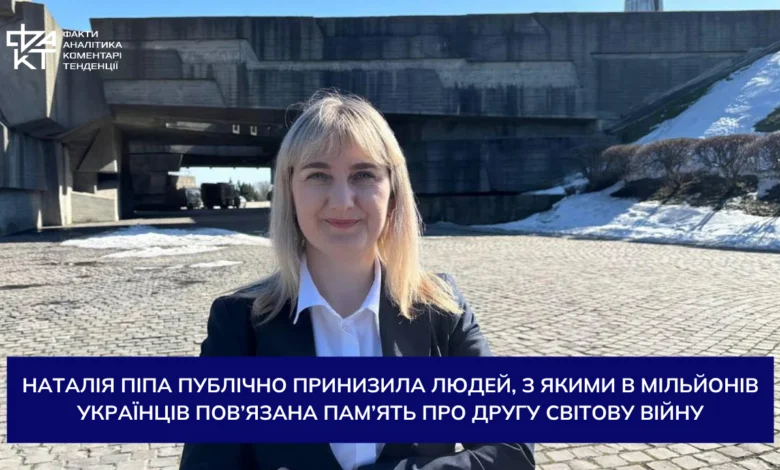
The topic of World War II is one of the most painful in our history, so any cynical statement by a representative of the government causes a wide resonance and indignation among Ukrainians. Now the issue of attitude towards the legacy of World War II, the Soviet past and people who fought against Nazism has once again become acute. This time, the cause of the loud scandal was a post on Facebook by the People’s Deputy from the “Golos party, Natalia Pipa, about the dismantling of the inscription “Their exploits will live forever” from the wall of the National Museum of the History of Ukraine in World War II.
A post that hit family stories: how Ukrainians reacted to the words of People’s Deputy Natalia Pipa
People’s Deputy Natalia Pipa commented on these actions as follows: “Their exploits will not live forever. Scum have no exploits! Finally, this disgusting inscription on the wall of the Museum of the History of World War II has been removed!
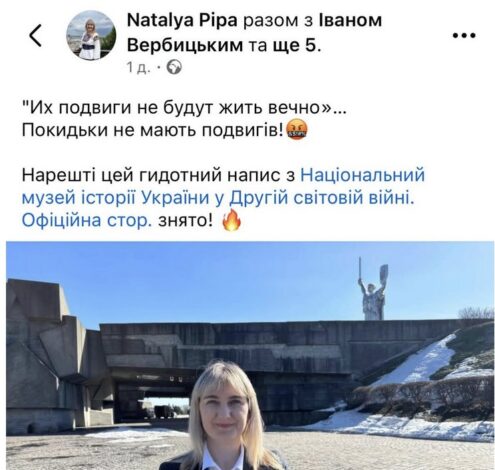
Public outrage arose not because of the fact of dismantling the inscription from the wall of the National Museum of the History of Ukraine in the Second World War, because for a part of society such a step seems quite natural within the framework of derussification and cleansing of public space from Soviet symbols. The sharpest nerve of this story was revealed in something else: a significant number of people read these words as a direct insult to those who fought against Nazism, and therefore as a disrespect for the memory of millions of families for whom World War II is a painful topic.
When the word “scum” is uttered in public by a member of parliament, it strikes at human experience, family memory, and the idea that the feat of a front-line soldier, soldier, medic, liaison officer, or person who survived the occupation cannot be crossed out with a cynical word. For millions of Ukrainian families, the generation of World War II is their fathers, grandfathers, great-grandfathers, grandmothers, and mothers, whose biographies went through the front, bombing, occupation, injuries, service, and the death of relatives and comrades. Because of this, the deputy’s words were perceived as a blow to people who, in their family consciousness, are associated not with the Russian Federation, but with sacrifice and the fight against Nazism.
In this discussion, society clearly showed that it is ready to separate Soviet propaganda from the memory of those who fought against Nazism, and is not ready to accept rhetoric that erases this line or makes it invisible.
After a wave of criticism, Nataliya Pipa deleted her initial post and tried to explain her own position in two subsequent posts, justifying her behavior. In them, she stated that she did not mean people who fought against Nazism, but spoke about the Soviet imperial system and its propaganda markers. To emphasize this point, the deputy published a photo of her grandfather and wrote:
“In this photo is my grandfather: in a Soviet uniform with Soviet buttons. A man who served after World War II. A man who was born in Chernihiv region, near Pryluky. A man who lived a significant part of his life in the Soviet Union, never joined the Communist Party of Ukraine and who knew very well who the “scum” were.
She then clarified her position with these words: “And that is why it is important for me to say clearly: my words from the previous post were taken out of context. We are not talking about people — not about our grandfathers and great-grandfathers who fought against Nazism or served, defending their land. My grandfather is among them, and I respect the contribution of those who defended their land.”
In addition, the deputy emphasized that she meant Soviet propaganda and the political elite of the USSR.
“When this inscription was hung, it was definitely not about our grandfathers, but about the glorification of the empire — the Soviet Union, and about the glorification of the political and military elite, who gave the order to destroy, torture and enslave Ukrainians! This is exclusively about Soviet propaganda slogans in Russian and the system that produced them — the repressive leadership of the USSR (in particular, the NKVD and similar structures), and not about ordinary military personnel.
It is precisely these narratives, not human destinies, that should not remain in the Ukrainian public space. And this is exactly what my parliamentary appeals were about, which, in particular, allowed us to remove this inscription.
“Scum” are those who occupied Ukraine at the beginning of the 20th century. And those from whom we were liberated in 1991. Their grandchildren and great-grandchildren today give orders to destroy us and skillfully use “complex topics” to quarrel us among ourselves. Those because of whom we hid and are hiding our relatives and friends. Those because of whom we do not sleep at night. Those because of whom they do not sleep, sit in shelters and our children cannot study normally,” – wrote Pipa.
At the end, she added: “I am very sorry that someone, without analyzing my activities, appeals and previous posts, took my words out of context. And I apologize if these words hurt anyone.”
However, even after these explanations, the conflict did not end, because Ukrainians did not accept this excuse. They saw the problem not in the fact that the words were misinterpreted, but in the fact that the very form of expression turned out to be unacceptable for a topic of such magnitude and such sensitivity. Even if the author of the post had in mind the Soviet state machine, her phrase sounded in a way that destroyed the line between criticism of an imperial symbol and humiliation of the memory of those whose personal war history is not reduced to state propaganda.
Who do Ukrainians elect and what narratives do elected officials put forward
People’s Deputy Natalia Pipa came to big politics not from the parliamentary environment or from many years of civil service, but from public activism, volunteering and local politics in Lviv. She was born on October 12, 1983 in Lviv, studied at Lviv Specialized General Education School No. 8 with in-depth study of the German language. In 1997, at the age of thirteen, she became a member of the Plast and began volunteering.
In 2000-2004, Pipa was a member of the international youth organization AIESEC, which is criticized for resembling a sect with its specific internal culture (songs, dances “roll calls”, specific slang), which may seem too fanatical or to an outside observer
From 2004 to 2013, Pipa worked as an insurance broker at the limited liability company “Insurance Broker “Expert”. Her political activity began in her hometown: in 2015, she became a member of the Ukrainian Galician Party, and later headed its Lviv city branch. In the early parliamentary elections on July 21, 2019, Pipa was elected a people’s deputy from the “Voice” party. At the same time, in the Verkhovna Rada she holds the position of Secretary of the Committee on Education, Science and Innovation, and is also a member of several groups on interparliamentary relations.
As we can see, Pipa has no experience in the field of public administration and politics, and has no relation to education, science and innovation.
When a random user of social networks expresses himself sharply and irresponsibly, it remains a private emotion, even if it is rude and offensive. However, a people’s deputy who represents the state, receives a salary from Ukrainian taxpayers’ funds and participates in the formation of public policy, publishes such a scandalous post, it already sounds completely different. Because we are talking about a public conscious statement of a person endowed with a mandate and political responsibility. In this case, it is important not only what the MP wanted to say, but also how her words were heard by society, which knows all too well the price of war and the memory of the dead.
Her statement is perceived especially sharply due to the scale of Ukraine’s losses in World War II, which does not allow us to speak about this topic frivolously and cynically. According to historians, our country lost from 8 to 10 million people in this war, including military personnel and civilians, which was about a quarter of the republic’s population at that time. That is, every fifth Ukrainian died then. Among the military personnel drafted in the summer of 1941, only 3% survived.
During that war, more than 700 cities and towns were destroyed on the territory of Ukraine, according to some data – from 714 to 720, as well as about 28 thousand villages. About 10 million people were left homeless. The war destroyed more than 40% of Ukraine’s economic potential, turning thousands of enterprises, schools and hospitals into ruins. In addition, during World War II, millions of Ukrainians went through the horrors of the Nazi system of concentration camps and labor camps. In addition to 3 million forcibly deported to work, more than 120 thousand were prisoners of the Auschwitz camp alone, and the total number of victims among civilians and prisoners of war in camps in Ukraine and Europe is estimated at millions.
So, behind these data lies the tragic story of almost every family in which someone did not return from the front, died under bombing, was occupied, survived captivity, lost their home or health.
In this regard, in such a topic, it is extremely undesirable to mix Russian narratives with the memory of specific people, because one cannot draw a line between them. When a politician allows himself harsh offensive formulations that society reads as humiliation of front-line soldiers and veterans, he is not attacking decommunization, but that part of historical memory that is based on the very personal experience of Ukrainian families.
Another painful dimension of this history is related to the fact that the dismantling of Soviet-era monuments continues in Ukraine. In this process, there is an increasing danger of not distinguishing between a monument as a carrier of Soviet symbolism and a monument as a sign of respect for people who died in the war against Nazi Germany, saving our country. Because of this, the question of the fate of such objects cannot be reduced to the mechanical principle of “Soviet means foreign”. Before making a decision to dismantle, relocate or rethink a World War II monument, it is necessary to carefully find out who exactly it was erected for, what historical meaning it had at the time of its appearance, what is an element of state propaganda in it, and what is the memory of the fallen soldiers, medics, underground fighters, and civilians destroyed by the war. Without such a distinction, it is very easy, by removing the symbols of a bygone era, to strike at the memory of those who paid with their lives for the victory over Nazism.
The lack of reaction to the scandal on the part of the speaker of parliament, the leadership of the Holos party, and the people’s deputies was no less revealing in this story. In cases where a people’s deputy publicly touches on one of the most sensitive topics of Ukrainian history in such language, society expects not silence, but a clear position. However, as it turned out, the deputy corps prefers not to intervene, as if this is ordinary informational noise that can be waited out. In fact, such episodes have a much more serious meaning, because in conditions of war, any rhetoric that divides society on the topic of historical memory strikes at the internal stability of the country. And this is already a matter of national security of the state, and it is indicative that Pipa, with her level of understanding of historical processes, will not bear any responsibility for her statements.
At this point, the scandal surrounding the museum inscription has turned into a much broader conversation about the responsibility of public speech. From the average user of social networks, society can expect harshness, emotionality, or boorish behavior. However, the expectations from the people’s deputy are different, because a public figure who shapes political meanings must bear responsibility not only for what she wanted to say, but also for how her words will be read in the country.
The memory of World War II cannot be pushed aside as an inconvenient fragment of the past, because it is part of our history, written in the blood of grandfathers and great-grandfathers. When politicians with impunity allow themselves to cynically reshape the attitude towards the heroes of the previous generation, suggesting that society look at them with contempt, sooner or later the heroes of today’s war may also see such an attitude towards themselves.
The scandal surrounding Natalia Pipa’s post showed that Ukrainian society clearly feels where decommunization ends and insults and contempt for people begin. And until this line is clearly outlined by politicians, calmly and without harsh political formulations, each new attempt to rethink our past risks turning into not a cleansing of memory, but a new split in society around it.