
Police training at the training ground: why the Minister of Internal Affairs’ plans could be a dangerous mistake

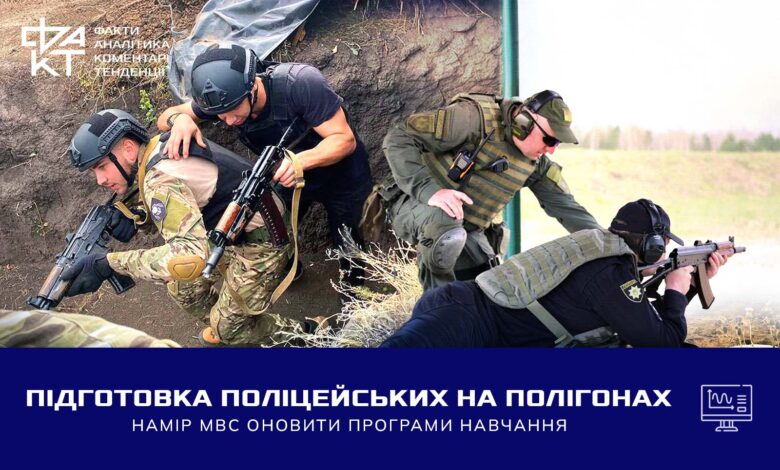
The shooting in Kyiv was a real verdict on the Ministry of Internal Affairs system, exposing a whole range of weaknesses that had been accumulating for a long time – from the unprofessionalism of the leadership and the low level of training of police officers for actions in an emergency situation to the lack of crime prevention and control by the permitting system. After the tragedy, the Minister of Internal Affairs finally took up the issue of better training of law enforcement officers at training grounds with the help of combat instructors. However, behind this reaction lies a deeper problem than the lack of shooting or tactical training.
Ukrainian police officers work in a country where a grenade, a machine gun or live ammunition may appear during a routine call, but their service takes place among civilians, where a mistake is measured in human life and criminal liability. Combat experience can strengthen individual skills, but it cannot replace a police school that teaches you to see the difference between a threat, panic and everyday aggression. The most pressing question is whether the system has enough of its own professionals capable of teaching young law enforcement officers to act quickly and legally.
How the minister plans to train police officers at training grounds after the shooting in Kyiv
After the shooting in Kyiv on April 18, Interior Minister Ihor Klymenko announced his intention to change police training, update training programs, and review the procedure for responding to situations where law enforcement officers may encounter weapons or explosives. According to the minister, police officers must be ready to act in conditions where even a normal call can escalate into a dangerous incident involving a grenade, ammunition, or firearm.
The Ministry of Internal Affairs plans to organize regular patrol training at training grounds, where law enforcement officers will practice behavior in stressful situations, tactics for using weapons, and responding to a sudden threat. During the long war, Klymenko has just now stated that training needs to be strengthened and modernized, since previous approaches must correspond to the real risks of wartime. Special attention is planned to be paid to tactics in situations where citizens may have weapons, ammunition or explosives on their person.
Patrol police units are to be the first to switch to this training format, after which the Ministry of Internal Affairs plans to extend the new approaches to district police stations. Training locations have already been identified, and the selection of additional instructors begins this week. It is planned to involve instructors from the special forces of the National Police, combat units of the National Guard and the State Border Service in training police officers. A separate role in the training may be given to military personnel and veterans who have combat experience and are able to transfer practical skills of working under threat. Klymenko also demands that the positions of deputies for service training in the units be occupied by people with combat experience. The Ministry of Internal Affairs plans to offer service in the police combat training system to war veterans who will be able to teach after demobilization.
The minister placed special emphasis on the psychological readiness of law enforcement officers, since, according to him, resilience in a dangerous situation is formed through practical training alongside experienced instructors. A police officer must be able to act under pressure, maintain control during an explosion, gunfire, or a sudden attack, and perform their duties without panic.
According to Klymenko, a significant part of the personnel has already undergone rotations in consolidated units and served for several months in more difficult conditions. The Ministry of Internal Affairs considers such experience as an important part of preparation for work in communities where the amount of weapons and ammunition creates additional risks for patrols.
Klymenko has already conveyed his proposals to the Deputy Head of the National Police, Oleksandr Fatsevich, who is temporarily assigned the duties of the Head of the Patrol Police Department. Further changes should cover training, personnel appointments in the field of service training and practical readiness of patrols for dangerous challenges.
Combat experience will not replace police training: what is the error in Klymenko’s approach
Ihor Klymenko’s decision to involve police instructors from the National Guard and the State Border Service in training seems, although belated, quite understandable against the background of the war, a large number of weapons in circulation among the population and real risks for patrols. However, there is a dangerous shift in emphasis in such an approach. Police officers really need to be taught to work with weapons, explosives, sudden aggression and stress, but the combat experience of a military instructor cannot automatically become the basis for training a law enforcement officer who works among civilians every day.
At the front, a person operates in an environment where there is a clearly defined enemy, a clear line of danger, different rules for using weapons, and a completely different level of acceptable risk. However, in civilian life, a police officer finds himself in a crowd, a yard, a driveway, a store, on the road, or in an apartment, where there may be children, random passersby, frightened witnesses, and people who do not understand what is happening.
In a combat situation, the main task is often to eliminate the threat, while in police work, the decision must take into account the legality, safety of bystanders, and the subsequent criminal-legal assessment of each action. A police officer must not only shoot accurately, but also understand when he has the right to draw his weapon, how to maintain control of the space, and how not to turn a dangerous challenge into a tragedy for random people. This is further complicated by the fact that the current legislation provides for punishment of police officers for the use of weapons in many cases, which is accompanied by a lengthy investigation, reports with explanations of their actions, so law enforcement officers prefer not to use them.
Instructors with combat experience are able to provide high-quality training in the handling of weapons, movement under threat, basic tactics, work under stress and survival during shelling. These skills are really important for police officers, especially in a country where a grenade or an automatic machine gun can appear during a domestic conflict, a car stop or a call for hooliganism. At the same time, such training does not form the main thing for the police – the automatic ability to act legally, restrained and accurately in a civilian environment, where every second of decision is combined with personal responsibility. Therefore, a police officer should be trained by someone who has experience in law enforcement and understands the legal limits of using weapons not on the battlefield, but among civilians.
The model proposed by the minister may be appropriate for training assault units, where military experience is a basic condition for survival and task completion. For the police, such a scheme requires different approaches, because after several months in the frontline zone, a law enforcement officer returns to public places, where instead of an enemy, he may face a drunk driver, a mentally unstable person, a domestic abuser, or a teenager with a dummy weapon.
The biggest risk is that combat reflexes, useful on the front, may work too harshly in public places. If a police officer is used to evaluating a sharp movement as a combat threat, and an explosion or shot as a signal for an immediate fire response, then a mistake may cost the life not of the enemy, but of a random person. After that, the responsibility will no longer lie with the training system, which gave the wrong emphasis, but with a specific police officer, for whom one shot may end in arrest, conviction, and a broken career.
For the police, scenarios that simulate real challenges in a public environment are critically important: a car stop with an armed driver, a conflict in an apartment, an aggressive crowd, a suspicious object in a public place, a wounded civilian next to an attacker, a dark entrance or a yard with random witnesses. Without such training, the training ground will turn into an exercise in shooting and tactics, although the real problem lies in the ability of a police officer to combine force, law and self-control.
So, Ihor Klymenko correctly raises the question of strengthening police training, but dangerously simplifies the approaches to it when he places the key bet on combat experience as a universal quality criterion. The police need a mixed model in which professional police instructors conduct basic training, and military specialists strengthen individual modules, where their experience is truly irreplaceable.
How other countries distinguish between combat experience and law enforcement training
The experience of other countries shows that tactical training for police officers has long become a separate professional system, where shooting, working in buildings, responding to an armed attacker, stopping a car, evacuating the wounded and negotiating are practiced through urban environment scenarios. A law enforcement officer is prepared for a situation in which civilians are next to the threat, every movement can be caught on video, and every use of weapons is evaluated after the incident by investigators, prosecutors, the court and society.
In the UK, law enforcement officers are trained according to police standards, where much attention is paid to decision-making, risk assessment, communication and the legality of the use of force. The British model does not reduce training to teaching an officer to shoot better, because for the police it is important to do something else: to recognize and warn of a threat in time, isolate a dangerous person, reduce the risk to bystanders and use weapons only within the limits of official necessity.
In the USA, despite the large number of weapons among the population and frequent training in the event of an active attacker, basic training of law enforcement officers is conducted by police academies, federal training centers and certified instructors from the law enforcement system. They can involve people with military experience, especially in the topics of tactics, survival, fire medicine or response to mass shootings, but the police training course is still built around the civilian environment, legal grounds, de-escalation and responsibility for each shot. In addition, in the USA there is a flip side of excessive militarization: after high-profile cases of the use of force, disputes have been going on there for many years because the police sometimes begin to behave like soldiers on operations, although they work among citizens.
France has an interesting feature, which is a two-tier system of law enforcement agencies, where the National Police and the National Gendarmerie, which have military status, work in parallel, reporting to the Ministry of the Interior. However, this does not mean that a patrol police officer is automatically trained according to the logic of an army unit. French police structures have their own training centers, their own instructors and their own system of training for interventions in an urban environment. Even special units that respond to terrorist attacks or hostage-taking operate within the framework of police logic: with negotiators, medical support, perimeter control, targeted use of force and constant consideration of the presence of civilians.
In Germany, the separation of military and police functions is even stricter. The Federal Police has its own academy, and the participation of the army in internal situations is allowed only under strict rules and in limited cases. There is an important principle in the German system: the military can help the state in times of emergency, but they do not turn the training of an ordinary police officer into a copy of combat training. For Ukraine, this experience is important because even countries with powerful law enforcement agencies do not mix military skills with patrol work in the city.
In New Zealand, where ordinary police have long worked without constantly carrying firearms, for the most dangerous incidents there are armed response teams from among the police. They are trained for situations with armed offenders, but the key remains the police logic: surround, restrain, communicate, protect bystanders and use weapons only when other options have been exhausted. This model clearly shows that even in the case of a serious threat, the police should not automatically switch to assault group mode.
Israel is often cited as an example of a country where the police work alongside a constant threat of terrorist attacks, a large number of armed people and a society in which military service is a familiar stage of biography for a significant part of citizens. At first glance, such a model could confirm the logic of Igor Klymenko: if the country is living in conditions of war, law enforcement officers need to be trained more rigorously, more practically and closer to combat conditions. However, the Israeli experience shows otherwise: military experience is used in the police system there, but it does not replace its professional logic.
In Israel, there is a National Police Academy in the Beit Shemesh area, which acts as a central training ground for the police and law enforcement agencies. This is an important detail, because even in a country with constant security tension, the training of law enforcement officers is not carried out in the army model, where combat endurance becomes the main criterion. The police officer there is trained to work in an environment where a potential attacker may be surrounded by passersby, drivers, bus passengers, hostages, children, or random people who have found themselves in a dangerous place without any connection to the attack.
A separate role in Israel is played by the Magav border police, which is militarized in nature and performs tasks at the intersection of public safety, border protection, counterterrorism, and work in high-tension zones. It is often confused with the army due to its uniform, weapons, specific tasks, and the fact that a significant part of the personnel serves through the conscription system. But the fundamental difference lies in subordination: Magav belongs to the police, not the army, so combat skills there are built into the law enforcement framework, where the operation takes place among civilians and must end not just with the neutralization of the threat, but with control of the territory, detention, preservation of evidence and minimization of harm to outsiders.
This boundary is even more clearly visible in the example of YAMAM – an Israeli special anti-terrorist unit, which is part of the police and border police system. People with extensive combat experience are selected there, often after serving in combat units. However, after selection, they undergo police counter-terrorism training, confined to hostage situations, urban development, pinpoint assault, sniper work, negotiation support, interaction with intelligence and medical evacuation. This approach shows that Israel does not mechanically transfer front-line logic to the street, but reworks combat experience for a law enforcement task, where excessive force can disrupt an operation just as dangerously as indecision.
For Ukraine, this example is important because of an important detail: in Israel, military experience is concentrated where close combat skills, counter-terrorism response, assault, work with explosive threats, and actions in high-risk areas are really needed. At the same time, an ordinary police officer does not turn into an infantryman after several months of front-line training, because his daily work remains work with people, transport, domestic conflicts, mass events, suspicious objects and situations where a threat may appear suddenly, but the response must still be legal and proportionate.
This is the main difference from the plans announced by the Minister of Interior. Israel is building a system so that the militarized elements remain within the police architecture: academy, border police, special forces, selection, scenario training, a clear distinction between ordinary patrol and a unit for an extreme threat. Klymenko’s idea of mass transfer of police officers to the frontline zone and the broad involvement of instructors from combat structures risks shifting training towards frontline tactics and psychology.
The lesson of Israel for Ukraine boils down to the fact that combat experience is useful only when it is subordinated to the police profession, and not placed above it. Ukrainian patrol officers need training grounds, stress scenarios, weapons, working with grenades, training in dark entrances, cars, apartments and crowds, but all this training should lead not to a front-line reflex, but to actions in public places, where every second of danger does not cancel the law and responsibility.
Military instructors in other countries are also involved in training police officers, but mostly on a spot basis: for explosives training, counter-terrorism exercises, medicine in dangerous conditions, working with complex weapons or joint training of special forces. However, the difference with Igor Klymenko’s plans lies in the scale and emphasis of police training. In many systems, military experience is an auxiliary element that is built into the police program, while in the plans of the Minister of Internal Affairs of Ukraine it risks becoming the main criterion for the quality of training, personnel appointments and psychological stability.
Klymenko’s plans can only be useful if combat instructors strengthen individual units, and the center of the system remains with people who know the work of the patrol from the inside. After training at the training ground, police officers should return to civilians, so their training should not cultivate a front-line reflex, but a professional ability to act quickly, not to lose control and not to turn the response to crimes and offenses into a tragedy for others.
However, in this situation there is another acute problem that the leadership of the Ministry of Internal Affairs prefers to keep quiet about. There are almost no enough experienced professionals left in the police who are able to train young law enforcement officers. The system lost some of these people long ago due to personnel purges, a formal attitude to experience, internal conflicts, low motivation and the managerial habit of replacing professional school with illogical orders from above. This has created a vacuum: they want to attract military instructors to places where the state should first rely on a strong police tradition, mentorship, and authority of people who have worked in the system for years. Without restoring this professional core, any modernization will be reduced to only training grounds, shootings, and high-profile personnel decisions, although the true quality of the police service involves not only the ability to hold and use weapons, but also experience, discipline, legal culture, and the ability to make the right decisions in a stressful situation.


