Hungary’s budget austerity versus Ukraine’s multi-million-dollar spending: two polar approaches to financing and discipline of parliamentarians

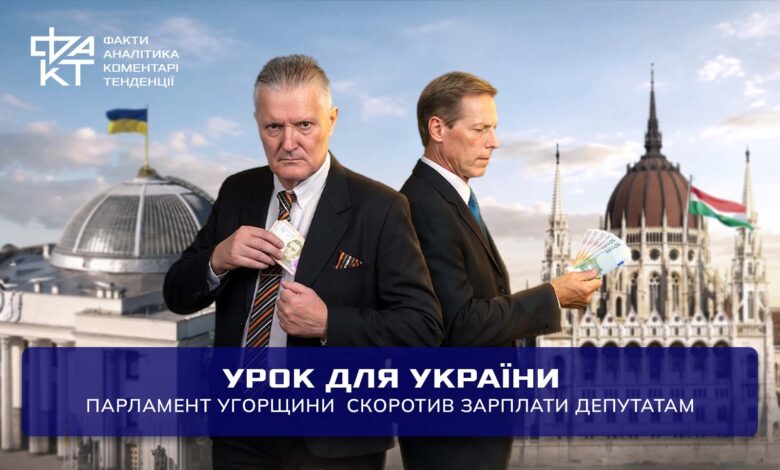
While the Hungarian National Assembly has unanimously reduced the salaries and privileges of its deputies, Ukrainian MPs under the dome of the Verkhovna Rada are confidently increasing their own earnings, which has created a sharp and telling contrast. In Ukraine, which has been waging a grueling war for a long time, the financial appetite of parliamentarians is only growing, although a quarter of the meeting hall has remained empty for years. The problem is that the budget fund spends millions on providing for people, some of whom openly skip work or have even fled abroad. A comparative analysis of these two opposing approaches reveals the unpleasant truth about the real price and quality of work of Ukrainian legislators.
Minus 40% to deputy salaries: how the new Hungarian government took on the privileges of politicians
The Hungarian National Assembly has made a decision that a few years ago might have seemed unlikely even for a country with sharp political discussions. The parliament supported the bill of the ruling party “Tysa”, which provides for a significant reduction in the salaries of deputies, a decrease in state support for parliamentary factions and a revision of the system of political privileges. The document received the support of 189 deputies, and a significant fact was that not a single vote “against” or “abstain” was recorded in the meeting hall. That is, the National Assembly of the country demonstrated a rare, almost phenomenal unanimity, supporting large-scale cuts in spending on the political elite.
The adopted innovations were a logical continuation of the pre-election promises of the leader of the “Tysa” party, Peter Magyar, who after coming to power headed the government and declared an uncompromising fight against waste. The new head of the cabinet made it clear to society that the former era of uncontrolled dispersion of budget resources is over, and representatives of the legislative branch of government and leaders of party factions must demonstrate to voters true understanding and solidarity in difficult times. At the same time, changes to the relevant law on parliament hit politicians directly on the wallets, removing a thick layer of financial privileges from them.
According to the rules that were in force before the adoption of the bill, the salary of members of parliament exceeded the average salary in the country by 3 times. After the new law comes into force, the salaries of deputies will be higher than the average salary in the country by only 1.8 times. If previously legislators received 2,182,488 forints (equivalent to approximately $ 5,300), now they will be content with the amount of 1,309,493 forints (about $ 3,200). Both figures reflect accruals before taxes are paid.
So, the MP’s base salary will be reduced by 40% immediately, and the financial restrictions will come into effect next month. The tough measures affected not only ordinary members of the legislature, as the Prime Minister, Speaker and heads of parliamentary committees were also subject to income cuts. In addition, the National Assembly significantly reduced the amount of additional parliamentary benefits and compensation: office rental costs were reduced by 52%, and housing compensation in Budapest by 31%. In addition, the payroll of MPs’ assistants was cut by 30%. MPs were also deprived of compensation for mobile phone expenses, and MPs elected from constituencies in the capital are no longer reimbursed for fuel expenses.
At the same time, a separate important lever of influence on the discipline of deputies in Hungary is the clearly prescribed rules of punishment for absenteeism from plenary sessions or committee meetings in the National Assembly of Hungary, which provide for strict disciplinary and financial penalties. If a deputy misses more than 1/3 of the votes at plenary sessions without a good reason, his special official remuneration is proportionally reduced. In the case of chronic absenteeism from parliamentary committee meetings during one regular session, when the absence of more than 1/3 of the meetings is recorded, not only is the allowance automatically reduced, but also the deputy’s unconditional exclusion from the committee and removal from work in it.
Péter Magyar’s main goal is to uncompromisingly fight against embezzlement and eliminate the consequences of long-standing systemic corruption. Experts cite figures according to which the abuses during the 16 years of former Prime Minister Viktor Orbán’s rule cost the state 186 billion euros. The current Prime Minister also plans to reduce the salaries of city mayors, but this intention has already caused serious resistance on the ground.
Such total savings are due to the fact that Hungary, as of 2026, is in a state of deep transformation and economic stabilization after a long period of stagnation. The country is not a prosperous one, having a number of acute socio-economic problems and signs of crisis, but it has now embarked on a course for reform and recovery. In the spring of 2026, the country held parliamentary elections, in which the Tisza party, led by Peter Magyar, won, removing long-time Prime Minister Viktor Orbán from power. The new government is focused on overcoming the legacy of the previous regime, eradicating corruption, and restarting relations with Western partners.
The country’s economy is now showing the first signs of recovery after several years of near-zero growth. Real GDP growth is projected to be around 1.6%-1.8% in 2026. This growth is supported by domestic consumption and the services sector, although industry and exports remain vulnerable. Inflation has slowed significantly and stabilized at just over 3%, and real wages have started to rise, boosting the purchasing power of the population. The state inherited a large budget deficit, projected at 6.2%, as well as a high level of public debt, which has prompted the government to initiate austerity measures and structural reforms.
Million-dollar budgets under an empty dome: how the payments of Ukrainian MPs grew against the backdrop of chronic absenteeism and desertion
Unlike Hungary, where the new government began its term with demonstrative salary cuts and the abolition of benefits, the Ukrainian parliament demonstrates completely different financial and disciplinary trends. Despite the fact that Ukraine is waging a grueling war, MPs are not going to reduce their payments, but on the contrary, they maintain a stable course for increasing expenditures on their own support. As of 2026, the net official salary of a member of parliament ranges from 33,280 to 39,936 hryvnias, but the real salary, together with numerous mandatory allowances for work intensity and length of service, averages 50,000 – 55,000 hryvnias per month.
It should be noted that in addition to salaries, Ukrainian MPs receive a significant list of personal allowances and bonuses, including additional payments for leadership positions in committees or factions, academic degrees, honorary titles such as Honored Lawyer, work with classified information, and annual health care allowance. This is also supplemented by direct non-taxable compensation, in particular 19,800–20,000 hryvnias per month for renting housing or a hotel room in Kyiv for those who live more than 30 kilometers from the capital, and fixed amounts to cover transportation costs within Ukraine.
In addition, the state separately allocates large budgets for official activities, where in addition to the aforementioned 199,000 hryvnias for the activities of constituencies, there is a fund for the remuneration of assistants, which on average amounts to about 1.6 million hryvnias per year (over 130 thousand hryvnias per month) per MP, which allows for the maintenance of up to 31 assistants. Together with the right to use the Verkhovna Rada’s car fleet, free medical care in institutions like Feofania, and fully paid trips abroad, the total financing of one deputy’s activities costs the state budget more than 350,000–380,000 hryvnias per month.
In December 2025, during the adoption of the state budget for 2026, the deputies tripled the so-called deputy powers fund. In general, the first in this chronology was the stage of decline, which fell on February 2022, when, at the beginning of a full-scale invasion, the deputies reduced their payments. Then, under the pressure of critical circumstances, they canceled all bonuses and allowances, leaving only salaries for themselves, as a result of which their real salary fell to 22,000–25,000 hryvnias. However, this period of austerity lasted for several months, giving way to a phase of return and growth that lasted from July 2022 to 2026.
In the summer of 2022, the Verkhovna Rada adopted a resolution that restored all canceled allowances, including the payment for work intensity in the amount of up to 100% of the salary, financing it through internal redistribution of the parliamentary budget. Then, in January 2024 and December 2025, due to the planned increase in the country’s subsistence minimum, to which the salaries of people’s deputies are legally tied, their salaries automatically went up, rising first to 30,280 hryvnias, and then to 33,280 hryvnias for an ordinary parliamentarian.
With such high payments and financial support, the indicators of internal discipline in the parliament remain low. According to monitoring data from the public movement CHESN, about 15% of MPs are completely absent from their workplaces during voting, and more than 30% of votes in the hall fail due to systematic absenteeism, with 13 MPs having a 100% absenteeism rate over the past year.
These chronic absenteeists can be divided into several real groups with specific surnames, where the first group consists of fugitive MPs who left Ukraine during the war and were declared wanted, but legally remain members of parliament due to the lack of a mechanism for deprivation of mandate for absenteeism, without receiving a salary. These include Artem Dmytruk, Andriy Odarchenko, Serhiy Shakhov and Yaroslav Dubnevych.
The second group is formed by those who do not attend sessions for good reasons, as they are in custody in a pre-trial detention center on suspicion of treason or corruption, including Nestor Shufrych, Yevheniy Shevchenko, Oleksandr Dubinsky and Oleksandr Ponomarev. The third group consists of traditional truants within the country, who have been ignoring parliamentary or committee meetings for years. For example, Ihor Palytsia with 100% absenteeism, Anzhelika Labunska, Vadym Stolar, who missed over 95% of the votes, Stepan Ivakhiv and the new figure in the anti-rating Oleg Tarasov.
Oleksandr Kunitsky, who represents the Servant of the People faction, became one of the most striking and resonant examples in the category of fugitive deputies, which clearly illustrates the problem of malicious absenteeism and leaving the country with impunity during the war. The situation surrounding his disappearance developed according to a clear chronology: in September 2024, Kunitsky officially left Ukraine for a week-long foreign trip to the United States for the purpose of interparliamentary cooperation, but he never returned to the country. Further journalistic investigations recorded his movement from the United States to relatives in Israel, and already in the spring of 2026, according to his new tax declaration, the fugitive deputy indicated Canada as his new country of residence, where he uses the apartment of a foreign citizen for free. As of 2026, this legislator has an absolute indicator of 100% absenteeism from Verkhovna Rada meetings, but legally continues to have the status of a people’s representative.
An additional high-profile scandal at the beginning of 2026 was the manifestation of the so-called paper work of truants, when in February some elected representatives, who had not participated in the voting for years, took advantage of a loophole in the legislation and applied for monetary compensation for unused vacations for all 6 years of their term. A vivid example of such cynical conversion was Oleksandr Feldman, who missed about 68% of the votes during the war, but officially received 429,500 hryvnias in vacation compensation. Current legislative norms allowed deputies to convert unused vacation days into large sums of money from the state budget, despite their long actual absence from their workplaces and failure to fulfill direct duties to voters.
Analysis of polar political cases of Hungary and Ukraine clearly demonstrates that internal discipline and financial accountability of the highest echelons of power depend on the presence of real instruments of control and political will within the state. The precedent in Hungary records an attempt to build a new model of relations between society and representatives of power, where the incomes of the political elite are directly tied to the general economic state of the state.
In contrast, Ukrainian parliamentary practice during wartime reveals systemic institutional distortions, when the secrecy of processes allows preserving high property preferences, paying for the fictitious activity of fugitives and ignoring catastrophic attendance rates at meetings. The preservation of such financial loopholes and the absence of effective mechanisms for depriving members of their mandates for malicious failure to fulfill their duties washes away scarce budget funds, and also deepens the value gap between society and its voracious elected officials.