After a long period of mass departures abroad, the movement of Ukrainian citizens across the state border is gradually slowing down. If earlier mobility was chaotic and often dictated by urgency, today it acquires a more stabilized character: the scale of movements decreases, and the difference between departures and returns is reduced. This does not mean a return to the pre-war norm, but it does demonstrate a change of pace. New realities mean new behavior.
Less difference between departure and return
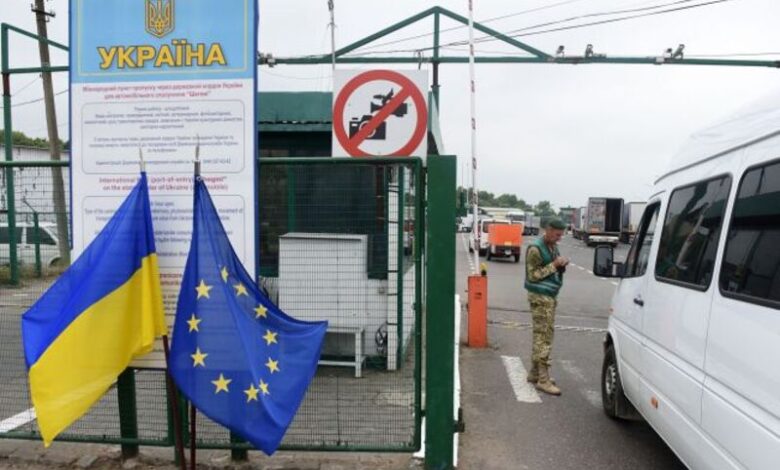
In the first half of 2025, the State Border Service of Ukraine recorded 16.47 million state border crossings are the combined number of exits and entries. Compared to the same period in 2024, the volume of crossings increased by 4%, meaning that border traffic remained high overall. However, there are significant changes in the traffic structure: 85% of all crossings (ie 14.08 million cases) are the movement of Ukrainian citizens. The rest belong to foreigners, diplomats, workers of humanitarian organizations and other persons.
From January to June 2025, 7.17 million citizens left Ukraine, and 6.92 million returned. The difference between these indicators is 250 thousand people. For comparison: during the same period in 2024, this difference was 60% greater — at that time, 404,000 more people left Ukraine than returned.
Thus, the total volume of movement remains the same, but the balance of departures—that is, the number of those who leave the country without returning—is reduced. This indicates a gradual decrease in the rate of population outflow. At the same time, the numbers remain significant. During the entire period of the full-scale war, more than 3 million citizens left Ukraine and did not return.
Peak in summer, dip in winter
The data of the State Border and Border Service for six months show seasonal fluctuations. On average, Ukrainians cross the border 2.35 million times every month. The lowest indicator was recorded in February — 1.78 million crossings, the highest — in June — 3.13 million. These dynamics correspond to a typical seasonal pattern: June, July and August are traditionally the peak months, accounting for a third of all annual crossings.
During the summer months, temporary movements become more active – for vacations, family visits, temporary return to solve household or documentary matters. But these trips often do not mean a final return, they are of a short-term nature.
What remains outside the statistics
The published data covers only official crossings of the state border. Cases of departure through temporarily occupied territories, illegal routes, in particular through the Tisza River, are not included in the statistics. This creates a certain “gray zone”, which makes it impossible to completely accurately account for all movements. However, even within the framework of official monitoring, clear trends can be traced.
The narrowing of the difference between departures and returns can have several reasons. First, depletion of resources — financial, physical, and psychological — reduces the possibility of multiple relocations. Ukrainian refugees who have settled in Poland, Germany, the Czech Republic, Italy, Spain, or the Baltic countries rarely return home “with a check”. Someone cannot leave the child, someone is afraid of another escalation, someone has lost their home, and someone has settled into a new life.
Secondly, the adaptation of Ukrainians abroad: many of those who left earlier have already integrated into the life of their host countries, and therefore move less. Many families remain separated: men in Ukraine, women and children abroad. But even this model is gradually changing: some families finally move to the EU, others, on the contrary, decide to return, but slowly and cautiously. There is currently no clear trend.
Thirdly, the expectation of a quick return is decreasing among part of the population, which affects travel plans — both to and from Ukraine.
On the other hand, a decrease in the flow of new refugees may indicate a relative stabilization of the situation at the front or worsening conditions for relocation to new countries: rising prices, limited access to social support, legal barriers.
Consequences of reduced mobility
The reduction in border traffic affects several sectors. First, the load on checkpoints, volunteer centers, airports, and train stations is reduced — the infrastructure is “resting” after two stressful years. But on the other hand, revenues of border services, customs authorities, and carriers are falling. A decrease in transportation volumes means a decrease in profits for airlines, bus operators, taxi services, and hotels near the border.
Secondly, reintegration is slowing down. Those who wanted to return, but procrastinate, postpone their return indefinitely. It becomes more difficult for the government to estimate how many people actually plan to return, and how to shape social and infrastructure policies for future demand. In some communities, there is already a noticeable shortage of students, consumers, and taxpayers — reintegration is happening more slowly than optimists expected.
What will happen next?
Possible development scenarios depend on external factors: armistice, peace agreement, intensification of hostilities, new waves of mobilization or changes in the policy of host countries. If the EU cuts support or restricts the rights of refugees, some people will be forced to return. If, on the other hand, the long-term stay programs work, the scale of repatriation will decrease.
Currently, the main task is not to lose contact with the diaspora, which is no longer temporary. Policy making must take into account that the “border” is no longer just a physical line on a map. It is a line between two lives, and the more time passes, the more difficult it is to return to what is left on the other side.
So, despite the fact that the total number of border crossings remains high, the structure of mobility of Ukrainians is changing. The rate of permanent population outflow is decreasing, and the ratio between those leaving and those returning is equalizing. At the same time, about 3 million Ukrainians who left the country since the start of the full-scale invasion have never returned.
The current situation is a challenge not only for demography, but also for the economy, logistics, infrastructure, return policy and social planning in Ukraine. Border statistics are gradually turning from a crisis indicator into a marker of long-term processes. The effectiveness of state policy in the coming years depends on how these trends are understood.