Registration and discharge in Germany: what you need to do to avoid problems and fines

For many Ukrainians who ended up in Germany because of the war, adapting to life abroad is accompanied by both everyday challenges and the need to follow strict local rules. One of the first steps after arrival is the registration of the place of residence. And if at first glance this procedure may seem formal, in the German system it is of fundamental importance: without registration, it is impossible to get access to most government and financial services, and non-compliance with the requirements threatens with fines of up to 50,000 euros.
Registration rules in Germany
Residence in Germany is not a bureaucratic convention, but a mandatory legal act. The law requires anyone who changes their place of residence to contact the relevant municipal authority and register a new address. The set period is 14 days from the moment of actual moving into the apartment. Even for those staying in temporary accommodation such as hostels or refugee hotels, registration is a necessary procedure.
The document issued after registration – Anmeldebescheinigung – opens access to bank accounts, health insurance, schooling for children, registration of the right of residence and integration courses. In some cases, even the purchase of a SIM card requires the presentation of a registration document. Without it, a stay in Germany turns into a stay “outside the system”, with all the consequences: from the impossibility of receiving medical care to complications with the legalization of status.
The legal basis for registering a place of residence in Germany is found in §17 of the Federal Registration Act (Bundesmelgedesetz). Violation of the requirements for timely registration may be grounds for imposing an administrative fine — from 10 to 1,000 euros. In practice, especially for displaced persons, local authorities often show leniency in the event of a slight delay, but this does not eliminate the possibility of formal prosecution.
More serious consequences occur in the case of fictitious registration, when a person registers at an address where he does not actually live. In this case, a fine of up to 50,000 euros is provided, and in some cases even criminal prosecution. For Germany, the veracity of registration data is a fundamental value, because the systems of taxation, social assistance, insurance and migration registration are based on them.
The registration process itself requires some preparation. Persons moving into new accommodation must contact the Einwohnermeldeamt or Bürgeramt in their community. In large cities – Berlin, Munich, Cologne, Hamburg – registration is done through online platforms, and you often have to wait several weeks for free places. In smaller cities, the procedure is simpler, but everywhere it is mandatory to submit a complete package of documents: a passport or residence permit, a housing rental agreement and a special confirmation from the landlord (Wohnungsgeberbestätigung). Registration cannot be completed without the latter.
An important nuance is that if housing is provided by relatives or acquaintances, the right to use it must be documented. Mere verbal confirmation or agreement is not considered sufficient.
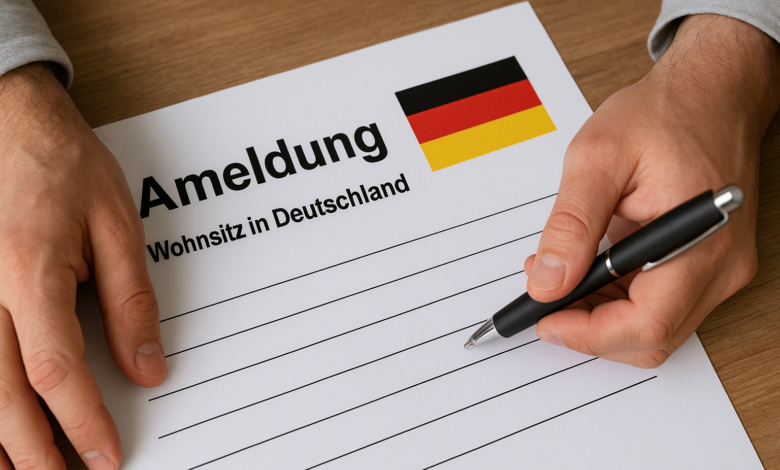
When registering, it is also necessary to fill in the Anmeldeformular questionnaire, which indicates basic personal data, previous address of residence (if any), religion (or “Keine” marking, which means refusal to pay church tax) and information about other family members moving in with the applicant.
Peculiarities of the registration procedure for Ukrainian refugees
In the case of accommodation in refugee centers, registration issues are usually dealt with by the institution’s administration. Citizens themselves only need to provide documents and provide up-to-date data. It should be noted that regulations may vary from camp to camp, so be sure to check local requirements immediately after check-in, especially if you are moving from a LEA to a more stable location.
In general, in Germany, the obligation to register applies to all foreigners, with the exception of some categories. Only persons staying in the country for a short time for tourist or guest purposes (up to 90 days without the intention of employment), as well as diplomats and officials equivalent to them, are exempted from the need to register. However, even in the case of a short-term stay, if there is a need to open a bank account or obtain a work permit, registration becomes mandatory much earlier than after three months.
Registration issues in Germany are dealt with by specialized institutions – Einwohnermeldeamt or Bürgeramt. Depending on the city or community, it can be a separate registration service or the administration of citizens’ affairs. In large cities, there are often separate departments that work exclusively with refugees – the Flüchtlingsbürgeramt. If there are no such institutions, the application is made through the regular Bürgeramt. It is worth making an appointment in advance, especially in large settlements, where the demand for the service remains high.
What documents are required to register a place of residence
To register a place of residence, Ukrainian refugees need to prepare a standard set of documents:
- foreign passport or residence permit;
- written confirmation from the landlord (Wohnungsgeberbestätigung);
- housing rental agreement (although it does not replace mandatory confirmation from the landlord);
- documents confirming family relationships, if family members are registered together (birth, marriage certificates).
In some cases, an apostille may be required on documents issued outside of Germany. If registration is carried out through a proxy, you need to issue the appropriate power of attorney and submit it together with the passports of the proxy and the representative.
How and where to submit documents
Regarding registration methods, personal visit remains the most common practice. Most offices require prior appointment through online platforms. In small cities, registration is possible on a first-come, first-served basis. In some regions, the possibility of registration via the Internet or even via e-mail is being tested, but these methods are limited and not widespread for foreigners.
When visiting the administrative office in person, it is important to arrive on time with a complete package of documents. Persons who do not have a sufficient level of German can be accompanied by an interpreter – it can be an acquaintance or a relative, without mandatory certification.
After successful registration, a confirmation called Meldebestätigung is issued. The document contains basic information: name, surname, date of birth and registered address. In some communities, additional information is added, including the date of registration and residence status.
How much does registration cost?
As for the cost of registration, in most communities the initial registration of the place of residence is free. However, some municipalities may charge an administrative fee of between 10 and 30 euros. Separately, it is worth taking into account possible costs for copies of documents or transport.
Thus, for Ukrainian refugees in Germany, compliance with the registration rules is not only a legal obligation, but also an important condition for integration into society: timely registration opens the way to all basic services and protects against potential problems with the authorities.
Change of residence and deregistration
In Germany, every change of residence requires citizens and residents to strictly follow the registration and, in certain cases, deregistration procedures. For Ukrainian citizens staying in the country, these rules are mandatory, regardless of the status of stay.
The procedure for official deregistration is known as Abmeldung einer Wohnung. It is required only in two cases: if the person leaves Germany for a long or permanent period, or if he gives up the residence for which he was previously registered.
If a person changes his address within Germany, he does not need to be additionally removed from the register at his old place of residence. New registration at a new address automatically cancels the previous registration. However, this does not relieve the obligation to timely conduct Anmeldung einer Wohnung — registration at the new place of residence.
Regarding the timing of the Abmeldung procedure: it can be carried out no earlier than one week before the actual departure and no later than two weeks after it. In some cases, it is possible to issue a statement by mail or e-mail. However, the exact conditions and possible ways of submitting documents should be clarified directly with the registration body where the person was registered.
Registration of several places of residence at the same time
A separate issue is the possibility of registering several places of residence at the same time. In Germany it is allowed. If a person has several addresses, it is necessary to clearly define which of them will be the main (Hauptwohnung) and which will be additional (Nebenwohnung). When registering again, it is always necessary to indicate whether the status of the old place of residence changes. The procedure remains standard, through the same authorities – Einwohnermeldeamt or Bürgeramt. In some cases, it may be necessary to fill out an additional form, which is usually communicated during the personal visit.
Thus, deregistration and correct registration when changing residence is an integral part of staying in Germany. Failure to comply with these procedures can lead to administrative difficulties, in particular when resolving issues of migration status or receiving social services. Improper registration or lack of registration creates risks not only of fines. It also means the loss of the right to medical care, complications when applying for social support, the impossibility of formal employment and the lack of basic guarantees in case of legal disputes.
So, even under the conditions of martial law in Ukraine and the challenges of mass migration, Germany insists on following clear legal procedures.