Remembrance Day for Children Who Died in War: A Date That Doesn’t Stop Adults from Putting an End to It

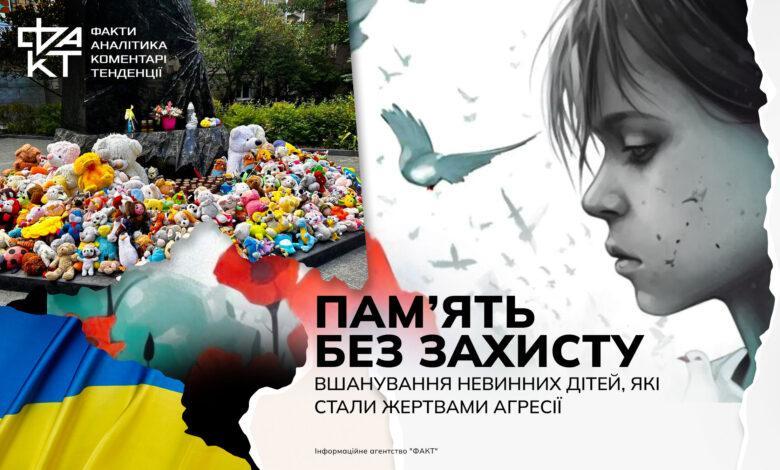
Children do not fight, do not make decisions, do not draw maps of fronts and do not command armies, but they are the ones who pay the highest price for foreign aggression. June 4 is the International Day of Innocent Children Victims of Aggression. On this same day, Ukraine honors the memory of children who died as a result of the armed aggression of the Russian Federation. Even in the 21st century, childhood can end not because of an illness or an accident, but because of rockets and drones. When children die, the words about “the price of peace” or “the loss of civilization” sound empty. Every year, adults mention them in reports, read out numbers at conferences, and put up lamps. However, at the same time, the siren is working again, explosions are heard, and once again only words are heard from those who can change the situation that they are “doing their best”. How many more children’s lives will the war manage to cut short, while adults are guided by the desire for power, resources or ideology?
A world where childhood is not guaranteed
The International Day of Innocent Children Victims of Aggression was launched by the United Nations in 1982 as a reaction to military actions against children in Palestine. Since then, its importance has gone far beyond the boundaries of a specific region. Today is not just a day of remembrance, but an anatomy of a global failure. The civilized world has once again failed to protect those who have no weapons, do not participate in conflicts and do not understand why their home has turned into a ruin. In 2024, child safety in conflict zones reached a new low.
According to UNICEF, this year has become one of the most difficult for minors around the world. At the end of 2023, 47 million children were forced to leave their homes due to armed conflicts, terrorist attacks and violence. But the world does not learn from mistakes. Every day the situation only worsens. New hotspots flare up in Haiti, Lebanon, Myanmar, Sudan, and Palestine. The number of children who are forced to live in shelters, camps or on the street without access to education, medical care, and psychological support is increasing.
Although children make up only a third of the world’s population, they make up 40% of refugees and more than 48% of internally displaced people. This situation points to the terrible fact that children have become one of the main victims of war. But despite everything, their lives become the background for headlines, not the object of systemic protection. Economic instability becomes an additional factor in the risk zone. In countries where hostilities continue, more than 34% of the population lives below the poverty line. This is more than three times more than in states without armed conflicts. For children, this also means a lack of food, water, and medicine. They lose not only their home, but also the basic conditions for survival.
If earlier humanitarian missions could operate more or less effectively, now due to the dynamism and multi-vector nature of conflicts, it is impossible to even assess the full scale of the disaster. UNICEF acknowledges that data for 2024 is fragmentary and the situation remains opaque in many regions. However, even the available statistics show that the war cripples the lives of thousands of children every year, and this process is not slowing down.
The Ukrainian dimension of the tragedy
In Ukraine, the Day of Commemoration of Children Who Died as a result of the Armed Aggression of the Russian Federation was established by the Decree of the President of Ukraine dated June 1, 2021 No. 266/2021 in order to honor the memory of the dead Ukrainian children who became victims of Russian aggression starting in 2014, and especially after the full-scale invasion in 2022.
As of June 2025, for data Office of the Prosecutor General, 631 children died, another 1,971 children were injured. The most affected fixed:
- in the Donetsk region, where 645 children were affected by constant shelling and fighting;
- in the Kharkiv region — 492 children;
- in Dnipropetrovsk region — 242 children;
- in the Kherson region — 208 children;
- in Zaporizhzhia region — 181 children;
- in Kyiv region — 146 children;
- in Sumy region — 139 children;
- in the Mykolaiv region — 119 children.
These regions have turned into areas where childhood has long ceased to be safe. So, for example, according to the official ones data According to the Kharkiv Regional Prosecutor’s Office, as of June 4, 2025, 96 children died in the region as a result of Russian aggression. The detailed data provided by the press service of the prosecutor’s office shows the structure of casualties: among the dead, 48 children were under the age of 14, and another 48 were between the ages of 14 and 18. Thus, almost half are children of preschool and elementary school age, who had no chance to escape during the attacks, even with the presence of shelters.
In total, 56 boys and 40 girls became victims of hostilities in Kharkiv Oblast. The recorded circumstances of their death are rocket attacks, artillery strikes, building collapses, being near targets that were hit by fire, or injuries due to flying debris.
In addition to the dead, the prosecutor’s office reports on 526 children who were injured or experienced an acute reaction to stress. Of them, 331 are boys, 195 are girls. Most of the victims were also among the younger ones: 255 children were under the age of 14, another 271 were between the ages of 14 and 18. These are wounds of varying degrees of severity: shrapnel, explosive, craniocerebral injuries, as well as psychological disorders that have the character of war trauma.
One of the latest examples is the terrible event that happened on June 3, when at nine in the morning Russian troops fired at the city of Sumy. One of the shells hit a vehicle moving through the central streets. Others hit the outskirts of the city. According to preliminary data, three people died. More than twenty were wounded, among them were children. These events are proof that today’s childhood in Ukraine can end in a minibus, a bedroom or in the yard. Without warning, without reason, and without choice.
However, despite the large amount of data, the authorities today still cannot name the exact number of dead children. This was announced by Volodymyr Zelenskyi on June 4. And not because someone forgot to calculate these numbers, but because part of the country is still under Russian occupation without access, without communication, without accounting. We do not know exactly how many children were killed in Mariupol, where mass graves, hastily dug, without names, stand among the ruins. We don’t know how many missing people are actually already dead, just not found yet. Unfortunately, this is not a temporary gap in statistics, but evidence of how deep the catastrophe is when even the state cannot count its own children. All these losses will still have to be established – document by document, grave by grave, and then silence will turn into evidence.
Unlearned lessons of tragic history
The history of wars tells us more than just battles, strategies and generals. She also reminds us of the silence after the shelling, which is broken by a child’s cry, of the toys left in the bombed-out houses and of the schools that became targets, and the children’s bodies that did not survive another “liberation operation”. Children have always been on the front line with a complete lack of choice.
Historians estimate that more than 1.5 million children of Jewish origin died in World War II. In Vietnam, tens of thousands of children became victims of bombings, and even more were born with developmental defects after the use of chemical weapons. In Rwanda in 1994, children became both victims and forced witnesses of the genocide that consumed about 300,000 minors. In Iraq, Syria, and Afghanistan, entire generations grew up not with books, but with mine fragments in their yards.
Even the UN, created as a response to 20th century war crimes, publishes reports every year that rarely make the headlines. And they contain data on the abduction, torture, rape and murder of children in conflict zones. Figures that are repeated from year to year. And every time, for some reason, they become a new “unforeseen” shock for the whole world.
By establishing commemorative dates, the world claims to remember. But we see that the lessons of history too often remain just empty words on paper. When after every war we find ourselves again in a situation where children become part of the statistics, it means only one thing: the previous lesson has been forgotten or ignored.
Of course, you can build museums, erect monuments and proclaim days of mourning, but the real lesson is not in the stone and not in the calendar. It is so that the child no longer wakes up at night from explosions. To not learn to hide better than to read. And so that a murdered child does not become a “collateral loss” for any government. History has already paid a bitter price for indifference. Its next page may be different, if the heads of states start to act, and not just count losses.
In today’s world, children increasingly become witnesses or victims of armed conflicts that they did not start and cannot stop. They are not interested in geopolitical schedules, control of ports, borders or transit. But they are the first to feel how destructive war can be. In many regions, today’s children live not with bedtime stories, but with stories of escape, loss, injury, resettlement, or survival.
International organizations such as UNICEF, the UN, and the Red Cross are working in crisis regions: evacuating children, providing humanitarian corridors, creating shelters, deploying mobile schools and medical teams. Some donor countries provide financial assistance, accept refugees, and launch educational programs for children who have lost the opportunity to study at home. But these actions, despite their importance, are often late or insufficient. Many programs crash due to lack of security guarantees. In some cases, humanitarian convoys are targeted or simply not allowed through the front lines. In international politics, conflict prevention sounds like an intention, but not an obligation. And children’s destinies, unfortunately, are not always included in the priority plans of negotiations.
Many conventions, protocols and resolutions have been implemented in recent decades. The world legally recognizes the protection of children during war as a mandatory standard. But more and more often we are witnessing how entire regions live in reality, where these norms simply do not work. International law provides for responsibility, but the mechanisms for its implementation are too slow. By the time it comes to court or sanctions, years have already passed, and dozens, if not hundreds, of children have already suffered.
The world has been talking about children in conflicts for more than 40 years, since the creation of the International Day of Innocent Victims of Aggression. However, so far this day looks more like a symbolic gesture than a real plan of action. With each new war, the situation does not improve, but only becomes more complicated. And while adults fight, change cards, negotiate and sign agreements, children continue to die and get injured with no guarantee of a happy future.