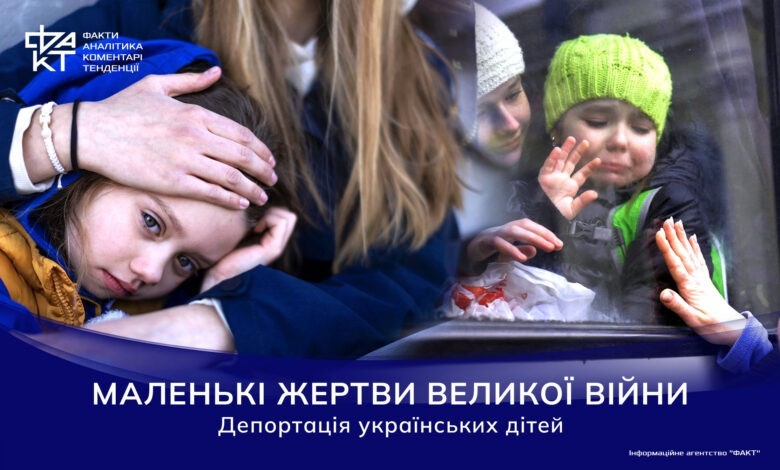
War is always pain and destruction. But when children become the target, it becomes something much darker, almost inhuman. Russia not only bombs Ukrainian cities or wipes villages off the face of the earth, it reaches out to the most valuable thing – children. Their abduction, forced removal from their native land, attempts to erase their memory and rewrite their identity are not spontaneous acts, but a purposeful strategy to destroy the Ukrainian nation, which politicians and the international community declare. Children are forced to forget their name, language, and culture. They end up in adoptive families, who instead of love offer them a new “truth”: their country is a fiction, their parents are traitors, and their place now here in Russia is “saviors.”
Victims of military arbitrariness in numbers
For data “Children of War” platform, as of today, the Russian Federation has deported at least 19,546 Ukrainian children, although total estimates may reach 16,000-300,000. These figures take into account both officially confirmed cases and alleged victims of forced removal. Deportation of children began as early as 2014, but increased significantly with the start of a full-scale invasion in 2022. Of these children, it was possible to return only 388, in the future the number seems to have frozen and this emphasizes the scale of the problem and the complexity of its solution.
As of November 2024 from 15 more children were saved in the temporarily occupied territories of Donetsk, Zaporizhzhia and Kherson regions, as informs Mykola Kuleba, founder of the “Save Ukraine” charitable organization. In general, the organization “Bring Kids Back UA” was able to save 538 children, returning them to the territory of Ukraine.
According to the statements of non-governmental organizations, Russia systematically changes data about children – their names, surnames and even citizenship, trying to fully assimilate them. Such actions are classified as a crime of genocide aimed at the destruction of Ukrainian identity. At the same time, the return of even one child is already a small victory, because each rescued person is a symbol of resistance to this terrible crime.
Ukrainian and international organizations continue to work on the identification and return of children. The problem remains global, because without increased international support it will be difficult to stop this systematic kidnapping. The Children of War platform and other initiatives are key tools in the fight for the rights of deported children.
Russia does not commit its terrible crimes alone. The neighboring country of Belarus helps her in kidnapping Ukrainian children. The report “Stolen Childhood: How the Belarusian Regime Erases the Identity of Ukrainian Children Through Displacement, Re-education and Militarization”, prepared by the ZMINA Center for Human Rights, the Regional Center for Human Rights, the human rights organization “Vyasna” and BelPol, with the support of Freedom House, states that during the period from 2021 to June 2024, 2,219 Ukrainian children were taken to Belarus from the occupied territories of Ukraine to its territory
As Onisia Sinyuk, an analyst at the ZMINA Human Rights Center, noted, this figure continues to increase. Such activities are advertised by Belarus as recreation or rehabilitation programs, but most children end up in a hostile country precisely during the school year, which makes it easier for them to be involved in Belarusian educational programs. It is known that at least 27 children who were initially in Belarusian camps were later transported to camps in Russia. At the same time, it should be noted that Ukraine did not give any consent to the so-called “humanitarian operation”.
The researchers found the existence of 18 re-education camps in Belarus, which are part of a wider network of 67 institutions in Russia and 13 in the occupied territories. Forced re-education and militarization of children take place in these camps, which are accompanied by discriminatory actions by camp administrations. Experts also note that the fact of not only deportation, but also re-education and militarization of children was established. The Russian Federation is trying in every possible way to influence the national identity of Ukrainian children, denying their origin and questioning the existence of Ukraine as a sovereign state. Children are sent to local schools, where education is conducted exclusively in Russian and also with the involvement of a wide range of propaganda materials.
According to experts, in order to militarize Ukrainian children, meetings with military units and youth military organizations were organized. They were taught how to handle weapons and told how to serve honorably and well in the Russian army. In addition, children are constantly subjected to psychological pressure when they are asked provocative and traumatic questions about their experience of living in the occupied territories
It is obvious that the political re-education and militarization of children of a systemic nature is nothing more than a crime against humanity and discriminatory persecution. And the recorded three cases of forced resettlement of Ukrainian orphans from Ukraine to the territory of Belarus for re-education are direct evidence of not just displacement, but forced deportation. By its criminal acts, Belarus has confirmed that it is part of the Russian system of re-education and militarization of Ukrainian children.
In turn, the Russian Federation creates many obstacles for the return of Ukrainian children to Ukraine. Thus, the US State Department responded to Russia’s disregard for international legal obligations by imposing a series of visa restrictions on five Russian officials involved in criminal deportation schemes. But this is not enough. Many children had their identities changed and their origins hidden, were subjected to pro-Russian ideology and militarization, or were adopted by Russian families.
Average 19.5 thousand children listed in the register are orphans, children deprived of parental care, or whose parents are illegally imprisoned in the Russian Federation or are in captivity. Finding these children and returning them is very difficult, and sometimes simply impossible, due to the constant obstacles of the aggressor. Thus, according to Ivan Fedorov, the head of the Zaporizhia Regional Military Administration, the Russian authorities deport Ukrainian children to Chechnya and Kabardino-Balkaria Republic under the guise of a vacation, where their traces are lost forever.
Researchers and law enforcement officers are not only trying to draw attention to this terrible crime, but also calling “support Ukrainian efforts to repatriate children and everyone who has been deported or is at risk of being deported”.
Deportation of children in the historical past
Forced deportation of children during wars is always a wound that never heals. This is not just a crime against people, it is a crime against time, against the future, which is being torn from our hands. Such stories become a ghostly hum that haunts generations.
Let’s start with the Second World War. Then Nazi Germany organized Operation Lebensborn, plucking children from Eastern European countries, particularly Poland, for “Germanization”. German soldiers literally snatched babies from their mothers’ arms, took them away by the thousands, changed their names, erased traces of their origins. Those who did not meet the “Aryan standards” were simply destroyed. Children who were playing in the yard just yesterday suddenly found themselves among strangers, forced to forget their native language and even themselves.
During the Spanish Civil War (1936–1939), thousands of children were evacuated to the USSR and other countries for protection from the war. Although the evacuation often had a humanitarian motivation, many of these children became tools of political propaganda and could not return to their homeland after the war.
The genocide in Rwanda in 1994 resulted in many children being abducted by paramilitary groups. Some were used as soldiers, others were deported to neighboring countries. These deportations were intended to separate families and destroy the ethnic identity of the Tutsi people.
During the ethnic conflicts in Bosnia and Kosovo in the 1990s, children were abducted to force families to flee or for forced adoption. Some were used as hostages for political pressure or human trafficking.
In Iraq and Syria, the ISIS group kidnapped children for use as soldiers, propaganda, or forced assimilation. In such cases as in Iraq, children from Yazidi communities were abducted for forced adoption or sale.
Currently, the full-scale invasion of the Russian Federation in Ukraine has resulted in the removal of thousands of children from the occupied territories. They are told that they are being “saved” from their own parents, from their native country. These children end up in “patriotic” camps, in foster families, where they are forced to call a foreign country “motherland”. It’s not a rescue, it’s a kidnapping — in the physical and emotional sense.
It’s sad to say, but history repeats itself. From Stalin to Hitler, from Hitler to modern dictators, this mechanism works the same way. War devours children, because those who wage it know that if you destroy the roots, the tree will never grow. Forced deportation is an attempt to steal entire generations. As in the 1940s, today there are organizations that find, identify and return kidnapped people.
Sad examples from the past prove that the forced deportation of children always has devastating consequences for their identity, family ties and mental health. This crime, often hidden behind humanitarian rhetoric, requires decisive action by the international community to document, investigate and bring the perpetrators to justice, because every abducted child is a tragedy that goes far beyond the borders of a single family and country. And if the world allows this to continue, we will witness a genocide that does not end with a bullet, but continues in the minds of the stolen generations.