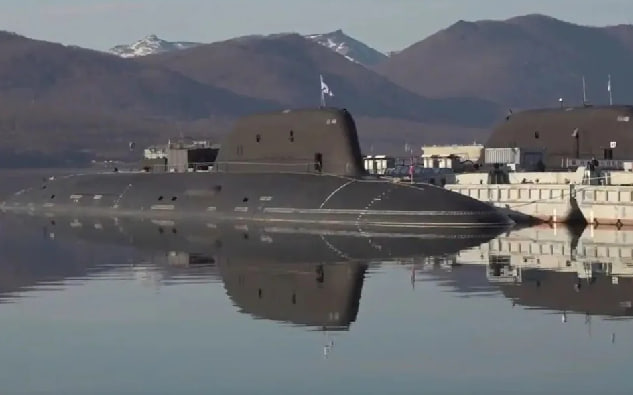
According to satellite images obtained by The Telegraph, the Far Eastern base of nuclear submarines of the Russian Federation suffered damage caused by the tsunami that swept along the Pacific coast of Russia.
The waves caused by the 8.8-magnitude earthquake covered the Rybachy base in Kamchatka, the location of the main nuclear submarines of the Russian Pacific Fleet.
The Umbra Space satellite recorded that a part of one of the piers has shifted from its original position, which may indicate its partial separation from the mooring elements. The submarine was not moored near this site when the waves struck, and experts believe that the damage to the structure is unlikely to have serious military significance.
However, questions remain about the possible wider implications for the base, which was likely hit within the first 15 minutes of the quake. The facility is home to nuclear-powered submarines, including the newest Borei-class ships and the Soviet-made Deltas, which are the closest to the U.S., except for front-line submarines.
The Rybachy base is located in Avachy Bay, approximately 75 miles west of the epicenter of the tremors. The Petropavlovsk-Kamchatsky base is located in the same bay, as well as separate facilities related to missile cargo and shipbuilding. Significant damage is observed in the North Kuril port, which is located almost twice as far from the epicenter as Avachy Bay.
Satellite images show a submarine moored near the pier, which now appears to have been damaged. In both images, the surface vessel is on the west side of the pier. Umbra Space satellites use Synthesized Aperture Radar (SAR) technology, which allows images to be obtained even in the presence of dense cloud cover, which has made it difficult for other surveillance systems to access clear information.
“The pier was tilted at a terrible angle”, Tom Sharp, a retired Royal Navy commander, noted.
According to him, this makes it difficult for ships to maneuver when docking and exiting. He also suggested that there was a tugboat at the end of the deformed section, probably doing initial repair work.