School under armed control: how children in the occupied Kherson region are forced to study in an atmosphere of fear

School life in the occupied territories of the Kherson region is increasingly losing the features of a familiar learning environment in which a child can focus on lessons, communication with teachers and daily rhythm without constant internal tension.
School under armed control
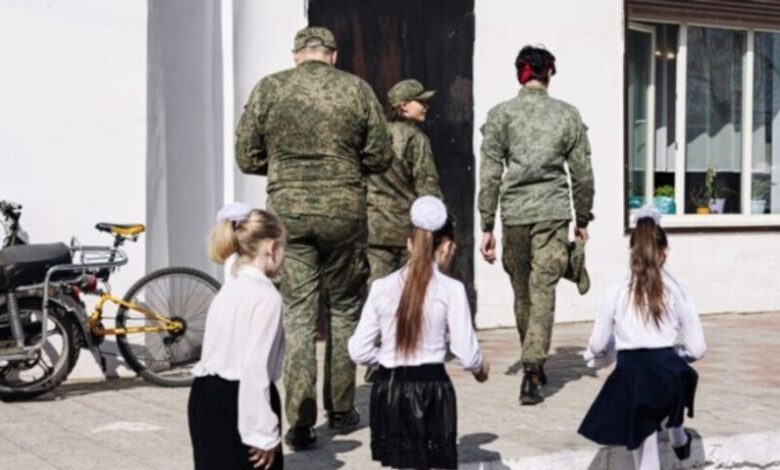
According to the report of the Center for National Resistance, armed Russian military personnel and representatives of the Russian Guard in balaclavas are constantly present in local schools, which is why the educational process takes place under continuous forceful supervision. Against the background of such a situation, even representatives of the occupation system are already forced to admit that children feel anxiety, apathy and increasingly less want to go to school.
The information published by the Center for National Resistance shows a consistent practice in which armed military personnel and Russian Guards are constantly present in schools. We are not talking about external security of the territory, but about the presence inside the school, where people with weapons attend classes and monitor the educational process.
Under such conditions, the school ceases to be a place where a child can feel at least minimal inner freedom. The classroom, the corridor, the teacher’s office and any other part of school life find themselves in a field of forceful control, where weapons and covered faces become part of the everyday background. For children, such an environment cannot be neutral, because it is a daily reminder of threat, coercion and dependence on someone else’s power.
Public recognition of anxiety among students
The occupation administration no longer hides that children in such an environment feel oppressed. In public statements, the so-called “psychologists” admit that schoolchildren feel anxiety, apathy and lose their desire to attend school. Such rhetoric shows that the psychological state of children has deteriorated so noticeably that it has to be explained even in the public sphere.
At the same time, representatives of the occupation authorities are trying to link this state of affairs with the vague “consequences of extraordinary events”, pushing into the background the environment in which education takes place every day. The presence of the military is presented as a security measure, but the very description of the situation indicates a different nature of what is happening in educational institutions.
Despite the public recognition that the psychological state of children is deteriorating, the occupation administration does not change the order that accompanies school life every day. The practice of the presence of armed Russian military and Russian Guards in schools in the occupied Kherson region, according to the Center for National Resistance, continues, due to which the atmosphere of pressure is maintained as a permanent condition for education.
The Center for National Resistance emphasizes:
“The lesson becomes an interrogation. Every word of a child or teacher is recorded. This is not education, but total surveillance of the “unreliable”. The occupiers know that it is their presence that cripples the psyche of children, but they continue to “militarize” classes. They need control, not healthy children.
The result: Apathy and fear instead of knowledge. Children learn not to think, but to be silent and look around. The occupation authorities are killing the future of the region right at the school desk.”
The constant presence of security forces changes not only the emotional state of children, but also the very logic of the school process. Where learning usually involves trust between student and teacher, the opportunity to freely respond, make mistakes, ask questions, and participate in joint work, another model appears – controlled and constrained, with the feeling that every movement, word, or reaction can be noticed by outsiders with weapons.
In this model of school existence, all participants in the process find themselves under pressure. The child is forced to get used to the fact that learning takes place in the presence of armed people, and the teacher works in an environment where the usual professional space no longer belongs to pedagogy. All this creates an atmosphere in which even a regular school day takes on the features of coercion, because everyone’s behavior is regulated not by the internal order of the educational institution, but by external force.
Covered faces, weapons, the appearance of security officers in classes, and the constant demonstration of the presence of state violence destroy the basic sense of security, without which the school environment loses its natural foundation. For a child, school under such circumstances becomes a place where anxiety is entrenched through repetition, through daily experience, and through the inability to escape this atmosphere, even for the duration of lessons.
If armed military personnel and balaclavas are constantly present in the school space, supervising classes and remaining a visible part of everyday learning, such a practice does not mean protecting children from danger, but keeping the entire environment under forceful surveillance.