
State Standard of Primary Education: How the Management Crisis and the Decisions of the Ministry of Education and Science Are Increasingly Destroying Education

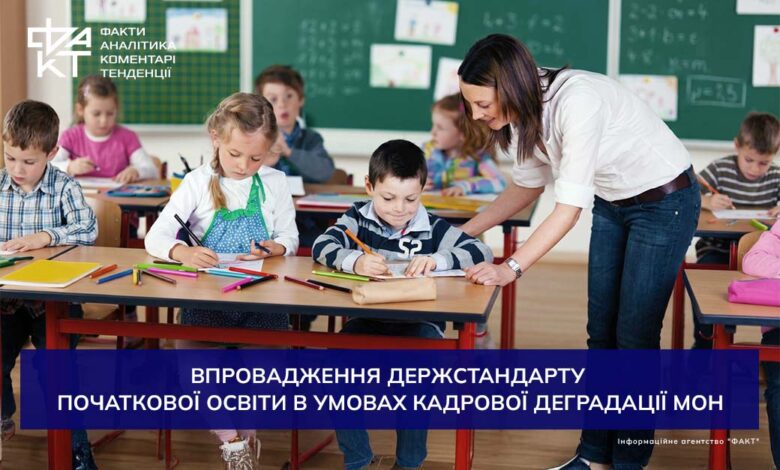
While the parliament is discussing the possible resignation of the Minister of Education and Science, Oksen Lisovyi, the ministry itself has another staff addition, his eighth deputy. However, for some reason, the system, which is overgrown with assistants to the minister, does not demonstrate tangible results for participants in the educational process. Instead of a clear strategy for its development, society is offered ambiguous reforms that are increasingly dragging kindergartens, schools and universities into the abyss. In the professional environment and among parents, one can increasingly hear about the detachment of decisions made by officials from the Ministry of Education and Science from the modern realities in which schools operate. This is what happened with the recently adopted new State Standard of Primary Education, which will come into effect in schools from 2028.
Reform without resources: the new State Standard of Primary Education
Adoption of the new
– 82.3% of 4th grade students passed the basic reading proficiency threshold, i.e. demonstrated the minimum reading skills necessary for further education;
– 17.7% did not pass this threshold, which means that almost every fifth primary school graduate in 2024 had significant difficulties with reading comprehension and basic reading skills.
These data emphasize that although the majority of students achieve the minimum level of reading proficiency, a significant part of the student body still does not have the necessary skills for effective reading. And this should be an important signal for educational policy and support for students both before and during war and post-war conditions of education.
The draft curriculum provides for a so-called free hour, which the school can direct, in particular, to the Ukrainian language. However, this hour belongs to the variable component, the financing of which is entrusted to the communities. In the absence of funds, it may remain unrealized, which has already happened in many regions in recent years.
Reducing the time for language has systemic consequences, since without the formed reading and writing skills, a child will not be able to fully master the content of other subjects in secondary school. The formation of literacy in primary grades is a kind of window of opportunity, which cannot be painlessly compensated for later. Due to the lack of time, part of the educational load is transferred to the family, where the result depends on the financial and educational resources of the parents. In such conditions, access to quality education will increasingly be determined by social status and place of residence, which is confirmed by data from external assessments and international studies.
As we can see, the new Dezhstandart is disconnected from the realities of modern schools; its development should not be superficial, but taking into account its priorities and capabilities.
Symptoms of a management crisis in the Ministry of Education and Science of Ukraine
The activities of the Ministry of Education and Science, as well as its head, Oksen Lisovy, are very often and rightly criticized in Ukrainian society. At the same time, the criticism covers several dimensions at once – from his personal academic reputation to a number of failed systemic management decisions. At the beginning of Lisovy’s appointment, the public outcry was caused by the discovery of plagiarism in his dissertation, which called into question the observance of the principles of academic integrity by the person responsible for the formation of educational policy. It was this episode that became the starting point for harsh criticism, within which direct accusations of incompatibility with the position and undermining trust in the ministry as an institution were made.
Later, the focus of the discussion shifted to his poor management decisions, in particular, the reorganization of higher education institutions. In the professional environment, there were reservations about the opacity of such processes, and the situation around the Uman State Pedagogical University was cited as an example. Such transformations, carried out without sufficient explanation of the logic and criteria, create risks of corruption schemes and undermine the autonomy of universities. Against this background, there were also accusations about possible monopolization in the field of higher education and the preservation of outdated approaches in strategic planning.
A separate block of claims against the minister are financial decisions – comments on the ministry’s reporting on loans from the International Bank for Reconstruction and Development, as well as on the costs of printing textbooks, which were called unfounded. The issue of financial discipline in the educational sphere is particularly sensitive, because every error in documentation or procedure immediately transforms into suspicions about the effectiveness of fund management.
In addition, there is criticism of the quality of the textbooks themselves, with educators and parents repeatedly drawing attention to errors, inaccuracies, and the weak structure of the material, which calls into question the effectiveness of the resources spent.
The ministry’s personnel policy has also come under scrutiny, as individual appointments and structural changes have caused such a sharp reaction that resolutions to dismiss the minister were registered in parliament. Although rumors of his resignation have repeatedly spread throughout 2024–2025, Lisovyi continues to hold office, and the criticism itself often fits into the broader context of talk about a possible “reboot of the government.”
At the same time, the management vertical of the Ministry of Education and Science is expanding, but this is not accompanied by tangible clarity of decisions or a decrease in complaints about the ministry. The number of deputy ministers is increasing so rapidly that the personnel list is beginning to resemble a catalog with constant additions. The Cabinet of Ministers yesterday added Anastasia Sofienko to the seven existing deputies, and now the leadership team looks even more numerous. This is an indicator of a cumbersome administrative apparatus, excessive funding during the war, while simultaneously inefficient activities. It is difficult to get rid of the impression that the focus is not on changing approaches, but on expanding offices, as if the number of officials is capable of compensating for systemic miscalculations.
At the level of the content of educational policy, the most debatable remain new standards and approaches to assessing children’s knowledge. Curriculums are overloaded and do not take into account the educational losses and psychological stress of children who receive education in war conditions.
The combination of these and other factors forms a complex picture in which the personal reputation of the minister, the ministry’s management decisions, financial policy, and the content of the reforms are intertwined. All this creates a situation in which strategic changes occur without due trust from a significant part of the professional community and participants in the educational process, and therefore are perceived not as the development of the system, but as another wave of chaos. As a result, the system gradually loses consistency and manageability, which means the gradual destruction of Ukrainian education.


