
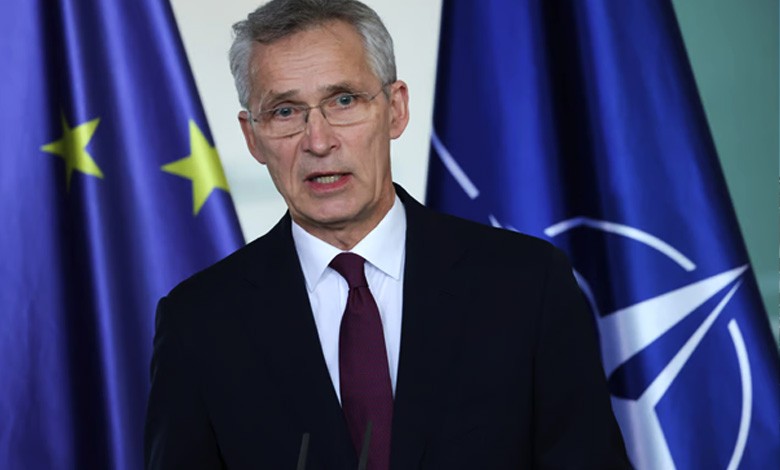
Jens Stoltenberg resigned as NATO Secretary General, making several loud confessions and charting a path for the further development of the Alliance. His farewell interviews were analyzed for quotes by the world media, including the Russian media. Therefore, the emphasis and assessments differ significantly – from thinking about the possibility of Ukraine joining NATO in the presence of occupied territories to pedaling the topic of Zelenskyi’s “bunker stay” in the first days of the war. The former head of NATO took part of the responsibility for the untimely and insufficient armed support of Ukraine. History does not allow a conventional way of thinking. And yet, looking back, Stoltenberg admits mistakes, miscalculations, incorrect assessments and talks about what would have happened if…
In an interview for Financial Times, published on October 4, Stoltenberg noted that Ukraine joining NATO during a war started by Russia would not necessarily mean that the Alliance would automatically become a participant in hostilities. This is due to the fact that security guarantees may not apply to the territories occupied by Russia. Stoltenberg recalled that similar precedents had already taken place in the history of NATO, for example, with the accession of West Germany in 1955, when the Alliance defended only its part without recognizing East Germany.
He also mentioned the example of Japan, whose security guarantees do not extend to the Kuril Islands, which it considers its territory.
We will remind that Japan has bilateral defense agreements with the United States. Stoltenberg points out that these security guarantees do not extend to the disputed Kuril Islands, which are controlled by Russia, although Japan claims them as its territory. So this example illustrates the possibility of limiting the effect of security obligations, similar to how it can be with Ukraine, if it becomes a member of NATO, but part of its territories will be occupied.
The example with Germany that Stoltenberg refers to is the entry of West Germany (Federal Republic of Germany, FRG) into NATO in 1955, when the country was divided into two parts: West Germany, which was supported by Western countries, and East Germany (German Democratic Republic, GDR), which was under Soviet influence.
At the time West Germany joined NATO, it did not control East Germany, but considered it part of its territory. However, NATO’s security guarantees extended only to the territory of West Germany, not including East Germany. This set a certain precedent: NATO defended only that part of the country that its government actually controlled, while not recognizing the division of Germany as permanent and irreversible.
Stoltenberg emphasized that if there is political will, a solution can always be found, but for this it is necessary to determine the line where Article 5 will apply, and this line must be controlled by Ukraine.
We will recall several other examples when NATO extended its security guarantees only to part of the territory of a member state.
Turkey became a member of NATO in 1952. In 1974, it carried out a military invasion of Cyprus after a coup organized by the Greek military. Since then, the island has been divided into two parts: the Republic of Cyprus, which is recognized by the international community as the only legitimate authority, and Northern Cyprus, controlled by Turkey, but recognized only by Turkey. Although Turkey is a member of NATO, Northern Cyprus is not part of the territory covered by the Alliance’s guarantees. This illustrates a situation where NATO’s security guarantees do not extend to disputed or occupied territories.
It is also worth noting that both countries — Greece and Turkey — are NATO members, but have long-standing territorial disputes in the Aegean Sea. Tensions between the two countries over maritime and airspace rights have repeatedly strained relations. Despite their membership in NATO, these disputes remain outside the scope of the Alliance’s guarantees, which tries to maintain neutrality in such matters.
Spain joined NATO in 1982, but its conflict with Britain over sovereignty over Gibraltar remains a complex territorial dispute. Spain does not recognize Gibraltar as part of British territory and does not consider it a controlled area covered by NATO guarantees. This example also demonstrates that the Alliance avoids intervening in territorial disputes between its members, which highlights the limits of collective defense in such situations.
Previously, Jens Stoltenberg repeatedly emphasized that NATO supports Ukraine’s aspirations for membership in the Alliance, but noted that the accession process depends on the fulfillment of certain conditions, including reforms in the country. He also said that membership is possible only after the end of the conflict. Stoltenberg noted that NATO is ready to support Ukraine in its struggle for sovereignty, and that the country has the potential to become part of the Alliance.
In farewell interviews, former NATO chief Jens Stoltenberg lamented the lack of military support given to Ukraine before a full-scale Russian invasion. He said the allies should have provided more weapons to Kyiv earlier to potentially prevent a conflict. Stoltenberg admits that the discussion about the supply of lethal weapons to Ukraine was significant before the start of the invasion.
The former Secretary General of NATO also emphasized the importance of providing security guarantees for Ukraine, calling NATO membership key to stable and lasting peace in Europe. He noted that without a stable Ukraine, stable security in Europe is impossible, and without NATO membership, Ukraine will not have reliable security guarantees. “The doors of NATO are open, and Ukraine will join the Alliance”, Stoltenberg assured.
“I insisted on crossing all those “red lines” established by Putin, and we have already crossed many of them, but he did not take any action. If President Putin decides to escalate the situation by using weapons of mass destruction, he will find an excuse to do so. At this point, we consider it a bluff.”, he noted.
The former head of NATO also called on the allies to create conditions for negotiations with Russia, but stressed that the final decision on negotiations should remain with Ukraine. As an example of a possible compromise, Stoltenberg cited Finland, which lost part of its territory during the Second World War, but received a stable border.
He also lamented the lack of NATO support for Ukraine before the Russian invasion and mentioned the problems with defense financing among the Alliance countries. Stoltenberg emphasized that in order to implement all the promises regarding military support, it will be necessary to allocate significantly more funds than provided for by the current norms.
In his farewell speech, Jens Stoltenberg acknowledged NATO’s mistakes regarding Russia and expressed concern that the allies could make similar mistakes in relations with China. He recalled that during his leadership of the NATO Alliance, it was repeatedly called into question, calling it “disjointed” and “obsolete”. However, according to Stoltenberg, today NATO is stronger and more united than ever, and Ukraine is closer to membership. He stressed that “freedom is more important than free trade” and that the Allies made a mistake considering the purchase of Russian gas as a purely commercial matter. Stoltenberg emphasized that Russia uses energy resources as a means of pressure to prevent support for Ukraine, and warned of similar risks in relations with China, particularly because of Beijing’s control over critical infrastructure and rare earth metals.
On October 1, he was replaced by Mark Rutte as Secretary General. The former Prime Minister of the Netherlands received his new position during a ceremony at NATO headquarters in Brussels. He declared that “there can be no long-term security in Europe without a strong, independent Ukraine” and confirmed that “Ukraine’s rightful place is in NATO.”
Rutte is a long-standing ally of Ukraine, emphasized analyst Armida van Rae, a senior researcher at the Chatham House think tank in London.
“During his premiership in the Netherlands, he actively supported Ukraine. It was he who made the decision to supply Ukraine with F-16 fighters. So he has a lot of support experience.”, – she noted.


