
Teaching children underground: instead of new lyceums, over 200 underground schools were built in Ukraine

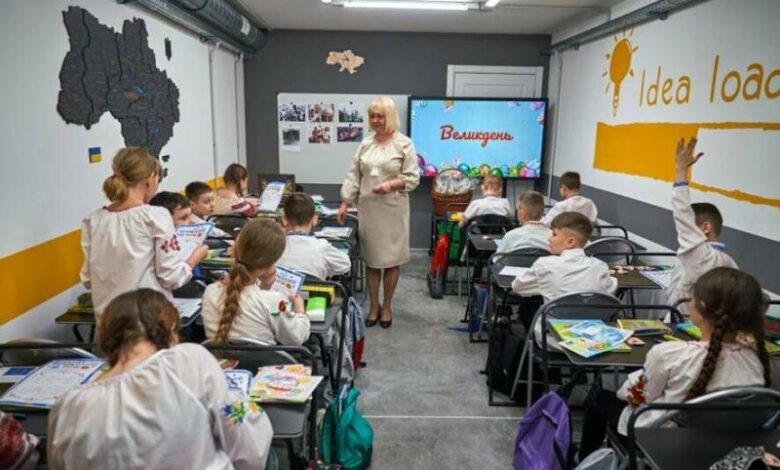
The war has long changed the perception of school space in Ukraine: in frontline and dangerous regions, children are forced to study underground for more than four years, because this is the only way to combine face-to-face education with safety. What was supposed to be a temporary exception has turned into a separate part of the education system, where lessons are held in specially equipped shelters and underground schools. Instead of new lyceums, more than 200 underground schools have already been built in Ukraine, as the war forced the state to change priorities in education.
What the statement of the Minister of Education and Science says
During a conversation about the new architecture of education, the Minister of Education and Science, Oksen Lisovyi admitted a fact that would have been difficult to imagine in peacetime: the state is investing huge funds not in a network of new lyceums, not in the expansion of laboratories, and not in the renovation of high schools as planned before the Great War, but in underground schools, without which in some regions, learning in a live format is simply impossible. According to him, more than two hundred such facilities have already been built in Ukraine, sixty-five more are to appear within the year, and the average cost of one underground school is about 150 million hryvnias.
Behind these figures lies a very rigid wartime logic, in which educational policy begins not with a discussion of profiles, standards or campus architecture, but with the elementary question of whether a child can get to school, sit down at a desk and finish a lesson without air raids, shelling or risk to life. That is why the minister speaks of a forced change in priorities: money that in another reality would have gone to the creation of full-fledged modern lyceums is now being spent on concrete, protective structures, ventilation, autonomous power supply, emergency exits and premises suitable for children to stay underground for a long time.
Why the underground school became part of the education system
The problem is that for a significant part of Ukrainian schoolchildren, distance learning has long ceased to be a temporary solution and has turned into a protracted mode of existence that exhausts children, disrupts the usual school sociability and gradually worsens the quality of education. Where air raids are regularly sounded and the threat of strikes remains constant, a regular school without reliable shelter is not able to operate stably, so returning children to classes without a protected space would mean either constant interruption of lessons or a direct risk that no responsible administration would take.
For this reason, the underground school became part of the educational infrastructure that arose from the need to protect children in an environment where a regular school often turns out to be too vulnerable.
The most acute meaning of the minister’s statement is that the war forced the state to pause part of the strategic plans related to the reform of high schools and transfer resources to where it is necessary to save, not modernize, first. In a peaceful situation, tens of billions of hryvnias could be used for another purpose: to create strong academic lyceums, modern science classrooms, workshops, dormitories, transport accessibility, a new school network, and high-quality conditions for specialized training. In wartime, the same money is forced to perform a much tougher function — to provide the opportunity to study at least in a protected space.
Lisovoi’s words that one underground school costs an average of 150 million hryvnias sound like an explanation of the price of security that education is forced to pay every day. This is not about choosing between a “good” and a “better” option, but about choosing between an underground school and the absence of full-time education at all. In this sense, underground schools cannot be considered a full-fledged replacement for the modernization of education, because they do not cover all the needs of the system, but they are the ones that give children a chance to return from prolonged isolation to the space of a live lesson, where a teacher is present, there is a classroom, the discipline of the school day, and the normal rhythm of childhood is at least partially restored.
What does underground education look like in practice
Underground schools have a different design logic than conventional buildings, since what is important here is not the facade, sports yard or outdoor recreation, but the durability of the structure, the ability to stay inside for a long time, high-quality air, lighting, sanitary conditions, safe entrances and exits and stable organization of the process.
For a child, this space remains a compromise, not a full-fledged norm, because the school day in an underground school always bears the imprint of war. Instead of natural light, there is artificial lighting, instead of wide corridors and a school yard, there is a limited space, instead of a feeling of ordinary life, there is a constant reminder of the danger for which the school had to be lowered underground. However, even in this form, face-to-face or blended learning gives children something that no screen can fully provide: the real presence of other people, live contact with the teacher, the feeling of the class as a community, and a return to the structure of the day, without which the child’s psyche in the conditions of a protracted war experiences additional pressure.
The minister’s statement separately mentioned the figure of 150–180 thousand children who are transferred to blended learning, and it is important not in itself, but because of the meaning behind it. Long-term distance learning, especially in conditions of constant stress, unstable communication, forced relocation, loss of familiar contacts, and fear associated with war, destroys not only academic discipline, but also the usual mechanisms of children’s development, which are associated with live interaction, the rhythm of the team, social ties, and a sense of belonging to the school environment.
Educational reform, which should be associated with openness, new opportunities, professional choice and modern infrastructure, in Ukrainian conditions is forced to go through a wartime reality, where the most necessary objects are not those that expand horizons, but those that provide elementary protection. This is the main paradox: the state continues to talk about a new architecture of education, but this architecture acquires an underground dimension, because without it, any renewal programs would remain beautiful documents with no chance of implementation in dangerous regions.
At the same time, the very appearance of more than two hundred underground schools indicates that the education system has not given up on trying to return children to live learning, even if this requires building spaces that under normal conditions no country would consider a desirable model of a school environment. This is not a story of comfort or a story of an educational breakthrough in the usual sense of the word, but a story of the system’s adaptation to war, which changed the very idea of what school begins with.


