The birth rate in Ukraine has fallen to one of the lowest levels in the world: causes and consequences

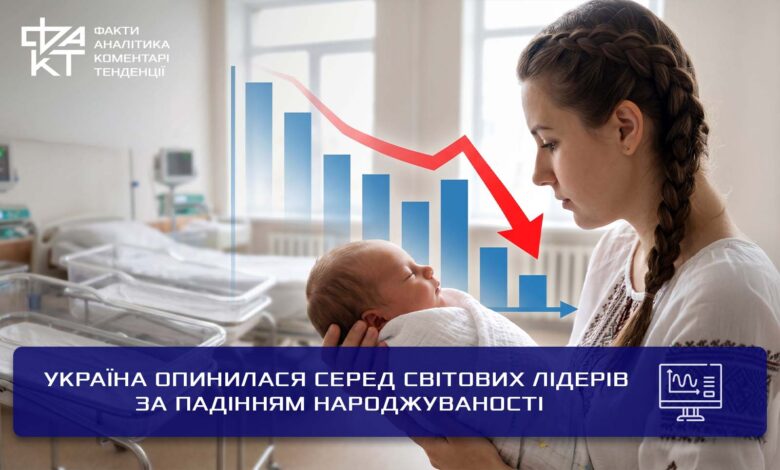
According to the latest UN study, Ukraine has entered the top countries with the lowest birth rate in the world. This is an extremely painful marker that for many families, having a child has become not a dream, but a decision that has to be postponed due to circumstances stronger than desire. Behind this indicator is the reality in which Ukrainians live. During a long war and economic crisis, they calculate risks, postpone plans, leave, increasingly lose stability and increasingly often do not see the conditions in which one can give birth and raise children without fear. The problem is that the low birth rate already shows how narrowed the space for a successful future of our country has become.
Three decades of decline: why Ukraine lost most of its births even before the full-scale war
The latest global UN ranking showed that Ukraine has entered the top countries with the lowest birth rate in the world. At the same time, it recorded a critical figure for our country, according to which today there is about one child per woman in the country. This is more than half the norm, which is needed simply to keep the population from decreasing. According to this indicator, Ukraine has joined the countries with the deepest demographic crisis in the world, finding itself next to China and significantly lagging behind the USA.
However, the situation in Ukraine is much more complicated than the usual decline in birth rates, which is often observed in wealthy countries. In the country, depopulation is catastrophically accelerated by the factors of war: the forced departure of millions of people abroad, losses at the front and a general decline in the population. The country found itself in a situation where a chronic shortage of babies was superimposed on the cruel reality of war, which turns demographic figures from an abstract problem for economists into a very real threat to the future existence of the entire society.
The birth rate in Ukraine ceased to be a purely statistical indicator long before the full-scale war. Over the past three decades, it has become one of the most accurate indicators of how the country has gone through economic crises, social upheavals, migration waves and prolonged uncertainty. If we trace the dynamics from the moment of independence to the present day, it becomes obvious that the current demographic situation did not arise suddenly after the Russian invasion, although it was the war that brought it to a critical point. The decline in birth rates continued for decades, gradually changing the age structure of the population, the scale of labor resources, and the very prospects for the reproduction of society.
At the time of independence, Ukraine was one of the largest European states in terms of population. In 1991, the country had a population of over 51 million, and the number of children born exceeded 630,000 per year. For comparison, in modern Ukraine, even half of this figure seems unattainable. The birth rate at that time still retained the inertia of the Soviet period, when a family with two children remained the social norm, and the demographic structure of the population was much younger. However, already in the first years of independence, this inertia began to rapidly collapse.
The economic collapse of the 1990s turned out to be no less destructive for demography than for industry or the financial system. Falling production, hyperinflation, wage arrears, unemployment, and sharp impoverishment of the population forced millions of people to postpone starting a family or to refuse to have a second or third child. By the middle of the decade, the number of newborns had decreased by almost a quarter. If in 1991 about 630 thousand children were born, then in 1995 – less than 500 thousand. In the early 2000s, the decline became even more noticeable, since in 2001 approximately 376-385 thousand children were born in Ukraine, that is, almost half as many as at the beginning of independence.
Not only the absolute decline in births was particularly significant, but also the change in the total fertility rate. At the beginning of independence, this figure was about 1.8 children per woman, although even then it no longer ensured simple population reproduction, for which a level of about 2.1 is required. By 2001, the coefficient had dropped to 1.1 — one of the lowest rates in the world at that time. In fact, each subsequent generation became numerically smaller than the previous one.
The beginning of the 2000s brought a short period of demographic relief. The Ukrainian economy gradually emerged from the deepest phase of the crisis, incomes of the population increased, and state payments at the birth of a child became more tangible. It was then that statistics began to show positive dynamics for the first time in a long time. In 2010, the number of children born again approached 1.5 million, and in 2012 exceeded 520 thousand. The birth rate rose to about 11 births per 1,000 population, and the total coefficient increased to 1.5 children per woman.
However, even this period did not mean a full-fledged demographic recovery. A significant part of the growth was explained by the fact that the generation of women born in the relatively stable 1980s was just entering the active reproductive age. The demographic structure compensated for the general trend towards population decline for a while. At the same time, fundamental problems did not disappear anywhere, as the level of emigration remained high, the population was rapidly aging, and young people increasingly postponed having children to a later age due to economic instability and lack of housing prospects.
After 2013, the situation began to deteriorate again. The annexation of Crimea, the war in Donbas, the economic downturn, and a new wave of labor migration marked the beginning of another demographic decline. While in 2012, over 1.5 million children were born in Ukraine, in 2015, there were approximately 412,000. By 2021, this figure had fallen to about 273,000 births per year. For a country that had a population of over 50 million at the time of independence, this meant the loss of almost two-thirds of its annual birth rate over three decades.
The full-scale Russian invasion in 2022 turned a protracted demographic crisis into an emergency. The birth rate fell to a historic low, and Ukraine found itself among the countries with the lowest fertility rates in the world. In 2022–2024, the total fertility rate, according to estimates by international demographic organizations, fell below 1 child per woman. This means that even if migration were to completely cease, the country’s population would continue to decline rapidly.
It is worth understanding that the reasons for this decline lie much deeper than the fact of the war itself. Millions of people have left the country, and among the refugees, women of young and middle reproductive age predominate. Some families have been divided between different countries, and many men have been living separately from their families for years due to mobilization or military service. Added to this are constant psychological pressure, danger to life, income instability, and complete uncertainty about the future. Under such conditions, the decision to have a child for many families is postponed indefinitely.
The demographic problem is further complicated by the fact that generations born during the crisis of the 1990s are now entering the reproductive age. They are numerically much smaller than the generation of their parents. Because of this, even a theoretical increase in the birth rate would not have a quick effect, because there were simply far fewer potential parents.
Against this background, the contrast between the beginning of independence and the present day is particularly stark. In 1991, more than 600,000 children were born in Ukraine each year; in the mid-2020s, less than 200,000, according to some estimates. At the beginning of independence, the country’s population exceeded 51 million people, while today, various assessment methods give figures ranging from approximately 35 to 39 million, depending on the occupied territories, migration, and the number of citizens remaining abroad. At the same time, the demographic crisis itself has long ceased to be just a matter of statistics. The decline in the birth rate is gradually affecting all spheres of life: from the labor market and the education system to the pension system and the state’s defense potential. Fewer children today mean fewer economically active people in twenty years, which, in turn, creates additional pressure on the economy, the social security system, and public finances.
Consequences of population decline in Ukraine
Such a long demographic decline triggers a chain reaction, where every unraised child turns into a lack of a taxpayer, skilled worker or consumer in the domestic market in twenty years. The rapid aging of the nation and the chronic reduction in the size of the working population are inevitably transforming the country’s economic landscape, turning the current demographic imbalances into a large-scale financial shock. The modern model, under which one officially employed citizen actually supports one pensioner with his tax deductions, is already on the verge of critical exhaustion.
Over the next 10-19 years, this demographic load coefficient will inevitably worsen, as a result of which there will be 1.5 – 2 disabled people for every working person. This dynamic means that the tax burden on the real economy sector must increase at least twice just to maintain payments at the current, already minimal, level. Every citizen will feel this through a catastrophic decline in purchasing power, since the lion’s share of earned funds will be withdrawn to finance the state’s social obligations.
This pressure will lead to the final collapse of the solidarity pension system, which in conditions of deep depopulation loses its mathematical meaning. Since the inflow of new funds from the younger generation will decrease every year, the state will be faced with a tough choice between two extremely unpopular steps. The first scenario involves a radical and regular increase in the retirement age, which will force people to work until old age without guarantees of living up to legal payments. The alternative path is the actual abolition of state pensions in their traditional sense and the transition to fixed social assistance, which will cover only basic biological needs. In this development of events, the concern for financial survival in old age will be completely shifted to the shoulders of the citizens themselves, while the previous deductions to the budget will turn into an irrevocable tax.
Along with the financial crisis, a systemic deficit in the labor market will unfold, which will bleed the key sectors of national production. The first to be hit will be industries that traditionally depend on the influx of young, physically hardy and technologically literate specialists. The construction industry and the agricultural sector, which provide a significant share of foreign exchange earnings and capital investments, will face an acute shortage of personnel, which will lead to the freezing of infrastructure projects and a decrease in productivity.
No less threatening is the situation in the field of education, where the natural aging of the teaching staff in the absence of a young replacement will cause the degradation of the training of new personnel for the entire economy. The chain reaction from the decline of these basic areas will provoke a general slowdown in business activity, making the shortage of human capital the main brake on economic development.
Attempts to overcome the demographic crisis solely by subsidizing the birth rate are increasingly demonstrating their failure in the long term. The mechanical distribution of budget funds, which seemed to be an effective tool in the first half of the 2000s, has today turned into an outdated tactical maneuver that is unable to compete with the complex socio-economic challenges of today.
Modern parents, when assessing the prospects for expanding their family, weigh not so much one-time financial assistance from the state as the quality of the environment in which the child will have to be raised over the next two decades. Bare monetary policy creates only a temporary surge in birth rates, which is later offset by an even deeper demographic decline, since it does not cure the root causes of fear of the future, but only hides them.
Direct cash payments for a child are perceived by society as short-term compensation, which is quickly devalued by inflation and the general increase in the cost of living. When the state offers a family capital for the birth of a baby, this can motivate vulnerable segments of the population or those families who have already planned a child in the near future to become parents, but this step has almost no effect on the middle class. Pragmatic young people realize that the costs of education, medicine and ensuring the basic comfort of a child are disproportionate to the amount of state assistance. Therefore, the era of financial incentives should be replaced by an era of capital development of a new infrastructure of parenthood, which will guarantee stability, security and the possibility of self-realization for both parents.
An important factor that can reverse the negative demographic trend is the creation of conditions under which the appearance of a baby does not exclude a woman from economic and professional life. Instead of prolonged isolation during maternity leave, which often leads to loss of qualifications and financial dependence, mothers need a widespread and accessible network of nurseries, ready to accept children from the age of six months. This approach, successfully tested in Scandinavian countries, allows to preserve the human resource potential of the state and minimizes career risks for young specialists who seek to balance professional success and motherhood. However, high-quality care for infants is only the first link in the chain of systemic changes that should adapt the space to the needs of new generations.
As we can see, the current situation is fundamentally different from even the worst periods of the 1990s. Then the decline in the birth rate occurred mainly due to economic shock and social disorientation after the collapse of the USSR. Modern Ukraine is simultaneously faced with war, mass migration, population aging, territorial losses and long-term psychological exhaustion of society. As a result, demographic decline has taken on a complex, critical nature, the consequences of which will determine the future of the country for several generations to come.