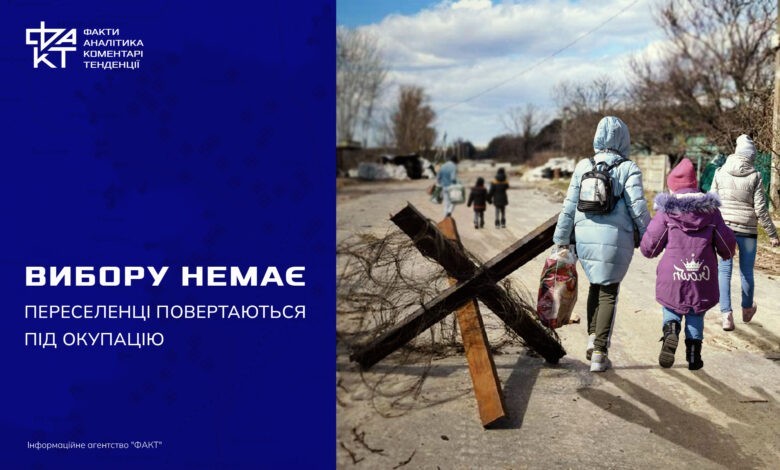
The full-scale invasion of the Russian Federation into Ukraine disfigured the lives of Ukrainians, forcing them to radically change their usual way of life. They were fleeing the war, saving the lives of their children, giving up their home, work, and normal life in order to find refuge in their own country. But what awaited them here was not understanding, but indifference: lack of housing, meager payments, indifferent officials. Now, finding themselves in poverty and hopelessness, thousands of internally displaced persons are forced to make a terrible decision — to return back to the occupation, where fear, repression and the risk of losing everything await them.
It’s not about choice, it’s about hopelessness. And this tragedy is not only personal for the displaced people, it is a problem of the state, which, it seems, no longer considers it its duty to fight for its own citizens.
IDPs in the occupied territories: a voluntary choice or a forced step
George Tuka, former deputy minister for temporarily occupied territories and internally displaced persons, stated that the vast majority (99%) of the displaced persons with whom he had the opportunity to communicate return to the temporarily occupied territories not out of their own will, but because of the impossibility of establishing their lives in the territory controlled by Ukraine.
In addition, People’s Deputy of Ukraine Maksym Tkachenko made public shocking data, according to which about 150,000 internally displaced persons (IDPs) returned to the occupied territories, 70,000 of them returned to the occupied Mariupol. Subsequently, the deputy denied his statement, referring to his unfounded and emotional assumption. But, no matter what Mr. Tkachenko is guided by, citing unverified data, the problem remains obvious – driven to despair, our compatriots are ready to return under occupation, because there is their home and their belongings, and in the new place, where there was supposed to be a shelter, only miserable things befell them existence and endless lines to offices in search of help.
Real figures confirm the existence of a serious problem in the policy of supporting IDPs. By data According to the Ministry of Social Policy, as of October 27, 2024, there are 4.6 million displaced people in Ukraine, which is 300,000 fewer than at the beginning of the year. Among them:
- women – 59.9%, individuals;
- men – 40.1% of people;
- young people – 80.3% of people;
- children under the age of 18 – 19.7% of people.
The largest number of IDPs is concentrated in Donetsk and Kharkiv regions. They returned 4,734,000 people returned to their homes and not because their homes are fit for habitation, but because of financial and economic difficulties.
It is obvious that insufficient attention to the problems of IDPs can become a basis for political manipulation, both by internal and external players. Russia is already actively using the situation for informational attacks to discredit the Ukrainian government and society.
Why the aid system for IDPs did not work
At the beginning of the conflict, aid for IDPs was based on temporary measures, which was quite understandable, because the situation was unpredictable. However, when it became clear that the war would drag on, no long-term strategy for supporting the displaced was developed. State policy remained chaotic, short-term and dependent on changing political decisions. Many aid programs for IDPs are limited due to lack of funds. Allocation of funding is often delayed or simply not enough. This leads to the impossibility of providing decent housing, medical care, and even basic support.
Why does this happen? The answer lies in a system that does not cope with its functions. The lack of affordable housing, meager financial assistance, and the indifference of officials to the problems of internally displaced persons (IDPs) create conditions in which people simply cannot survive.
After evacuation, internally displaced persons are quickly registered, given some food and bedding, and then placed in dormitories of educational institutions, which do not have all the necessary conditions for the residence of the elderly and persons with disabilities. Inconvenient small rooms, toilets and showers on the first floor or in the basement. It is unlikely that an old person will find it convenient to go up and down the stairs several times a day in such conditions.
In Ukraine, there are very few places of temporary residence for IDPs where they can live in relatively comfortable conditions free of charge. The number of these places did not increase, but, on the contrary, decreased after the adoption Resolution of the Cabinet of Ministers No. 930 in September 2023. New criteria have been introduced, but of the places that were previously used, only a quarter currently meet these requirements.
One option is to look for rented housing. But the prices for such housing in comparison with payments of 2-3 thousand hryvnias and at the same time, which are not available to everyone, is a daily struggle that drives people into a dead end. Since March, two-thirds of forced migrants, i.e. more than 60%, have been deprived of payments. And this, of course, contradicts the President’s statement about maintaining payments to IDPs in 2024.
It seems that local authorities should carry out audits and put the locations in order, because the partners’ funds are directed to these purposes. But, probably, the funds do not find their way to their destination. As Maksym Tkachenko told in his interview, during the inspection of the communal building in Khmelnytsk, it was found that, even after the repair work was completed, the building was not inhabited by IDPs. Instead, the responsible people decided to turn this place into a “hotel”, demanding 1,200 hryvnias per person, or at least 4,800 hryvnias per family, from the poor migrants, although this accommodation should be provided free of charge.
Another vivid example of the inaction of the local authorities is the incomplete construction near the regional hospital in Cherkasy on the territory of the geriatric boarding house, which has not been put into operation for more than 25 years. Although, if it were to be put in order, it could shelter 100-150 IDPs.
To find money for rent, you need to find a job. But here, too, IDPs face trials. Employment centers are limited to an indifferent call, where they say, if you need a job, contact them. And that’s all – no information, no program for retraining and training. A large number of IDPs could not find work due to the skeptical attitude of employers towards them, and all those offers that are provided to displaced persons are, in fact, very low-paid. Thus, the picture emerged that the resettled people, among whom there are professionals from various fields, cannot fully realize their potential due to the lack of support and opportunities. The loss of qualified personnel is a direct threat to the economic development of the country in the conditions of war.
For data survey of the International Organization for Migration (IOM), 60% of displaced persons spend half of their income on housing rent. On average, it is 8,500 hryvnias with utilities. The salary often does not exceed 8-12 thousand hryvnias. It is obvious that people simply do not have enough money to meet the minimum necessities of life.
The state, instead of creating conditions for integration and assistance, is limited to formalities. Support programs exist only on paper, officials throw up their hands, and society turns away because “it’s hard for everyone now.” As a result, thousands of people are faced with a choice: to survive in poverty in the rear or to return to danger, but at least to their native home.
The state promises to provide IDPs with housing rental subsidies. About 4 billion hryvnias are provided in the budget for the implementation of this experimental project. Immigrant families who spend more than 30% of their total income on rent will be eligible for a housing rental subsidy. At the same time, if the family’s income does not exceed 5,840 hryvnias per person, the subsidy will cover most of the rent. Appropriate subsidies will be assigned by the Pension Fund, so the lease agreement will have to be registered there, and the corresponding benefit can be received in parallel with the subsidy for housing and communal services. As the Ministry of Social Policy assures, the process of obtaining a subsidy for IDPs to rent housing will begin in mid-January 2025 and will proceed quickly and efficiently. Knowing how our officials like to create bureaucratic obstacles, the whole procedure will take a long time. And it is unlikely that the homeowners themselves will be willing to provide official lease agreements to the Pension Fund. So we have a dilemma, even before the launch of the project.
The state is also relying on another initiative of its own – the “eRecovery” program, according to which IDPs should be compensated for destroyed housing in temporarily occupied territories. Currently, UAH 3 billion is provided for destroyed housing and UAH 1 billion for damaged housing. But all these payments are somewhere out there, in the distant future, and people need housing and means of subsistence right now. Indifference to those who need help the most is a sentence for a system built not on values, but on bureaucratic formalities. And the price of this indifference is not only the fate of those who return to the occupation. This is the risk of losing citizens’ trust in their state, demographic and social losses, strengthening the enemy’s position. If we do not change our approach now, then after the war we may find ourselves in a country that has lost not only part of its territory, but also part of its people.
This situation poses a threat not only to individual people, but also to the state as a whole. The return of Ukrainians to the occupied territories plays into the hands of the Russian Federation, which successfully uses it for its propaganda. People abandoned by the state become vulnerable to manipulation, and their forced return looks like Ukraine’s defeat in the war for its own citizens.
Life in the occupied territories of Ukraine is a reality where every day turns into a struggle for survival and preservation of one’s own self. Time flows differently here: broken roads lead not only to the ruins of houses, but also to broken destinies. The people who remain are experiencing a double burden. On the one hand, daily restrictions: curfews, searches, arrests for pro-Ukrainian statements. On the other hand, the fear of losing one’s property and roots. But despite all this, many Ukrainians in the occupied territories are trying to preserve their identity.
At the same time, Ukrainians face another problem – absence of a mechanism for recognizing the learning outcomes obtained at the TOT of Ukraine. It turns out that citizens who received their education in the temporarily occupied territories do not have equal access to further education and professional realization in the territory under the control of the Government of Ukraine. Thanks to the initiative of Dmytro Lubinets, the Commissioner for Human Rights of the Verkhovna Rada of Ukraine, in November 2023, the Verkhovna Rada of Ukraine adopted Law of Ukraine No. 3482-IX, according to which the persons who lived in the TOT of Ukraine have the right to the recognition of the results of studies obtained in such territory in the authorized bodies, except for the cases specified by the Law. The draft resolution is still at the stage of approval by the Ministry of Finance, after which it will be submitted to the Government for consideration. The state should support those who suffered from the Russian occupation and do everything possible to facilitate their reintegration into society.
Therefore, the return of people to the occupied territories is a failure of the state system, which should protect every citizen. Anyone who is forced to return to occupation due to contempt by the state becomes not only a victim of war, but also a victim of indifference. The government must eventually understand: indifference to one’s own people today can cost statehood tomorrow. The choice that is made now will determine what Ukraine will look like after the war — a state that fights for everyone, or a country that has left its own people to fend for themselves.