
The civil service is losing professionals: why state bodies are losing the competition for personnel

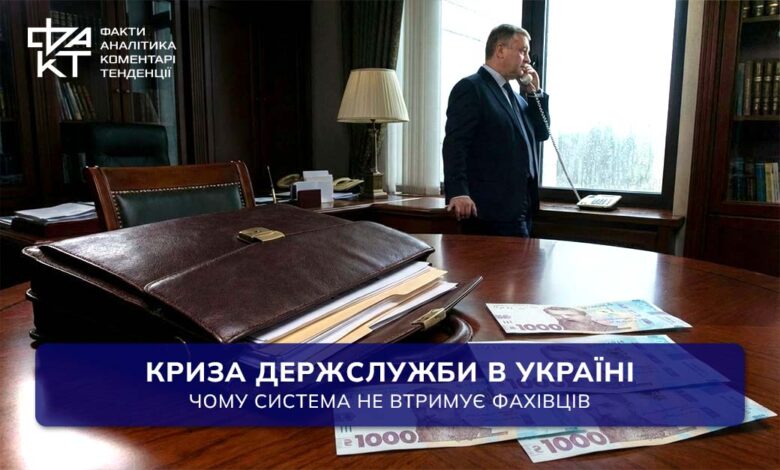
The modern system of public administration in Ukraine increasingly resembles not a professional elevator, but a hermetic reserve, where the ambitions of young specialists are smashed against the deaf wall of financial discrimination and institutional stagnation. While political tribunes are full of slogans about European integration and the digital state, the dry figures of the Ministry of Finance reports expose significant problems of public administration. The situation in which a specialist in territorial administration is forced to survive on 15.5 thousand UAH, being under the microscope of declaration, pushes the most valuable personnel out of the system, leaving in their place either the “old guard” or empty vacancies.
Payment in the civil service: how the budget model shapes the gap between the center and the regions
Statistical data for January 2026, published by the Ministry of Finance, highlight a complex hierarchical model of remuneration, which covers 165.5 thousand specialists involved in the public sector. The distribution of human resources within this system demonstrates a clear concentration, where a significant share of employees, namely 108.1 thousand people, falls on the central executive bodies together with their branched territorial divisions.
The deep gap in financial support becomes obvious when comparing the income of central office employees, whose average salary is 53.3 thousand UAH, with the remuneration of specialists in the field. As the distance from the administrative center increases, the figures decrease rapidly:
- At the regional level, specialists in central departments receive an average of 31.5 thousand UAH;
- In territorial departments, this figure drops to a critical level of 15.5 thousand UAH.
Such a three-fold difference between the “center” and the lowest level of the departmental vertical emphasizes the specifics of budget distribution, where strategic planning in the capital is valued much higher than direct executive work in the regions.
The specifics of financing local state administrations reflect a similar, albeit less radical, trend towards a gradual decrease in payments depending on the administrative status of the territory. Employees of regional state administrations have an average income of UAH 24.1 thousand, while their colleagues in district structures receive UAH 20.1 thousand, which creates a certain financial parity between these links. Interestingly, the level of payment in district administrations is somewhat higher than in territorial divisions of central government bodies, which indicates the heterogeneity of social guarantees even within the same geographical region.
January indicators traditionally bear the imprint of the seasonal factor, since the beginning of the year in the budget process is usually accompanied by a certain decline in the intensity of additional payments. The Ministry of Finance emphasizes that the recorded decrease in the average level of payment is an expected cyclical adjustment that does not reflect the general dynamics of changes in the civil service system.
Despite these fluctuations, the formed salary structure clearly outlines the contours of the state personnel policy, where the level of responsibility and the geographical location of the body remain the determining factors in the formation of official salaries.
Civil Service as a Risk Zone: Staff Turnover, Load, and Uncompetitive Conditions
It is worth noting that the modern architecture of public administration in Ukraine has found itself in a situation of critical imbalance, where chronic staff turnover, which has reached over 20% in recent years, has become only the tip of a deep structural crisis. Instead of the expected strengthening of institutions, the public sector is demonstrating increasing vulnerability to external and internal challenges: from the direct impact of war to the inability to compete for intellectual capital with private business.
Despite efforts at digitalization and attempts at reform, the civil service is perceived by potential candidates not as a prestigious platform for self-realization, but as a zone of increased risks, where low wages and limited opportunities for remote work nullify any patriotic intentions of young professionals.
The financial component of the civil service after the introduction of the grading system from January 1, 2026 has undergone a radical transformation, which, while declaring transparency, at the same time deprived the system of the necessary managerial flexibility. Although the transition to a model where the official salary is 70% of total payments, and bonuses are limited to 30%, was intended to eliminate corruption risks and management subjectivity, in practice this led to financial stagnation for the most promising personnel. Even with an average salary in individual departments, ordinary performers remain outsiders in the labor market, especially against the background of the aggressive recruitment policy of the IT sector or international corporations, where the incomes of professionals significantly exceed state limits.
Institutional stagnation is deepening with legislative decisions, in particular the adoption of Law No. 4782-IX, which in March 2026 allowed service up to 75 years of age, which effectively preserved management positions for the “old guard”. For ambitious young people, such a step became a clear signal of the lack of real career elevators, turning state bodies into hermetic structures with limited access to decision-making. Combined with strict requirements for a master’s degree and perfect language skills, which in the conditions of a general personnel shortage of 4.5 million people look like additional barriers, potential candidates choose simpler and more dynamic paths to employment in the non-state sector.
At the same time, the lack of awareness-raising campaigns in educational institutions leads to the fact that young people perceive the public sector as a closed “black box”, not understanding either the specifics of daily tasks or the algorithms for passing competitions. The lack of clear media coverage turns state bodies into invisible players, whose critically important role is neutralized by stereotypical ideas about bureaucratic inertia.
Despite the natural desire of the younger generation to influence public policy and gain unique managerial experience, the low level of financial remuneration becomes an insurmountable obstacle to professional realization. Civil service agencies are forced to look for new formats of dialogue, since traditional methods of information are no longer able to reach the target audience, which requires clear rules for the functioning of the structure and proven social significance of its work.
The critical point of no return for many current specialists is coming due to the toxic atmosphere in teams and excessive bureaucracy, which forces experienced employees to plan their dismissal in the next six months. Those who are currently refusing a career as an official are ready to reconsider their position only if flexible work schedules are introduced, political pressure is limited, and the level of corruption is actually reduced. A deep review of management approaches is a requirement of the time that cannot be ignored, because every day of delay in reforming procedures only deepens the personnel shortage and reduces the quality of public service.
It is worth noting that the electronic declaration system in 2026 has turned into a kind of “endurance test” that forces specialists to avoid public service due to excessive publicity of private life. The need to report not only on their own assets, but also on the property of family members creates a “glass house” situation, where any unintentional error in the figures under the strict control of the NACP can lead to administrative or even criminal prosecution. Moreover, the status of a politically exposed person (PEP) leaves a lifelong imprint on the financial operations of the entire family, which for a successful top manager turns into an unjustified sacrifice that no government position can compensate for.
As a result, the operational burden on current employees is becoming increasingly difficult due to the colossal shortage of personnel, which in central government bodies is measured by tens of thousands of vacancies, which automatically doubles the workload for those who remain. In addition to security risks and a ban on traveling abroad, social insecurity is also added, because in the event of mobilization, only a place is reserved for a civil servant, but the payment of average earnings is not made, which makes military service financially critical for the official’s family.
Against the background of the budget deficit at 18.5% of GDP and the constant threat of cuts, the civil service is losing its main historical advantage, namely stability, turning into a zone of constant uncertainty and reputational tension under the watchful eye of the public.
Civil service without trust: the consequences of opaque procedures and personnel decisions
Citizens’ perception of a state institution is traditionally crystallized through the figure of a specific executor, turning each civil servant into a living embodiment of the legitimacy and efficiency of the government itself. When public trust in the administrative apparatus begins to melt rapidly, this becomes an alarming indicator of a systemic failure, which requires not cosmetic corrections, but a deep modernization of the entire state mechanism. Under martial law, this problem has become particularly acute, as the forced pause in open competitions has created the illusion of availability of positions for some and at the same time revived toxic practices of employment “through connections” for others, destroying the principles of meritocracy (the principles of organizing a society or a system of government in which people receive promotion, positions and rewards according to their abilities, knowledge, skills and achievements, and not through connections, origin or political loyalty – ed.).
The everyday identification of the civil service with a corruption swamp or bureaucratic routine is fueled by persistent stereotypes about the professional incompetence and excessive appetites of officials who supposedly exist exclusively at the expense of taxpayers. Ukrainians are often inclined to demonize the image of a manager, attributing to him neglect of state interests and tactlessness, although the reality usually consists of exhausting daily work on draft documents and the provision of critically important services in extremely difficult conditions.
The situation is also complicated by terminological confusion, because in the eyes of the average Ukrainian, absolutely everyone is mistakenly classified as a civil servant — from doctors and teachers to judges and deputies, which is why any local scandal in the budgetary sphere automatically casts a shadow on the entire institution of public service.
It is worth realizing that the fundamental improvement of the system requires not only the correction of its public image, but also a real solution to problems that have been dragging on for years due to the political situation and the subjectivism of the leadership. Imperfections of competitive procedures and formal evaluation, a blatant imbalance in remuneration for positions of identical complexity have become destructive factors in the destruction of the system from within. Political influence on disciplinary commissions and arbitrary dismissals create an atmosphere of insecurity that pushes talented specialists out of the system, preventing the formation of a stable institutional memory necessary for future integration into the European Union.
Transforming the motivation system in conditions of limited budgetary resources requires the introduction of innovative tools, such as an extensive network of grants for leaders with zero tolerance for abuse. Since a radical increase in salaries at the current stage remains a distant prospect, the state should compensate for the shortage of funds through investments in intellectual capital, offering employees continuous access to international training programs. This approach allows for the formation of an environment of experts for whom professional growth and work in technical assistance projects become an intermediate link between the public sector and private contracts.
Large-scale modernization of management within the framework of the Ukraine Facility plan and European integration commitments promises a radical revision of the functions of state bodies in order to eliminate duplication of powers. The reform involves not only optimizing the staff structure, but also a complete reformatting of the remuneration model, which should become the foundation for effective interaction with the European economic space. Simplifying decision-making procedures and reducing administrative barriers are designed to reorient civil servants from “paper” support of processes to their real content, freeing up time for strategic planning. However, these are all just promises that, as is known, are far from always fulfilled.
The digitalization of administrative services has not eased the bureaucratic pressure in the work of the ASC network, demonstrating that the state apparatus must work on the functionality of the system. A return to historical practices, such as professional competitions “Friendly Administration” or “Best Civil Servant”, could once again actualize the idea of openness and prestige of the profession, shifting the emphasis from dry execution of instructions to high-quality interaction with a person. Such initiatives can counteract media populism, which often manipulates calls for thoughtless reductions in staff or salaries, ignoring the fact that it was this apparatus that ensured the country’s vital activity in the first, most difficult months of the full-scale invasion.
In addition, the key to transformation should be a consolidated political will aimed at completing the wage reform on a transparent basis and restoring full-fledged competitions with compliance with all security protocols. It is already necessary to rethink the role of the civil servant as the architect of post-war reconstruction, whose activities are based not on the preferences of the leader, but on professional standards and responsibility to society.
Only under such a comprehensive approach will the civil service cease to be an object of criticism and become a guarantor of stability, giving every citizen confidence that the state mechanism works harmoniously, transparently and exclusively in the interests of the people.


