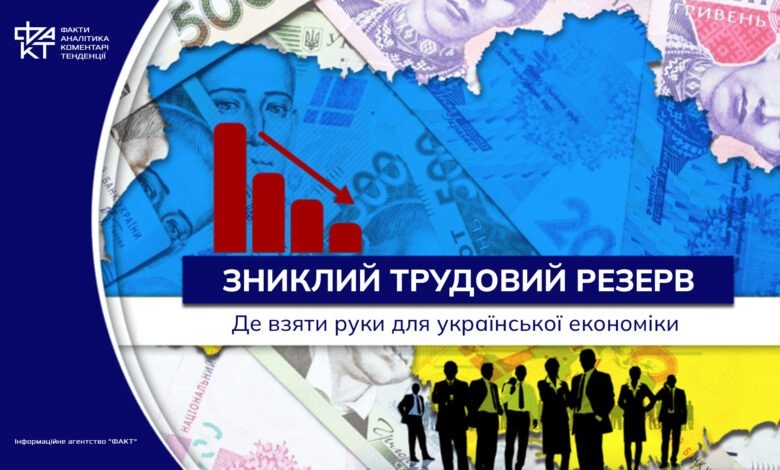
Ukraine’s economy is cracking under the weight of multiple challenges: war, migration, rapidly ageing population, growing disability and a catastrophic decline in employment. In a country that just a few years ago had about 41 million inhabitants, only a tiny fraction is actually working. Of the 31 million people who, according to official figures, still remain in the government-controlled areas, a huge proportion are pensioners, children and people with disabilities. In addition, about 8 million more Ukrainians remain economically inactive today. Can a small group of working Ukrainians develop the economy, support the state’s social obligations, pension system and infrastructure? Does the country have a chance to get out of this demographic trap, which is draining the budget and limiting any prospects for economic growth?
Economic and demographic catastrophe: the working population is less than 3 million
Ukraine is facing a serious demographic challenge that directly affects its economic development, where every working person becomes not only an important part of the economy, but also a guarantee of its survival. Pre-war official data showed that the country’s population was about 41 million, but these figures were conditional, as they did not take into account the real number of people in the occupied territories. Today, demographic data vary depending on the source, which indicates that the authorities do not have a common understanding of the situation or are unwilling to disclose real data. For example, in July 2024, Deputy Minister of Health Serhiy Dubrov noted that the population had fallen to 35.8 million. Other sources, such as the Centre for Economic Strategy and the Institute of Demography, put the figure at 31 million, which seems more realistic given the millions of Ukrainians who have moved abroad.
Of these 31 million, a significant portion of the population can no longer drive the economy. In early October 2024, the Pension Fund estimated that the number of pensioners reached 10.34 million. In other words, almost one in three Ukrainians is now a pensioner, and their support depends on those who are still working and paying taxes. This imbalance is dangerous for any country’s economy. To maintain a stable pension system, the normal ratio of workers to pensioners should be around 4:1, but in Ukraine this ratio has fallen to a critically low level. This means that the country is actually on the verge of a financial crisis. After all, those who are currently working are unable to support such a large number of non-working people.
In addition, according to various estimates, about 10 million Ukrainians are currently abroad, many of them are of working age and have no plans to return home. This is not just statistics, but the loss of an active population that could work to rebuild the country. Demographer Ella Libanova recently noted that in 10 years’ time, Ukraine will remain economically weak, and many Ukrainians will continue to travel abroad if the borders are opened.
The birth rate is also at an extremely low level, with only 0.9 children per woman, compared to the 2.2 required for simple intergenerational reproduction. If this trend continues, the Institute of Demography and Quality of Life Problems of the National Academy of Sciences predicts that Ukraine’s population could decline to 28.9 million by 2041 and 25.2 million by 2051. Moreover, population forecasting is becoming increasingly difficult due to the lack of necessary statistics, including the inability to take into account demographic data from the temporarily occupied territories and various possible scenarios of military events.
The third factor affecting demography and the economy is disability. According to the Confederation of Employers of Ukraine, in 2021, the number of people with disabilities was 2.565 million. However, in 2024, according to the Ministry of Social Policy, this figure increased to more than 3 million. Of these, only 448,200 are employed, or 17.4%. For comparison, in the UK, this figure reaches 53%, in France – 44%, and in the US – 23%. This indicates that the Ukrainian labour market is still not adapted to the needs of people with disabilities, depriving the country of another segment of the potentially active population.
The issue of women and veterans is also acute. Women, especially mothers, do not have adequate support to combine work and childcare. The military, on the other hand, face numerous barriers when returning to civilian life, from psychological adaptation to physical limitations that prevent them from returning to their regular jobs. Thus, a huge number of people are left out of the workforce, which only increases the burden on the budget. Currently, about 8 million people are not economically active. Deputy Minister of Economy Tetiana Berezhna spoke about this at the Kyiv Economic Forum, explaining that this segment of the population includes war veterans, women who cannot combine work with family responsibilities, people with disabilities, and those who simply have not found themselves in the labour market.
If we summarise the approximate data, we get the following:
Total population: 31 million, of which:
- Pensioners: 10.34 million
- Children: 7.35 million
- Unemployed persons with disabilities: 2.5 million
- Economically inactive population: 8 million.
So, if we subtract pensioners, children, people with disabilities and the economically inactive from the total population, the number of working people is less than 3 million. Think about it: less than 3 million people working for a country as large as Ukraine!
The economic growth of a country primarily depends on the number of working-age people. The main intensive factor for the growth and development of the modern economy, both industrial and innovative, is high-quality human capital. Its deficit is becoming not only an economic but also a social problem that threatens the stability of the state. At the same time, the war has made its own devastating adjustments. Looking at the situation from all angles, it becomes clear that Ukraine simply does not have enough working citizens to sustain economic growth. The state is forced to increase the tax burden on those who remain in the workforce, which reduces the country’s investment attractiveness. Unemployment, inadequate infrastructure for the employment of people with disabilities, and the lack of retraining programmes for veterans are all additional challenges that prevent Ukraine from restoring economic stability.
‘It doesn’t matter what colour the cat is, it’s important that it catches mice’: why Ukraine needs real reformers to overcome the economic crisis
In Ukraine, officials constantly pay lip service to their ‘patriotism’ by publicly declaring their love for the country. Statements about ‘protecting national interests’ or ‘serving the people’ are heard from high places and fill the media, creating a picture that is supposed to inspire confidence in society. However, as practice shows, the real interest of many of these officials is focused on political populism and personal enrichment, and they give little thought to long-term economic transformation and the welfare of the population. It is a sad fact that at a time when the country desperately needs bold reforms and a coherent economic strategy, the majority of the political elite are acting mainly in their own interests.
In order to understand how Ukraine should proceed, we can look to the useful examples of other countries that have successfully recovered from deep economic crises. From China to Germany, these countries have gone through their own difficult periods, but have chosen the path of real change rather than declarative patriotism. Their experience shows that success depends on the willingness of the political elite to work for the good of the state, not for themselves. Even China, a country with a strict communist ideology, has achieved economic growth because its leaders put the real welfare of the people above ideological doctrines. China’s challenging economic journey can serve as a vivid example for any country trying to emerge from the crisis. Just a few decades ago, the country’s economy was stagnant and its poverty rate was one of the highest in the world. However, under the leadership of reformers such as Deng Xiaoping, China has embarked on real economic reforms. His approach of ‘No matter what colour the cat is, as long as it catches mice’ symbolises a pragmatic approach to politics, where results are important, not form. Between 1978 and the early 2000s, China reformed its economy by liberalising trade, opening its borders to foreign investment and creating special economic zones. This was possible because political leaders were guided by the real needs of the economy, not ideological prejudices. As a result, in a few decades, China turned from a country struggling to survive into the world’s second largest economy.
Germany was destroyed after the Second World War and lagged behind in economic development. However, the ‘German economic miracle’ was made possible by the country’s choice of structural reforms. The Minister of Economy Ludwig Erhard rejected the popular policy of nationalisation and collective management at the time. Instead, he initiated reforms aimed at supporting entrepreneurship, privatising state property, deregulating the economy and attracting foreign capital.
His approach was based on market principles and promoted the active development of small and medium-sized businesses. Erhard’s approach proved so effective that within a few years Germany became one of the most powerful exporters in Europe, and the war-torn economy turned into one of the world’s leading.
Another example for Ukraine is South Korea, which in the mid-twentieth century was one of the poorest countries in Asia. However, its leaders realised that the country needed innovative development and investment in education. The government focused on high-tech industries and developed an education system that focused on training specialists for new industries. As a result, in a few decades, South Korea became a leader in electronics, automotive and innovation, and its economy grew to the level of the world’s leading powers.
After the Second World War, Japan also faced large-scale economic challenges. The country was in a state of economic devastation, but political leaders, including Yoshida Shigeru, chose to recover quickly through industrialisation and the merger of traditional values with the modernisation of the market economy. Japan invested in technology, education, and industry, and by the 1980s it had become one of the world’s largest economies. The government promoted the development of large corporations that led the country to success, providing employment and stability. Importantly, these were result-oriented reforms, not political populism.
Singapore is also one of the most striking examples of how a country can transform from an economic outsider to a global leader. In the 1960s, after gaining independence, Singapore was on the verge of economic collapse: without natural resources, with high unemployment and political instability. However, thanks to the decisive reforms of the government under Lee Kuan Yew, Singapore has chosen a course of strict discipline and attracting foreign investment. Key steps included supporting entrepreneurship, liberalising the economy and investing heavily in education and human capital development. Lee Kuan Yew created an economic freedom zone and special conditions for foreign companies, which led to a rapid inflow of capital and the development of technology.
The government has put education at the forefront, training qualified professionals, making the country attractive to high-tech companies. In a few decades, Singapore has managed not only to get out of the crisis but also to become one of the most economically successful countries in the world, showing that even small states can become global players with the right reforms.
Does Ukraine still have a chance to escape the demographic trap that is dragging the economy down?
With an ageing population, fewer and fewer of whom are working, mass emigration and unemployment, the economy has virtually no prospects. The state budget is cracking under the burden of social payments, which are increasing every year, while revenues from taxes and active business are steadily declining. For every worker, there are more and more pensioners and people unable to work, which means that Ukraine spends more than it earns.
And this is a real trap. The more the country spends on social programmes, the fewer resources it has left for economic development. Capital investment in production, innovation, education – all of this is declining because there is simply not enough money. A situation where the budget spends more than it earns threatens to bring the country to economic collapse, especially if commodity prices and taxes rise, while exports and investments fall.
The experience of successful countries shows that in order to achieve economic growth, Ukraine needs to have a professional and truly patriotic elite that cares about the real interests of the state and is ready to implement bold reforms. Only true patriots who consider the welfare of the people a priority, not a means of self-promotion, can change the situation. A successful way out of the economic crisis is only possible when political leaders understand that efficiency is more important than ideology, and real deeds are more valuable than slogans.
Our officials need to move from populist promises to concrete economic solutions. This means that patriotism should not be manifested in demonstrative statements, but in real actions for the benefit of the economy – attracting investment, deregulating business, supporting innovation and creating favourable conditions for entrepreneurship. An even better way would be to replace inefficient and corrupt managers with decent professionals capable of leading the country out of the economic crisis. Without this, the Ukrainian economy will continue to decline, and the people will remain hostage to political populism.
In addition, Ukraine needs to mobilise all available resources to stop the outflow of young people, create conditions for the return of refugees, develop business, engage the economically inactive population to the maximum extent possible, implement effective comprehensive support programmes for people with disabilities, provide access to retraining for veterans, and create jobs with flexible conditions for women. These are not just economic policies, but the country’s survival. If these measures are not implemented, the country will face the prospect of an even more rapid economic decline, as maintaining a social protection system without a stable labour force is an impossible task.