
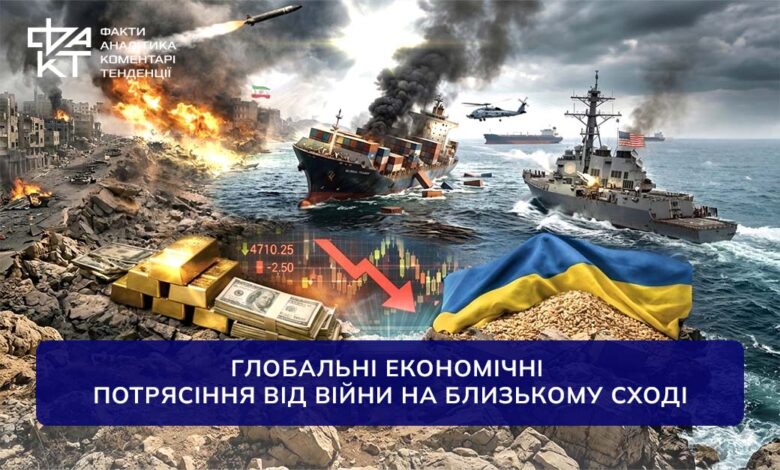
The causes of the war in the Middle East go far beyond purely military ambitions, having created a chain reaction in the global economy, raising oil and gas prices, creating chaos in logistics networks and increasing inflationary pressure in many countries. The Strait of Hormuz, through which a fifth of the world’s oil exports pass, is under threat of blockade, and any escalation is instantly reflected in prices, logistics and balances of payments in dozens of countries. Ukraine, which imports a significant part of energy resources and at the same time exports grain and oilseeds, is also under economic pressure: rising world prices increase production costs, threaten with inflation and complicate currency stability. Already now, events in the Middle East are capable of changing not only the global economy, but also the financial and food stability of Ukraine, and every day the conflict drags on adds new risks.
How the War in the Middle East Affects the World Economy
Analysis of the US and Israeli attacks on Iranian facilities shows that the reasons for these actions go far beyond purely military ambitions. Despite last year’s declarations of the “complete destruction” of Iran’s nuclear program, Tehran continues to enrich uranium to a level that has no civilian applications, creating the impression that it could potentially produce nuclear weapons. Although direct evidence that a bomb could be created in the near future has not been made public, the very prospect of this scenario remains a strong argument for the US and Israel in maintaining military pressure.
It should be noted that, in addition to the political, an important economic factor is control over the oil market. Iran, being one of the largest oil exporters, directly influences world prices, and restrictions on export revenues serve as a means of curbing the financing of proxy groups in the Middle East. The strategic importance of the Strait of Hormuz, through which about 20% of the world’s oil consumption passes, adds another dimension to this pressure: any threat of blocking this route could trigger global energy instability. At the same time, military and economic pressure limits the development of Iran’s gas sector, which is beneficial to competitors, in particular suppliers of liquefied natural gas from the United States.
In addition, an equally important factor is the strategic importance of Iran’s minerals. The country has some of the world’s largest reserves of oil and natural gas, as well as important metal ore resources: zinc, copper, iron ore, chromium, lead, manganese and gold. In addition, significant deposits of rare earth metals, including lithium, are critical for the production of batteries, high-tech products and the defense industry. Iran’s non-metallic minerals include gypsum, barite, celestine, fluorite, and rock salt, as well as precious and semi-precious stones, including turquoise. In total, the country has about 68 types of minerals with total reserves of over 40 billion tons, which corresponds to approximately 7% of the world’s mineral resources.
Strategic raw materials for the United States and its allies are becoming not only an economic but also a political tool. Military pressure and sanctions allow to limit the export of Iranian resources, reduce Iran’s global presence in the oil and gas markets, and weaken the country’s influence on key consumers, including China. At the same time, control over critical minerals is considered a matter of national security, since they are necessary for the defense industry and technological production. Preliminary plans for future resource extraction agreements with the “new regime” in Iran indicate that the United States considers the strategic use of these minerals as an instrument of geopolitical influence.
The economic fallout from the Middle East war has affected Iran, Lebanon, Israel, and the United States, and has also hit Iraq, Qatar, Bahrain, the UAE, Jordan, and Saudi Arabia with missile strikes. Its effects began to manifest themselves almost immediately: in the first days, Brent crude — the main international barrel benchmark — rose by 10–13%, crossing the $80–83 mark per barrel, and at times approached levels not seen since 2024. West Texas Intermediate also showed daily volatility of +12–13% from its previous trading level.
In the United States, where gasoline is tied to the oil market, the price per gallon of gasoline rose to its highest level in three months, exceeding $3 per gallon in some regions after the price of oil rose. This means that the end consumer — the owner of a car or truck — has already felt the impact of the war on his wallet. Iran is also suffering heavy losses—before the war, it produced about 3.3 million barrels of oil per day, the fourth-largest OPEC member by that figure. The rial is falling amid the fighting, inflation in the country is already exceeding 40% annually, and GDP, which was forecast at around +1.1% in 2026, risks collapsing into negative territory if economic blockades and war spending increase.
A deeper understanding of the scale of the impact is provided by estimates from global think tanks: if energy shocks continue, eurozone inflation could rise by 0.3–0.5 percentage points above target levels, and EU real GDP could be held back, losing 0.1–0.2 percentage points of growth in 2026 compared to previous forecasts. In some “worst case scenarios” (a sustained rise in oil prices to $90–100 per barrel and gas to €70–100 per MWh), inflation could rise several percentage points above expected levels, potentially forcing the ECB to raise rates two more times or more. This means that the cost of borrowing for businesses and households could rise, and companies’ investment plans would have to be revised towards more cautious investments.
Even more dramatically, it is not just oil that is rising in price. Jet fuel prices in Northern Europe have jumped to $1,416 per tonne, a multi-year high and about 12% above seasonal standards. Jet fuel premiums have been as high as $200 per barrel over Brent in short bursts, meaning airlines operating on thin profit margins are already recording losses in the millions. For example, one of the major European budget airlines reported at least €50 million in lost profits due to the increase in fuel prices alone.
The global gas market is also currently in a state of collapse: prices in Europe have soared by 400-500% due to the complete halt of exports from Iran and the de facto closure of the Strait of Hormuz, through which more than 20% of the world’s liquefied natural gas (LNG) passes. The countries of Southeast Asia and the EU are suffering the most, having lost stable supplies of Qatari gas, while Iran’s own energy infrastructure has suffered extensive damage as a result of air strikes that disabled the world’s largest field, South Pars.
An example of a direct global effect is Qatar, which has now suspended its production of liquefied natural gas — about 20% of global LNG exports — due to security risks. If this continues, analysts do not rule out that energy prices could rise to $150 per barrel of oil and $40 per MMBtu for gas, which would cause new shocks for energy importers, particularly in Asia and the EU.
It is important to understand that energy markets are just the beginning. The war has already overloaded global logistics networks. Some shipping companies have suspended flights to Persian Gulf ports, forcing cargo to seek longer routes around Africa, increasing transportation costs and delays for global supply chains.
Financial markets are also reacting sharply to the war, as investors in uncertain conditions abandon risky assets, such as stocks in economically sensitive sectors, and move capital into “safer” instruments — gold, some government bonds, precious metals. Exchange rates are showing increased volatility, and the US dollar is gaining additional appetite as investors traditionally seek more stable reserve currencies in times of global stress.
One key example of the compounding effect is that the war in Iran has made not only oil supplies but also the food system less predictable: the price of fertilizers produced using natural gas and oil (such as urea) has already increased by up to 16% per ton in the former war regions, which automatically transfers pressure to agricultural costs and can raise food prices in importing countries.
Countries at the ends of supply chains remain particularly concerned, including Pacific island economies that are completely dependent on oil imports, as well as low-income countries with high public debt. These include Pacific islands such as Fiji, Tonga, Samoa and Vanuatu, as well as low-income economies with high public debt, including Yemen, Sudan, Lesotho, Malawi, Nicaragua, Haiti and Bangladesh. For their economies, even a short-term energy shock can lead to balance of payments deficits, rising commodity prices and the need for external financial support.
Impacts of war on the EU, China and Russia
Dependence on Middle Eastern oil and gas makes the European economy the most vulnerable to the consequences of war. If the conflict is short-lived and energy prices only rise for a short time, the damage will be limited. However, a protracted war that keeps oil and gas prices high could force governments to spend more to protect voters from rising prices and put pressure on incumbent leaders. This scenario means that EU governments will have to balance between stabilizing consumer prices and supporting economic growth, while limiting investment programs and social projects.
The situation in Europe has looked promising so far: increased public spending in Germany and elsewhere should support moderate economic growth and inflation, in line with the European Central Bank’s 2% target. Despite external risks, there is no reason yet to panic that the eurozone has gone off course. A permanent oil shock of $10 per barrel would, according to Morgan Stanley, increase eurozone inflation by 0.4 percentage points while cutting economic growth by 0.15 percentage points, underscoring the sensitivity of European economies to energy shocks.
According to the ECB’s latest forecasts, consumer prices will remain below the target until 2028, with growth accelerating to 1.4% next year from 1.2% in 2026. However, even a modest increase in energy prices could put these forecasts into question, especially if the conflict drags on, as high oil and gas prices immediately weigh on business and household spending.
It is worth noting that the International Monetary Fund has drawn attention to the global consequences of the war in Iran. A 10% increase in energy prices could increase global inflation by 40 basis points and slow economic growth by 0.1-0.2%. IMF Managing Director Kristalina Georgieva noted that global GDP growth is currently 3.3%, and policymakers need to closely monitor price and currency developments, while rebuilding fiscal buffers during economic upturns. The IMF is already negotiating with some countries for assistance in the event of a balance of payments deficit amid instability, a direct signal of the seriousness of the risks for countries with high public debt or dependence on energy imports.
The IMF warns that many countries are approaching the new crisis with depleted reserves, which limits their ability to contain the negative effects of shocks. At the same time, a number of Asian economies, thanks to long-term policies of reserve accumulation and strengthening fiscal positions over the past two decades, have better financial cushions that allow them to respond more flexibly to external shocks.
The impact on Europe is already visible through higher energy costs, delays in the supply of resources and rising prices for transport services. Airlines are feeling the impact of higher jet fuel prices, which have risen by 12% above seasonal averages, which is reducing profitability and forcing the postponement of route expansion. At the same time, industrial enterprises are forced to optimize production due to the increase in the price of electricity and gas, which directly affects the pace of economic growth.
According to analysts, the increase in the price of energy carriers can reduce the gross domestic product of the eurozone by almost 0.6%, and the economy of the United Kingdom – by approximately 0.5%. Moreover, Europe remains particularly sensitive to fluctuations in natural gas prices, which determine the pace of production and the level of consumer spending.
China, which is among the world’s largest oil importers, finds itself under additional economic pressure due to current energy instability. Previously, Iran and Venezuela supplied the country with significant volumes of oil at preferential prices, which allowed stabilizing the costs of the industrial and transport sectors. Now, if the price of a barrel reaches one hundred and eight dollars, this can add almost one percentage point to the level of inflation in the Chinese economy, exacerbating the already existing challenges.
At the same time, new players are emerging in the global distribution of benefits from the energy shock. Russia, thanks to a sharp increase in world oil prices, can significantly increase state budget revenues, practically eliminate its deficit and obtain additional resources to finance its military programs. The main reason lies in the structure of the economy: about 40% of the revenues of the Russian federal budget are formed by oil and gas exports, so any increase in world prices instantly increases revenues to the state treasury.
In addition, the volume of Russia’s production and exports allows it to monetize this effect without additional investments, and control over state-owned companies such as Rosneft and Gazprom ensures that profits remain within the country. At the same time, most other countries that are net importers of energy resources are forced to spend more on fuel, face balance of payments deficits and inflationary pressures, which is why the benefits from rising prices are absent for them.
Additionally, high oil prices strengthen the foreign exchange reserve and the stability of the ruble, reducing the risks of external financial vulnerability, especially during sanctions. Russia can also expand its influence on the world energy market, directing supplies to those consumers who depend on oil and gas imports, and receiving premiums for geopolitical risks.
Paradoxically, war and global upheavals that harm most economies turn into a source of additional resources for Russia: export revenues allow it to finance military operations, maintain domestic economic stability, and at the same time strengthen its position in strategic energy markets. This illustrates the uneven economic consequences of energy shocks: importing countries suffer from deficits and inflation, while exporting countries, such as Russia, benefit from rising prices and strengthen their geopolitical influence.
Possible Scenarios for the Development of the War in the Middle East and Their Impact on the Global Economy
The war in the Middle East is currently in a critical phase, and further developments will determine the state of the global energy market and economic stability. If the confrontation remains local and does not affect key oil pipelines and ports, basic supplies will remain available, which will allow oil prices to remain at around $80 per barrel. In this scenario, risks to the global economy will be limited, but tensions in the energy market will cause short-term increases in production and transportation costs, and financial markets will continue to demonstrate increased volatility.
In addition, regional economies that depend on stable energy supplies may face limited opportunities for infrastructure development and investment.
If a diplomatic settlement and ceasefire can be achieved, the economic effect will be more noticeable. Зниження напруженості зменшить ризики перебоїв у поставках нафти та газу, що потенційно дозволить цінам на нафту опуститися до 65–70 доларів за барель. Це, у свою чергу, зменшить тиск на виробництво, транспортну логістику та споживчий сектор у країнах-імпортерах енергоносіїв. Водночас зниження напруженості створить сприятливі умови для відновлення міжнародних торгових потоків, стабілізації валютних ринків та відновлення інвестиційної активності у регіоні. Політична стабільність зменшить ризики терористичних актів і дозволить урядам країн Близького Сходу сконцентрувати ресурси на економічному розвитку, а не на підтриманні військових операцій.
Найгірший сценарій передбачає повномасштабну ескалацію конфлікту з ударами по нафтовій інфраструктурі та тривалою блокадою Ормузької протоки. У цьому випадку світові постачання нафти будуть обмежені, а ціни можуть стрімко перевищити 100 доларів за барель, що одразу позначиться на глобальній економіці. Високі ціни на енергоносії спровокують прискорення інфляції, підвищать витрати на виробництво та логістику, а країни з обмеженими ресурсами опиняться під загрозою економічного спаду. Тривала нестабільність негативно вплине на фінансові ринки, змусить інвесторів уникати ризикових активів і підвищить вартість страхових та кредитних продуктів. Також політична напруга посилить міграційні потоки, що створить додаткове навантаження на сусідні регіони і країни Європи. Масштабна ескалація також може змінити баланс сил у регіоні, посилюючи вплив держав, які мають військову присутність, і знижуючи вплив країн, що раніше виступали як посередники у мирних переговорах.
Таким чином, розвиток конфлікту на Близькому Сході має мультифакторний характер, і його наслідки виходять далеко за межі енергетичних ринків. Стабільність економіки, фінансових потоків, міжнародної торгівлі та політичної безпеки регіону залежить від того, чи вдасться сторонам знайти компромісні рішення і запобігти повномасштабній ескалації, а також від того, як швидко міжнародне співтовариство відновить логістику та забезпечить стабільність ключових маршрутів постачання.
Вплив війни на економіку України: ризики, логістика та аграрний сектор
Війна в Ірані і загострення конфлікту на Близькому Сході створюють для України комплекс економічних викликів, пов’язаних насамперед із зростанням цін на енергоносії та ризиками для аграрного сектора. Основна проблема полягає у загрозі судноплавству через Ормузьку протоку, яка забезпечує транзит значної частини світових обсягів нафти та газу. Вже зараз нестабільність на маршруті призвела до підвищення світових цін на нафту, що безпосередньо відбивається на вартості імпорту енергоресурсів в Україну.
Дорогий імпорт означає додаткове навантаження на валютні резерви країни, збільшення витрат підприємств та зростання собівартості продукції. У разі затягування конфлікту ціни на нафту і газ в Європі можуть істотно підвищитися і для нашої країни, що створить подальший тиск на внутрішню інфляцію та здорожчання виробничих ресурсів.
Це безпосередньо впливає на аграрний сектор, де енергоносії і добрива формують значну частину собівартості. Подорожчання газу та аміаку автоматично підвищує вартість азотних добрив, критичних для вирощування кукурудзи та соняшнику. У структурі собівартості цих культур добрива та пальне складають близько 25–30%, а подальше зростання цін може збільшити цю частку понад третину, що значно позначиться на рентабельності аграрних підприємств.
Кукурудза та соняшникова олія є ключовими позиціями українського агроекспорту, і навіть незначні коливання собівартості здатні вплинути на конкурентоспроможність продукції на міжнародних ринках. При цьому лише частина експорту, приблизно 10%, орієнтована на країни Близького Сходу, тому скорочення поставок до окремих імпортерів створить локальне напруження, але не призведе до системного колапсу експорту. Україна має можливість переорієнтувати ці поставки на Туреччину, країни Північної Африки, частково на регіон Субсахарської Африки та азійські ринки, що дозволяє зберегти обсяги експорту й уникнути критичного дефіциту доходів у валюті.
Крім того, вже зараз спостерігається балансування ринку зерна та олійних культур. Геополітичні ризики підтримують ціни на певні види продукції, тоді як обмеження попиту з боку окремих імпортерів зменшує тиск на зростання котирувань. Це відображається на соєвій олії, що використовується для виробництва біопалива, і яка відреагувала на подорожчання енергоносіїв зростанням цін, тоді як соняшникова олія, орієнтована на харчовий ринок, залишилася відносно стабільною. У сезоні 2026 українські аграрії стикаються з поєднанням кількох негативних факторів: підвищенням витрат на добрива й енергоносії, впливом глобального профіциту на світові ціни, здорожчанням залізничних тарифів і ризиками для портової інфраструктури, що збільшує складність планування виробництва та експорту.
В енергетичній сфері ризики зростають через поєднання внутрішніх ударів по інфраструктурі та нестабільності світових ринків. Україна значно залежить від імпорту газу, нафти і нафтопродуктів, і навіть часткові перебої у постачанні через Ормузьку протоку спричиняють затримки суден, зростання витрат на страхування та логістику, роблячи ринок енергоресурсів непередбачуваним. Високі ціни на імпортоване пальне збільшують виробничі витрати підприємств, підвищують тарифну базу для транспорту та формують додатковий інфляційний тиск на внутрішній ринок, що загострює фінансові обмеження для бізнесу та населення.
Однак вплив конфлікту на Близькому Сході не затьмарює основного фактора ризику для вітчизняної економіки – війни РФ проти України. Втім, ескалація на Близькому Сході може змінити глобальні цінові сигнали, збільшити витрати на логістику і страхування, а також підсилити тиск на міжнародні фінансові потоки. В результаті економіка України опиняється під подвійним впливом: з одного боку, прямий тиск війни на власній території стримує виробництво, руйнує інфраструктуру та виснажує бюджетні ресурси, а з іншого — глобальні потрясіння на енергетичних ринках підвищують витрати на імпорт енергоносіїв, транспорт і страхування, ускладнюють доступ до зовнішніх фінансових потоків і збільшують ризики дефіциту платіжного балансу. Така комбінація внутрішніх і зовнішніх шоків створює нестабільність, яка вимагає від уряду оперативної макроекономічної реакції та стратегічного перерозподілу ресурсів, щоб підтримати виробництво, соціальні витрати та енергетичну безпеку водночас.


