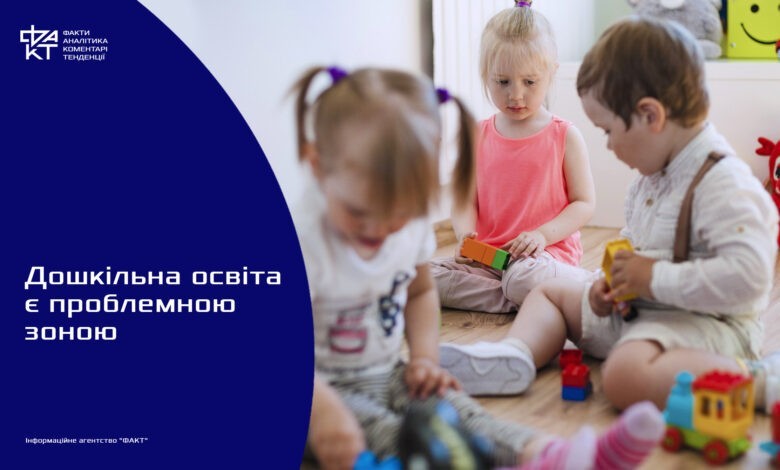
Ukraine has long faced chronic problems in the field of preschool education, which only intensified in the war. The reforms, which were aimed at modernizing the system and improving conditions for children and educators, instead revealed a number of significant shortcomings. Lack of funding, overcrowded groups, lack of modern teaching materials and low salaries of educators are just some of the challenges faced by preschool education. However, despite the planned changes, the reforms are still far from ideal. Why is reforming preschool education in Ukraine not bringing the expected results, and what new problems arise along the way?
State of preschool education in Ukraine in numbers
For data MES, as of June 2024, 11,918 preschool education institutions were registered in Ukraine.
Training is carried out by:
- in the full-time format – 8,665 institutions for 564,806 pupils;
- in remote format – 1,933 institutions for 106,696 pupils;
- in the mixed form – 1,320 institutions for 83,424 pupils.
Inclusive education in Ukraine is provided by 6,860 groups, where 12,814 children receive education and correctional services. 35,290 children study in special groups, numbering 2,989.
But, despite such large numbers, despite numerous initiatives and the adoption of new legislative acts, the problems of preschool education in Ukraine remain systemic and deeply rooted. The first and foremost of them is the chronic lack of places in kindergartens. In large cities, such as Kyiv and Kharkiv, parents often face months-long queues, and in rural areas the situation is even worse: there are simply no kindergartens in many settlements. Despite the reform, neither plan provides sufficient funding to build new kindergartens or expand existing ones.
For data Monitoring the quality of school education, the actual number of children in every third city primary school, every fourth village school and every fifth village school exceeds the projected capacity. 20% of junior and middle-aged children and 15% of older preschoolers are waiting for enrollment in preschool.
The lack of places in kindergartens is not only an inconvenience, but a real social problem. After all, many parents cannot go to work because there is no one to take care of the child. This affects their financial situation, career, and most importantly, the well-being of the children themselves, who lose the opportunity for socialization and early development. But the most painful thing in this situation is that this deficit puts pressure on the most vulnerable – families who cannot afford to pay for a private kindergarten or hire a babysitter. They have to choose between working and raising a child at home, which can lead to feelings of isolation and stress.
Financial dependence on local budgets is another important problem. In the context of decentralization, many kindergartens depend on how wealthy the communities are. This leads to great inequality: kindergartens in big cities receive more funding than institutions in small settlements. And while in some regions the kindergartens are updating their material base, in other places they continue to work in old, neglected buildings.
Another serious problem is the outdated infrastructure of many institutions. In rural areas, where public funding is limited, kindergartens are often left without proper maintenance and up-to-date educational materials. Moreover, the shortage of qualified educators is becoming more and more evident. Salaries in the field of preschool education remain among the lowest in the country, which leads to the fact that young professionals do not aspire to work in this field. The lack of qualified personnel leads to a decrease in the quality of education, as well as an increase in the burden on existing educators.
In addition, inclusion in preschool education remains at the level of slogans. Although much is said about the need to integrate children with special needs, there are few real changes in this area. Many kindergartens do not have the material and technical base for implementing inclusive programs, as well as qualified personnel to work with such children.
What innovations will the new law “On preschool education” bring
On June 6, 2024, the Verkhovna Rada adopted a new Law of Ukraine “On preschool education”, which will enter into force on July 7, 2025. Therefore, we have a year to prepare for its implementation. The state aims to ensure equal and barrier-free access to preschool education for all children. The law emphasizes that every child has the right to a quality education, starting from an early age. Therefore, perhaps the most important innovation will be the emergence of alternative types of preschool institutions:
- mobile kindergartens – specially equipped buses that will travel around settlements according to the schedule, providing temporary care and education for children in regions where preschool institutions were destroyed due to the war;
- family (family) kindergartens – private houses or apartments specially adapted to educational needs for small groups of children;
- pedagogical partnership centers – will provide support to parents who raise children at home without attending kindergarten;
- mini-kindergartens – designed for groups of up to five children, which will ensure an individual approach to each pupil;
- special kindergartens for children with special educational needs – will contribute to the acquisition of preschool education by children aged two to seven or eight years old with special educational needs caused by physical, mental, intellectual and / or sensory disorders, behavioral disorders;
- preschool centers – will function on the basis of various institutions, including libraries, ministries or business organizations, and will provide services for the children of employees of these institutions.
Financing of preschool education will be carried out at the level of local budgets, but at the same time, the state plans to help communities in security matters, in particular, in financing shelters for kindergartens in eight frontline regions.
According to the new law, a combination of remote and mixed forms of education is foreseen in preschool institutions according to the security situation. The mixed format will depend on the capacity of the kindergarten shelter. If it is impossible to accommodate all children and teachers at once, such institutions will alternate offline and online modes.
According to of the law “On the use of the English language in Ukraine” dated June 4, 2024, from September 2026 it is planned to introduce mandatory English language learning for children aged 5-6 years in preschool institutions. To implement this, the Ministry of Education and Culture plans to launch a teacher training program with free courses in English and its teaching methods.
According to regional departments, as of September 15, 2024, staffing of preschool education institutions is 92%; the total percentage of teacher vacancies is 8% (5,640 positions). The state aims to raise the status of educators so that more young people willingly choose this difficult profession. The new law envisages a reduction in the teaching load and an increase in wages. So, the average salary for educators will vary:
- a young teacher without a category and work experience — UAH 9,382;
- second category educator — UAH 11,672;
- a teacher of the first category — UAH 12,499;
- for a teacher of the highest category — UAH 13,325.
Also, the new law provides a certain autonomy to the founders of state and communal kindergartens regarding the establishment of official salaries, additional payments, allowances and monetary rewards in an amount exceeding that determined by the Cabinet of Ministers, as well as the appointment of additional rewards and allowances for teaching staff.
However, the adoption of the new Law of Ukraine “On Preschool Education” caused a wave of discussions and criticism, the first steps already show that the changes will not be so easy. One of the most controversial innovations of the law is the transfer of responsibility for financing preschool education to local budgets. And here begins the most interesting. Large cities such as Kyiv, Lviv or Odesa have sufficient resources to finance their institutions. But what should small towns and villages do, where local budgets are unable to cover even basic needs?
In fact, this may lead to the fact that inequality between regions will only deepen. In cities, wealthier regions will be able to provide better conditions for their children, while in remote areas, kindergartens will continue to suffer from a lack of funds. Instead of solving the problem of access to preschool education, the law may further complicate the situation for thousands of Ukrainian families.
Another problem that arose in connection with the new law is the issue of admitting children to kindergartens. New requirements for registration of children can complicate the process for parents. Given the already existing queues at kindergartens in big cities, these changes could create even more obstacles for families. This will only increase the tension among parents, who often cannot find a place for their child in a public kindergarten.
In addition, experts believe that the new law provides for an increase in the number of children in groups, and there will be no reduction in the workload of teachers. Educators are already raising concerns about this, as overcrowded groups mean children will receive less attention. Instead of an individual approach to upbringing, which is so important in the early stages of development, children will be forced to adapt to conditions where there are up to 20-30 children per educator. This seriously reduces the quality of education and upbringing.
But the law is most criticized for the fact that the issue of raising teachers’ salaries remains only on paper. Although it foresees new requirements for the qualifications of educators, in practice it may become another test for the system. Low wages, lack of proper working conditions and large groups lead to a shortage of personnel. Many qualified professionals leave this field, and as a result, kindergartens are often left without the necessary personnel.
Inclusive education has become one of the main topics of educational reform. However, as practice shows, despite the declarations of the law on inclusion, the implementation of these provisions remains a difficult task. Many kindergartens simply do not have the necessary resources to work with children with special educational needs. According to official data of the Ministry of Education, at the beginning of 2024, only 30% of kindergartens were ready for the implementation of inclusive education. This means that thousands of children with special needs remain without adequate support.
Adoption of the new law “On preschool education” was an attempt to reform the system, but this path will certainly not be easy. Problems that have accumulated over the years require a systematic approach to solving them. Without adequate funding, salary increases for educators, and implementation of inclusion in practice, changes can only remain on paper. Meanwhile, thousands of Ukrainian children will continue to face problems of access to quality preschool education.
The coming years will be decisive for whether Ukraine will be able to find a way to modernize the system of preschool education, or whether these reforms will turn into another bureaucratic game without real results.
Preschool education in foreign countries
In the EU countries, considerable attention is paid to preschool education, because it is precisely the link of education that has a significant impact on the country’s economy. That is why, according to EU requirements, all EU countries must achieve 96% coverage of preschool education for children aged three to six. While in Ukraine, as of 2024, the total percentage of children covered by various forms of preschool education is only 73.1%. Preschool education in foreign countries differs significantly in terms of approaches, programs and structure, which is due to the cultural, economic and social characteristics of each state. It is presented in many different forms that meet the modern needs of the child: from public and private kindergartens to specialized approaches such as Montessori, Waldorf or forest kindergartens.
Public kindergartens are the most common form of preschool education in many countries, including France, Sweden, Finland, and China. In such kindergartens, education is often free or subsidized by the state. Also, in many countries, private kindergartens offer alternative programs that may include different pedagogical approaches or additional services. Many countries are developing inclusive education, which provides access for children with special educational needs. Such kindergartens exist in most European countries, particularly in Sweden, Denmark and Germany, where inclusiveness is an important aspect of the education system.
For example, the Finnish preschool education system is often considered one of the best in the world. It is based on the fact that children learn through play, not through formal education. Education up to the age of 7 focuses on the development of social, emotional and cognitive skills, which creates a stable foundation for further education. Educators have a high level of training, and groups of children are small, which ensures an individual approach.
In Sweden, pre-school education is also focused on play and exploration, but here more attention is paid to the development of independence in children. Preschools place great emphasis on mainstreaming gender equality and inclusiveness. Most programs involve learning through natural exploration, and children often spend time outdoors.
In Japan, preschool education is very disciplined. Here, great attention is paid to teaching children social norms, respect for others and collectivism. Pupils are required to be independent and responsible for their actions, starting from an early age. Learning includes collaborative activities that help children develop teamwork skills.
In the United States, preschool education focuses on school readiness. Often the emphasis is on formal learning—reading, math, and other academic subjects. Programs may vary significantly by state or private institution. Some preschools emphasize the integration of technology and STEM (science, technology, engineering, and math) skills.
In Germany, so-called “forest kindergartens” (Waldkindergarten) are very popular, where children spend most of the day outdoors, regardless of the weather. Being in nature is believed to help children develop physical endurance, creativity and resilience. In addition, the German preschool education system focuses on free play and development through exploration of the surrounding world.
French preschool education (“école maternelle”) begins at age three and is free for all children. The system is more oriented towards formal learning with an emphasis on reading, writing and mathematics. The government ensures equal access to education, and kindergartens are an important stage of preparation for primary school.
In China, preschool education is more structured and oriented toward preparation for formal schooling. Educators focus on developing academic skills including math, writing and reading. Discipline and respect for teachers are key aspects of education, which often become the basis of the educational process.
As you can see, each country develops its system of preschool education based on cultural and social traditions. Despite their differences, successful models have one thing in common: they give children the freedom to explore the world, create an environment where the child feels safe, and build the skills necessary for a successful life. It is obvious that it is not enough just to form alternative forms of kindergartens and introduce the study of the English language. Modern kindergartens, unfortunately, often remain within the framework of template education. Instead, the world has long proven that a child’s development begins not with textbooks, but with his interests and needs.
The reforms, which should become a new impetus for preschool education in Ukraine, turn out to be another bureaucratic experiment, from which children, parents and educators suffer more than they benefit. Funding problems, disparities between regions, and staffing shortages have only worsened against the backdrop of inaction on the part of the authorities. The reality is this: if radical measures are not taken, Ukrainian kindergartens will remain in a state of decline, and a generation of children will be deprived of access to quality education at the very beginning of their lives.
Loud promises of reforms remain on paper, and real changes needed to improve the situation are postponed indefinitely. The Ukrainian system of preschool education does not need a cosmetic repair, but a complete reconstruction. If the government does not start acting decisively and systematically, these reforms may go down in history as one of the most unsuccessful in the country’s modern education policy.