
The price index for manufactured goods showed the highest monthly jump since the mid-1990s

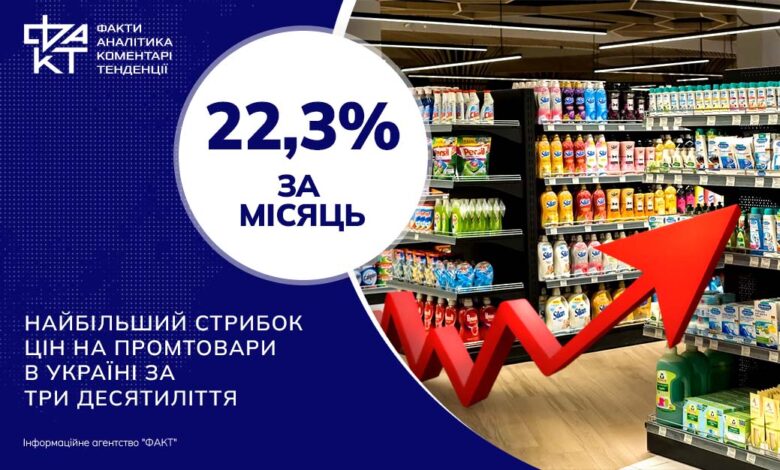
February 2026 brought an indicator for Ukrainian industry that cannot be explained by ordinary fluctuations in costs or local increases in the price of individual resources. According to official data of the State Statistics Service, the producer price index in February 2026 increased by 22.3%, and in annual terms reached 34.5%. Ukrainian industry has not seen such a rapid monthly increase in prices for more than three decades, starting from January 1995.
The main source of this blow was the energy sector, where the cost of supplying electricity, gas, steam and conditioned air for industrial consumers jumped by 53.1% in one month. After the decision of the National Commission for the Regulation of Energy and Power Generation and Energy, the basic costs for production changed, and with them the entire system of calculations shifted – from the food industry to metallurgy, from processing to warehouse logistics.
The government’s attempts to present such a surge as a temporary regulatory effect do not change the main thing, because the enterprise works with actual costs, not with formulas for reports. If energy bills increase by more than half in one month, the manufacturer must either squeeze the margin to a dangerous level or revise the price of the product. In a short time, such decisions are passed along the entire chain – from the production site to the wholesale warehouse, and then to the retail shelf.
Against the background of the energy jump, price increases were also recorded in other segments. In the production of computers and electronics, prices increased by 9.1%, in the production of coke – by 7.8%. These figures look more modest than the energy explosion, but they show that the pressure is already spreading to related industries, where the share of energy, technological costs and complex production infrastructure is high.
For businesses, the problem is that such costs cannot be kept within the company for a long time without consequences. Bakeries, dairy producers, processing, logistics, warehouses and retail chains operate in a system where electricity and related resources are included in the daily cost price. After such a jump in costs, an increase in the price of goods becomes a matter of time, not an assumption.
The producer price index always shows what is happening at the entrance to the economy, even before the consequences become visible to the buyer. Therefore, the February record should be read as an early signal for the consumer market: the increase in production costs has already started, and the retail segment is only beginning to adjust to the new conditions. In the coming months, this pressure is most likely to manifest itself in those categories where the share of energy in costs is particularly high. The main intrigue now concerns the speed of this transition and which product groups will feel the new cost first.


