
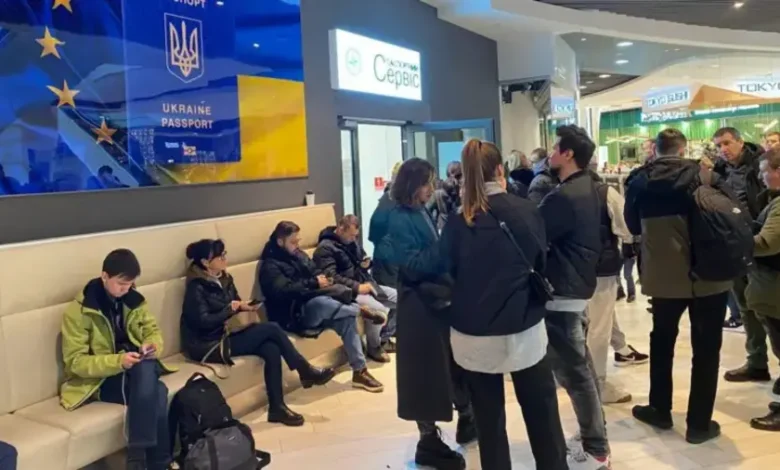
The war forces millions of Ukrainians to remain abroad and continue to leave their homeland, leaving behind their usual rhythm of life, work, and social ties. Large-scale population movements have covered all regions of the country, forming new demographic realities both within Ukraine and abroad. Analysis of the latest data on the departure of citizens and resettlement abroad allows us to assess not only the number of refugees, but also the composition of those who left the country, as well as to understand the impact of this process on the economy, social structures, and the future of children who are forced to live in war conditions far from home.
Dynamics of departures and main routes
According to data from the latest monitoring wave of the Center for Economic Strategy (CES), by the end of 2025, about 5.6 million citizens were outside Ukraine. The vast majority of them crossed the country’s western borders, and the rest left in transit through neighboring states or settled in Russia and Belarus. These figures are close to the UN estimates, which record almost 5.9 million Ukrainian refugees in the world, of which more than 90% are in European countries.
From the beginning of the full-scale war to the end of 2025, more than 60 million people crossed the Ukrainian border to leave, while 56.3 million entered. The difference of about 4 million corresponds to the number of those who left and did not return. About 4 million citizens left the country through the western borders, almost 277 thousand more crossed the borders in transit through Russia or Belarus, and more than 1.3 million remained registered as refugees in these countries.
Even with the slowdown in migration, the total number of Ukrainians abroad continued to grow: compared to the end of 2024, the increase was about 400 thousand people. This reflects a combination of mass evacuations in 2022 and steady departures in subsequent years, which occurred more slowly but systematically.
Demographic characteristics of refugees
Women and children predominate among Ukrainian refugees, with women accounting for about 40% of all those who left, and children for almost a third. Men over the age of 18 make up only 29% of migrants. At the same time, two-thirds of refugees are of working age aged 18–65, and young people under 35 make up more than half. The share of older people has decreased, which indicates a greater willingness of this group to return to the country.
Families with children make up a significant part of migrants: more than a third of refugees are complete families with children under 18, who in 2025 left even more actively than in previous years. At the same time, after the easing of travel restrictions, the outflow of young men aged 18–22 increased significantly, which indicates a specific trend for the young male population.
Among European countries, Germany and Poland remain the largest host countries for Ukrainian refugees. According to the CES, the largest share of Ukrainians abroad is concentrated in Germany (23%) and Poland (19.5%), which amounts to millions of people; Together, these two countries have received over 40% of all migrants from Ukraine. Germany attracts mostly young Ukrainians under 35, while there are significantly fewer of them among older people (35+). Poland, on the contrary, is more attractive to representatives of the middle generation: 24% of Ukrainians aged 35–49 have chosen this country for temporary residence. Other European countries, including the Czech Republic, Italy, Spain and Hungary, have received smaller groups of Ukrainian migrants.
Official UNHCR data confirm a significant influx of Ukrainians to Poland – about one million people. By the beginning of 2026, Poland had received about as many refugees as any other country in the world. Other large host countries include Hungary and several Western European countries, but none of them come close to the scale of Germany and Poland.
Intention to return and impact on Ukraine
One of the key topics remains the question of the intentions of Ukrainian refugees to return home. According to a survey by the Center for Economic Strategy (CES), only 43% of respondents expressed an intention to return to Ukraine, while 36% do not plan to do so. Among those who wish to return, almost 80% specify that they will do so only after the end of the war and the restoration of civil air traffic. The greatest willingness to return is demonstrated by the so-called “classic war refugees” – people who left their homes due to active hostilities in the region of residence; Among them, 63% intend to return in the near future or are likely to do so.
Researchers include the presence of relatives in the country and the possibility of employment as factors contributing to return. For example, the presence of a partner (husband or wife) in Ukraine significantly increases the chances of returning. In addition, remote work or study, as well as regular money transfers to relatives, maintain contact with the country and motivate people to consider returning as a real option.
CES analysts warn that even under a moderate war scenario, only about 1.6 million people will return to Ukraine, and under a pessimistic one, about 1.3 million. This means that in 2027, from 2.1 to 3 million Ukrainians will remain abroad, which creates risks for the economy due to the loss of qualified personnel. According to CES estimates, the consequence of this “drain” could be a decrease in the country’s GDP from 2% to 9.5% each year.
The problem of “brain drain” is particularly acute, since most refugees have higher education: 71% previously worked in positions with a medium or high income. Today, about 1.7 million adult Ukrainians have already integrated into the labor markets of Western countries. On the one hand, this makes it possible to gain independence and a stable income abroad, on the other hand, after the end of the war, Ukraine may experience a shortage of qualified specialists, which will complicate the restoration of the economy and public administration.


