
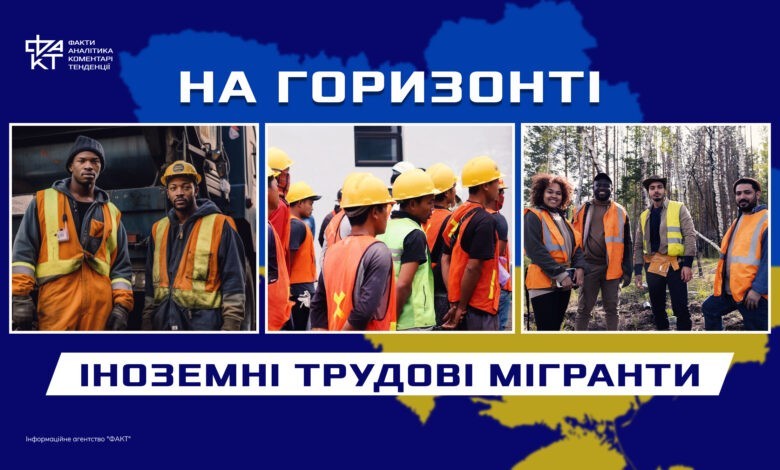
The full-scale invasion not only destroys Ukrainian cities and villages, but also became the cause of a terrible migration crisis in the country. As of 2024, according to UNHCR, there are 6.48 million people abroad, of which 6.004 million are concentrated in Europe, and 475.6 thousand people are in the USA and Canada.
The UNHCR survey showed that 65% of respondents plan to return to Ukraine, while 11% said they were unwilling to return. It is obvious that Ukraine suffers from a lack of people on the labor market. And this problem will become increasingly acute over time. Therefore, the society has long had a question about the involvement of foreign labor migrants to improve the situation in the country. According to the calculations of the Ministry of Economy, in order to achieve GDP growth of 7% by 2032, the state must provide the labor market with about 4.5 million workers.
According to Kyrylo Kryvolap, executive director of the Center for Economic Recovery, as a result of the outflow of Ukrainians abroad and the aging of the nation that remains within the country, 2 million people will leave the labor market in 6 years. Kryvolap calls on the state to create all possible conditions for Ukrainians to return from abroad, as well as to develop legal norms of migration policy. Obviously, in order to get out of such a situation, it is necessary either to increase labor productivity, and thereby reduce the need for specialists, or to look for a shortage of workers in other countries.
In order to solve the problem of labor shortage, it is necessary to invite migrants from other countries, according to the director of the Institute of Demography and Social Research named after Mykhailo Ptukha, Ella Libanova.
But the attitude to such a perspective on the part of Ukrainian society turned out to be ambiguous.
As Marina Ogai, an employee of the Institute of Demography and Quality of Life Problems of the National Academy of Sciences, noted, the majority does not support the idea of attracting foreign migrants to improve the situation caused by the migration crisis in the country.
According to the majority of community representatives, attracting labor migrants to Ukraine can cause a number of problems:
- Social integration.
Since the expected immigrants will be representatives of those countries where the standard of living and wages are lower than in Ukraine, they will most likely come from Asian and African countries. And since these are culturally very distant regions from our country, it is likely that cultural, religious and ethnic differences will negatively affect national identity and the social stability of society as a whole. The language barrier will also stand in the way of integration into Ukrainian society.
- Economic challenges.
Dissatisfaction of the local population due to increased competition in the labor market will be inevitable. This will be especially noticeable in the low-wage sector, because the country still has a high level of unemployment. Additional expenses for the maintenance of immigrants (provision of housing, social and educational services, medical care) will be a significant burden for the country’s economy.
- Political and legal issues.
In Ukraine, there is still no clearly formed migration policy, and, therefore, there is no legislative framework that would deal with the effective regulation of migration processes. After all, insufficient regulation can lead to illegal employment and exploitation of migrants, which violates their rights and has a negative impact on the labor market as a whole. Some respondents also expressed fears about political forces that could destabilize the situation by exploiting the topic of migrant integration problems.
- Infrastructure problems.
Respondents do not rule out such a possibility as overpopulation of cities due to a large number of migrants, which will create significant pressure on infrastructure and require additional investments for its development.
At the same time, among those interviewed, there were also supporters of the involvement of migrants in labor activities in Ukraine, who expressed the following arguments in favor of such a decision:
- Economical development.
Labor migrants will be able to contribute to economic development, as they will fill vacancies suffering from a shortage of labor.
- Income and currency flows.
Remittances from migrant workers who will work in Ukraine will contribute to the country’s economy and increase currency flows.
- International relations.
Migrants are likely to bring with them international experience and connections that will facilitate cultural exchange and strengthen international relations.
The experience of the EU countries in the integration of migrants
Among the EU countries, Sweden is a model of integration policy, as it has been dealing with this issue since the 1970s and has a number of its own strategies. According to the Social Adaptation Program, migrants are involved in language learning, gain access to internships or have the opportunity to confirm the experience gained in their country, and also undergo a civic orientation course. All these measures provide an opportunity to integrate from the first day. In addition, the state provides assistance to cover living expenses.
In Germany, non-EU citizens have the opportunity to be employed in seasonal jobs, complying with the requirements defined in Directive 2014/36/EU. The procedure of employment of migrants in Germany takes place in several stages. Recognized refugees get the opportunity to get a job after 9 months of the protection procedure. Migrant workers must also apply for a work permit each time a job becomes available. Moreover, employment will be possible only after the approval of working conditions by the Federal Employment Agency. Although this procedure somewhat delays the process, it obviously stands for the protection of migrants’ rights.
It is worth noting that both countries have a common feature – it is the restriction of migrants’ access to highly qualified jobs.
At the same time, the participants of the survey were united in one thing – the labor market must be restored at the local level and everything possible should be done to attract Ukrainians themselves to work first, and only then to create conditions for the integration of migrants. It is also worth doing everything possible so that Ukrainians who are currently abroad have the desire to return.
According to the UNHCR survey on migrants, among the main obstacles that stand in the way of return, Ukrainians single out:
- security situation in the state;
- lack of financial resources;
- housing issue;
- lack of jobs.
The prospect of involving labor migrants in the reconstruction of the state should not be dismissed, but this issue should be approached competently. It is worth analyzing the needs of the labor market and the flow of potential migrants to the country. The composition of probable migrants will be influenced by the request of investors, a simplified visa regime, and the presence of bilateral labor agreements. So, most likely, we should expect citizens from Georgia, Armenia, Moldova, Azerbaijan, and Uzbekistan, as visa-free regime applies to these countries. Ukraine has concluded bilateral agreements on labor cooperation and activities with such countries as Moldova, Armenia, Latvia, Lithuania, Poland, the Czech Republic and Azerbaijan. The executive director of the Center for Economic Strategy, Hleb Vyshlinskyi, advises to open the Ukrainian labor market to EU citizens unilaterally.
A positive effect from attracting foreign migrants and minimizing risks is possible only if Ukraine’s migration policy is improved. The state should work out visa agreements, standardize labor contracts for migrant workers, and agree on qualifications in the country’s labor market. Yulia Kabanets, an expert at the Cedos Analytical Center, notes that the State Migration Service of the country is currently mainly focused on control and punitive functions. But no one has yet dealt with the issues of migrant integration.
In order to avoid the negative impact of the involvement of labor migrants in reconstruction, it would be useful to use the experience of European states regarding the policy of multiculturalism and involve migrants only for temporary work, that is, by the shift method.
Migration processes should not be chaotic in the country. The state has set up cooperation with the State Statistics Service and the Ministry of Internal Affairs for the purpose of carrying out clear statistical activities regarding the migration processes taking place in the country. Employers must provide information on the beginning and termination of employment relations with foreigners in a timely manner in order to prevent unofficial employment in the country. The Ministry of Education and Science of Ukraine should develop a course that will include the study of the Ukrainian language, the functioning of the administrative and social systems operating in the country, and familiarization with the cultural and historical aspects of Ukraine. Local governments should consider strategies to attract foreign migrants to local communities.
Labor migration is widely used all over the world, so it is worth taking into account the experience of other countries in integration processes and developing our own effective system that will not bring negative consequences to Ukraine and its citizens.


