Ukrainian School in Northampton: How Refugee Children in the UK Are Helped to Preserve Language, Memory, and Connection to Home

The war changed the logic of everyday life for thousands of Ukrainian families, in which issues of education, language, cultural memory and emotional balance of children came to the fore. For those who found themselves in the UK after the Russian invasion, school became much more than a place to gain knowledge, because through education children get the opportunity not to lose touch with Ukraine, not to dissolve in a foreign environment and to maintain a sense of belonging to their own country. St. Mary’s Ukrainian School in Northampton plays a special role in this matter.
St. Mary’s Ukrainian School in Northampton
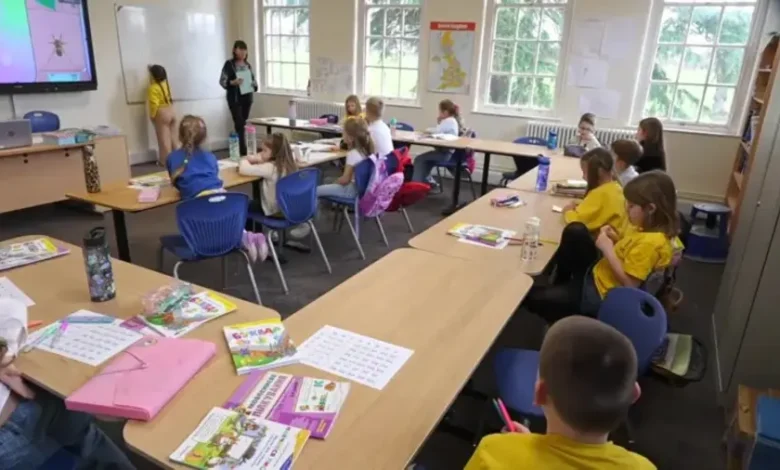
St. Mary’s Ukrainian School in Northampton is helping 55 children from Ukraine to cope with the aftermath of the war in a more sustainable way while maintaining a lively connection with their homeland. The importance of this school lies in the fact that it has created a recognizable educational and cultural space for them, where the Ukrainian language, literature, history and art remain part of everyday life, and not a memory that gradually recedes under the pressure of new circumstances.
The status of St. Mary’s School in Northampton deserves special attention, as it is a certified educational center, and its curriculum is approved by the government of Ukraine. Such a detail changes the very weight of this educational institution, because it is no longer an optional or symbolic format of preserving the native language, but a full-fledged educational model, inscribed in the Ukrainian education system.
It is thanks to this that students can take official exams, the results of which are recognized by Ukrainian schools. For families living in forced displacement and not always being able to predict where they will end up in a year or two, this opportunity is crucial, as it ensures continuity of education and reduces the risk of a child losing time or finding themselves between two education systems without a clear prospect of returning to the usual educational path.
Connection with the homeland through objects that form memory
The school offers lessons in the Ukrainian language, literature, history, and music, and it is this set of subjects that allows us to understand how a child’s connection with a country that has been left behind geographically, but should not disappear internally, is formed. Language in such a situation becomes not just a means of communication, but a space in which the child retains the intonation of home, family memory, and the ability to think in the coordinates of their own culture.
Literature, in turn, maintains a living contact with texts, images, and plots, through which the Ukrainian experience ceases to be an abstraction, and history returns to children a sense of the continuity of their own country, which is especially important in conditions of war, when identity often has to be defended not only on the battlefield, but also in the sphere of cultural presence. Music complements this space with an emotional dimension that cannot always be conveyed through a textbook, because a song, rhythm, and familiar melodies sometimes restore a sense of home more accurately than any explanation.
School as a place where a child is not left alone with trauma
St. Mary’s School also helps children overcome the trauma of war. This formulation is much more than just a friendly atmosphere or a caring attitude of teachers, because for a child who was forced to leave his home, country, familiar environment and usual rhythm of life, the very presence in an understandable linguistic and cultural space is already an important factor of internal stabilization.
In a foreign country, where the language, everyday life, rules of communication and even the school atmosphere are changing around him, the Ukrainian educational center plays the role of a support, like a bridge between two worlds. On the one hand, the child lives in a British environment, which inevitably affects his daily life, and on the other – he does not lose contact with what defined him before the forced departure. It is this continuity, which may seem secondary to an adult, that often becomes a way for a child to maintain a sense of integrity in their own lives.
The importance of clubs and creative activities
The educational space of the school is not limited to lessons, as there are also dance and art clubs. At first glance, this may seem like a routine addition to the curriculum, but in a situation of forced displacement, such activities take on a different meaning. They allow children not only to develop their abilities, but also to experience complex emotions through creativity, movement, color, and joint activities.
Where ordinary conversation does not always allow for the expression of experiences, drawing or dancing often become a softer and more natural way of expressing their inner state. In addition, it is group work that forms a circle of communication in which the child feels part of a community, and not an isolated person in a strange environment. For children who find themselves far from home, such a community is of particular importance, because it helps not to lose the sense of normality of life.
Who creates this space for children
The school is run by a team of teachers who moved from Ukraine after the Russian invasion. This circumstance adds special depth to the story, because it is about people who themselves experienced forced displacement, the loss of their usual professional and personal environment, and therefore understand well the emotional state of children and their families.
In such a combination of professional experience and personally experienced ordeal, trust arises, which is difficult to create purely institutionally. A teacher who himself went through forced departure from Ukraine perceives children’s anxieties not as an abstract problem from a psychology textbook, but as a reality familiar from his own experience. Therefore, the school in Northampton is not just an educational institution, but an environment where Ukrainian children see adults nearby who are able to understand them without unnecessary explanations.
For refugee families, the issue of education always goes beyond the school schedule, as it is connected with the future return, with the possibility of not losing a year or several years of education and with the feeling that the child’s life has not stopped because of the war. That is why the recognition of learning outcomes by Ukrainian schools has such weight: it leaves the door open to return to the Ukrainian educational system without a gap that would then have to be painfully made up for.
In this sense, St. Mary’s School works on two levels simultaneously. On the one hand, it gives children support in the present, helping not to lose language, cultural memory and a sense of belonging. On the other hand, it preserves for them an educational perspective that does not end at the border, but continues onward, like a thread that prevents the disintegration of the coherent story of childhood.
The history of the Ukrainian school in Northampton is important as evidence of how great the need is for spaces where refugee children can remain in touch with their own country without feeling that they have to choose between integration and memory. This school combines several important things: a recognized curriculum, official exams, Ukrainian subjects, creative activities, and a team of teachers who have a living connection to the Ukrainian experience.