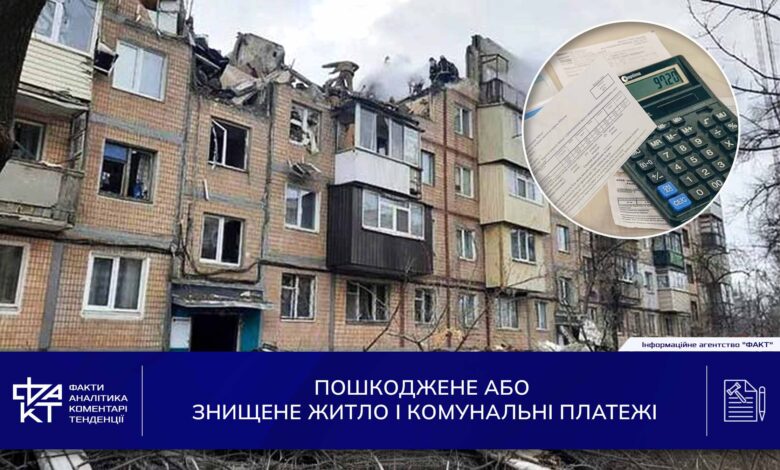
The issue of charging for housing and communal services for owners of damaged or destroyed housing is one of the most painful in wartime realities. People who have lost the opportunity to live in their apartments or houses often continue to receive bills for services in full, despite the lack of actual use of housing and even basic living conditions. The adoption of a law that defines the specifics of charging such payments has become an important step towards a more equitable regulation of this area.
Lawyers from the Repeshko & Partners Law Firm commented on how the new law changes the approach to charging for housing and communal services in cases of damage or destruction of real estate, what mechanisms are provided for terminating or suspending payments, and what homeowners should pay special attention to when confirming their right to recalculation.
On March 25, 2026, the Verkhovna Rada of Ukraine adopted the long-awaited law “On the Peculiarities of Charging for Housing and Communal Services and Other Payments Provided by Law in Connection with Damage or Destruction of Real Estate Objects.” It currently defines the principles for charging and paying for housing and communal services and other payments provided by law in connection with damage or destruction of real estate objects as a result of hostilities, terrorist acts, and sabotage caused by the armed aggression of the Russian Federation against Ukraine. This law shall enter into force on the day following the day of its publication. It was published on 04/14/2026 in the official publication – the newspaper “Holos Ukrainy”.
The effect of this law extends to several categories of real estate objects. First of all, it concerns destroyed real estate objects, that is, such property that, as a result of hostilities, terrorist acts or sabotage caused by the armed aggression of the Russian Federation against Ukraine, has become unsuitable for use for its intended purpose, and its restoration is impossible or economically inexpedient.
The law also applies to real estate objects themselves, which include buildings, houses, structures, complexes of buildings and structures, residential and non-residential premises, individual parts of the common property of an apartment building, as well as other real estate in which housing and communal services are provided or were provided.
The law also separately defines damaged real estate objects. This is property that has been damaged as a result of hostilities, terrorist acts or sabotage caused by the armed aggression of the Russian Federation against Ukraine, but can be restored, and such restoration is economically feasible.
In addition, this law provides that during the martial law introduced by the Decree of the President of Ukraine dated February 24, 2022 No. 64/2022 “On the Introduction of Martial Law in Ukraine”, as well as within two years after its termination or cancellation, in the event of damage or destruction of an object of real estate as a result of hostilities, terrorist acts or sabotage caused by the armed aggression of the Russian Federation against Ukraine, special rules for charging and paying for housing and communal services shall apply. These are cases when, due to damage or destruction of the property, it is no longer possible to use or operate it for its intended purpose, in particular to live in it, or when such an object poses a threat to the life or health of people. In such situations, the procedure for charging and paying for housing and communal services is determined in accordance with the legislation, taking into account the provisions of this law.
Thus, the law regulates the situation when utility services continue to charge full fees for dilapidated houses and apartments unfit for habitation in which water and heat supply are cut off. In this case, the fact of destruction/damage to the real estate object is confirmed in the manner established by law. That is, it is necessary to go through the full procedure of submitting applications, examination by a commission, and collection of evidence.
If, according to the results of the examination, the real estate object belonging to the owner or owners is recognized as destroyed or damaged and not subject to further exploitation, a notification of the results of the examination is sent by the executive body of the village, settlement, city, district council in the city, if one has been established, or the military administration of the settlement, if one has been established. Such notification must be sent no later than thirty business days from the date of destruction or damage to the real estate object.
The notification is sent to the owner or owners of such real estate object, the territorial body of the central executive body that implements the state policy on the provision of housing subsidies and benefits for payment of housing and communal services, the utility service provider, the manager of an apartment building, the association of co-owners of an apartment building, a housing and construction or housing cooperative.
Thus, after submitting documents and conducting an inspection, the procedure for notifying utility services about property damage must be carried out in accordance with the procedure established by law. Such a notification contains, in particular, information about the fact and date of damage or destruction of the real estate object and is the basis for:
- termination or suspension of the provision of housing and communal services;
- termination of the calculation of the payment for housing and communal services in the event of the destruction of the real estate object, as well as other payments provided for by the contract for the provision of the relevant service;
- suspension of the calculation of the payment for communal services, as well as recalculation of the calculated payment from the date of damage to the real estate object, specified in the document drawn up based on the results of the inspection of such object in accordance with the legislation;
- suspension of the calculation or recalculation of the payment for housing services by decision of the meeting of co-owners;
- termination or suspension of the provision of housing subsidies and benefits for the payment of housing and communal services, as well as other payments provided for by by the contract for the provision of the relevant service, from the date of termination of the accrual of payment or suspension of the accrual of payment for the relevant housing and communal services.
The starting point for all further decisions in such cases is the date of destruction or damage to the real estate object, indicated in the document drawn up based on the results of the survey in accordance with the legislation. It is from this date that the law connects the termination or suspension of accruals. If, according to the results of the survey, the property belonging to the owner or co-owners is recognized as destroyed, the accrual of payment for housing and communal services, as well as other payments provided for by the contract for the provision of the relevant service, is terminated. That is, in this case, we are not talking about recalculation for the future or individual preferential conditions, but rather about the termination of accruals.
The law provides for a different approach for damaged property. If, according to the results of the inspection, the real estate object is recognized as damaged and unfit for further operation, that is, it cannot be used for its intended purpose, lived in, or its operation poses a threat to the life or health of people, including due to damage to individual parts of the common property of an apartment building, and provided that such an object is actually not used for its intended purpose, the calculation of utility services is suspended. At the same time, the law establishes a separate condition regarding housing services: the suspension of the calculation or recalculation of the payment in this case is carried out exclusively by decision of the meeting of co-owners.
At the same time, the law takes into account not only the interests of the owners of damaged or destroyed housing, but also those entities that, due to the termination or suspension of calculations, incur costs and losses. These are managers of apartment buildings, performers of utility services, associations of co-owners of an apartment building, housing and construction and housing cooperatives, as well as state authorities and local governments.
Compensation for such expenses and losses that arose as a result of the termination or suspension of the calculation of housing and communal services and other payments stipulated by the contract for the provision of the relevant service, contributions, payments and deductions related to the maintenance and maintenance of damaged or destroyed property, will be provided in accordance with the procedure to be approved by the Cabinet of Ministers of Ukraine.
The issue for associations of co-owners of an apartment building has been separately regulated. In accordance with the amendments, the general meetings of the association may adopt decisions on the full or partial exemption of individual co-owners whose real estate objects were damaged from the payment of contributions, payments and other deductions established in accordance with this law. That is, the law directly allows taking into account the real situation of specific co-owners and does not leave this issue solely to the discretion of current practice or internal agreements.
The law provides for a similar approach for cooperatives. The competence of the general meeting of members of the cooperative includes the adoption of decisions on the exemption of individual members of the cooperative from paying contributions or on reducing the amount of such contributions in the event of damage or destruction of their real estate object. This applies not only to those persons who are already owners of such property. This norm also applies to those members of the cooperative who had the right to own, use or dispose of this object, but as of the date of its damage or destruction had not yet acquired ownership rights in accordance with the procedure established by law.
The issue of debt for housing and communal services that has already arisen requires special attention. The law stipulates that consumer debt for housing and communal services that arose after February 24, 2022, except for debt that arose in temporarily occupied territories during their temporary occupation, may be restructured. However, such restructuring will not be carried out arbitrarily, but in accordance with the procedure and on the terms to be approved by the Cabinet of Ministers of Ukraine.
At the same time, for debts that arose after February 24, 2022, specifically during the period of temporary occupation, the law establishes a separate approach. These are debts for the period from the start date to the end date of the temporary occupation of territories included in the List of Territories in Which Military Operations Are or Were Conducted or Which Are Temporarily Occupied by the Russian Federation. The procedure for verifying and settling such debts must be approved separately by the Cabinet of Ministers of Ukraine, after a decision is made on the specifics of the provision, accounting, accrual, and payment of housing and communal services in the territories of Ukraine temporarily occupied by the Russian Federation after February 24, 2022.
It should be noted that until the Cabinet of Ministers of Ukraine approves the procedure for verifying and settling such debts, the law establishes a direct ban on any actions aimed at forcing the consumer to pay for services or to repay debts for these services during the period of temporary occupation. However, such a debt does not disappear automatically: it continues to be recorded on the personal accounts of consumers until it is settled in accordance with the procedure to be determined by the Cabinet of Ministers of Ukraine.
In addition, the law specifies that its effect extends not only to the relationship between the consumer and the provider of utility services. Among other things, it also covers legal relations between consumers and providers of services for the maintenance of buildings and structures and adjacent territories in an apartment building, if such services continue to be provided.
The law also applies to cases where damage or destruction of an object of real estate occurred before it entered into force, but provided that this fact is confirmed in accordance with the procedure established by law. In such cases, termination, suspension and or recalculation of payments for housing and communal services will be carried out from the date of entry into force of this law and in accordance with the procedure to be established by the Cabinet of Ministers of Ukraine.
Separately, the law regulates the issue of utility metering devices – legally regulated measuring devices installed on a real estate object. If the positive results of their periodic, extraordinary verification or verification after repair are certified by an imprint of a verification stamp and or issued with a verification certificate, such results are considered valid throughout the entire period of restoration of the damaged real estate object.
However, this rule applies precisely to those objects that were not subject to further operation, that is, could not be used for their intended purpose. In particular, for living, or the operation of which created a threat to the life or health of people, including due to damage to individual parts of the common property of an apartment building, and which were actually not used for their intended purpose.
Therefore, we advise owners of damaged or destroyed housing not to delay recording the consequences of the destruction in accordance with the procedure established by law, to submit the necessary applications in a timely manner and to monitor whether the relevant information has been transferred to the utility service providers. Properly confirmed damage or destruction of real estate is a key basis for terminating, suspending, or recalculating charges, and therefore for protection against unjustified payments and subsequent disputes.