Veterans with disabilities after the war: between labor and sports achievements and the cynicism of bureaucracy

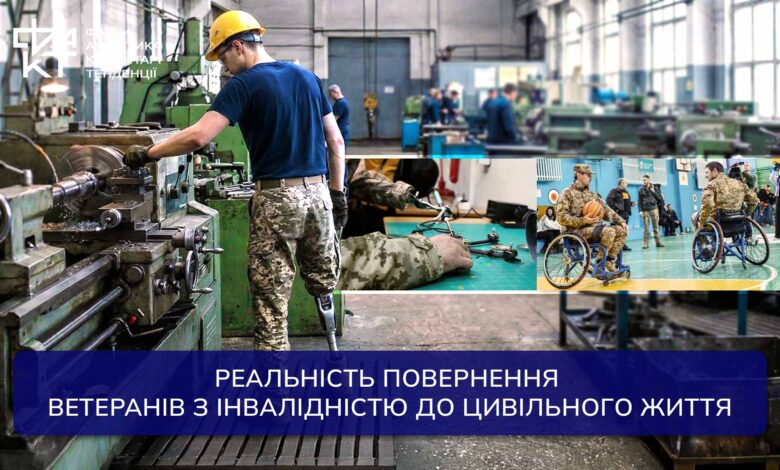
As of 2026, there are officially 130,000 disabled veterans in Ukraine, but it is expected that after the end of hostilities, the community of veterans and their families will reach 1.5 million people. Despite the fact that these people find the resources to conquer sports podiums and return to professional life, they face endless trials and obstacles every day. The current situation indicates a critical gap, when a country that aspires to EU membership continues to apply a cynical “use it and forget it” approach, where a person with a disability becomes invisible to the economy and society.
From the hospital bed to international pedestals: stories of veterans’ victories
The path from the hospital bed to the world sports pedestal becomes a confirmation of the daily victory of disabled veterans over their own despair and pain. Embodying an example of true indomitability, our defenders have proven that an injury can be not a point in life, but the beginning of a completely different, extremely difficult, but bright path. Recently, we have seen the birth of a new community of people who, through sport, regain the right to be leaders, professionals and role models. For example, 2025 demonstrated how far Ukraine has advanced in this direction: third place in the overall standings at the Invictus Games confirmed that veteran sports have ceased to be just a form of rehabilitation.
The personal transformation of each athlete is a quiet feat, which is best illustrated by the example of Igor Oliynyk. His 6 awards, including 3 gold and 3 silver, are impressive not only in number, but also in how a person was able to master such different disciplines after a serious injury. This story well demonstrates how the body’s capabilities are often determined by the strength of the spirit, because Oliynyk actually abolished the stereotype of “limitedness”, showing that a veteran can be a surprisingly versatile athlete.
The same inner strength is demonstrated by Ruslan Serhiychuk, whose 3 gold medals are perceived as a real miracle, given his vision problems. His success tells us that when a person finds the strength to move forward, physical obstacles give way to concentration and will. Ruslan became the one whom his brothers who have just received similar injuries look up to today, seeing in him real hope that the world has not lost its colors, but only requires a new way of interacting with it.
A special feeling of closeness and support is given by team achievements, which sometimes heal emotional wounds better than any medicine. Andriy Boychuk’s bronze medal as part of the sitting volleyball team demonstrates an example of how people learn to trust each other again. After loneliness in hospital wards or during a difficult stage of treatment, the opportunity to feel a comrade’s shoulder and work as a single unit returns the same feeling of “one’s pack” that was at the front, but now it is filled with the joy of creation, not the horror of war.
This humanity and openness to the world is also manifested in the international format. Ilya Pylypenko, performing in a mixed wheelchair basketball team, showed that the common experience of trials makes veterans from different countries kindred in spirit. Alexey Gorb’s silver in alpine skiing proves that our veterans are not looking for easy ways, choosing disciplines that require incredible coordination and courage, which again makes them the masters of their own destiny.
The leadership in this community looks very sincere and responsible, as in the case of the team captain Alexey Tyunin. This athlete puts his soul into developing veteran initiatives, understanding that his experience can become a bridge for others. Thanks to such examples, we see how an entire culture is being formed in Ukraine, where a veteran should not be perceived as a person with a past, but a person with a great future, active, visible and very necessary for society.
The achievements of Ukrainian veterans remind everyone that behind every medal there is a person who, having great will, found the strength to get up and move on. For the state and each of us, this is a signal that supporting such people is not charity, but an opportunity to be part of the incredible energy of renewal. Veterans who have found themselves in sports are today writing a new history of Ukraine, where the trauma, which has become a difficult episode in life, exists alongside the unbreakable will to be happy and useful despite everything.
Veterans and the Economy: When War Experience Becomes a Resource
No less important is the transformation of combat experience into a socially responsible business, which becomes the foundation of a new economic ethic of Ukraine, where profit is inseparable from inclusiveness and support for fellow citizens. The story of Lviv resident Andriy Prots, founder of the Kombatant furniture factory, illustrates this transition from personal resilience to systemic changes in the production environment. With over two decades of professional carpentry experience and a hereditary loyalty to the craft, Andriy faced a full-scale invasion in the ranks of the 125th Separate Brigade of the Ukrainian Armed Forces. Even on the front lines in the Serebryany Forest or near Lyman, he remained a builder.
The restoration of the enterprise after demobilization began with the elimination of the consequences of a missile strike that damaged the workshop, but the veteran’s ambitions quickly outgrew the scope of ordinary repairs. Having received grant support from the Ukrainian Veterans Fund for “Varto 11.0”, Prots invested in the construction of a new factory, which is designed as a standard of barrier-free access. The uniqueness of the facility lies in the involvement of architects and fellow veterans with injuries to test inclusive solutions – from specialized evacuation stairs to rehabilitation rooms directly at the factory. This is not just a furniture business, but the creation of a safe space where veterans, in particular those who use wheelchairs, are given the opportunity for full self-realization without architectural or psychological barriers.
A similar vector of adaptation through entrepreneurship is demonstrated by Serhiy Sokol in Zhmerynka, whose path from a howitzer commander in the Donetsk region to the owner of a power tool store became a manifesto of will. Having received a serious spinal injury near Stupochky, which deprived him of the ability to walk, Serhiy refused the role of a passive observer and invested all his front-line savings in his own business. The name of his store “Veteran. Will or Death” is devoid of marketing pathos, because for the father of three children this space has become the main tool of social rehabilitation. The store functions as a living communication hub, where veteran chevrons and military trophies on the walls create an atmosphere of trust for customers and comrades, and daily work helps to overcome phantom and physical pain.
Along with the industrial and trade sectors, the agricultural direction is mastered by Ihor Hlynyany from Poltava region, who after serving in the 110th brigade and being wounded in Avdiivka radically changed his profession from engineer to farmer. Thanks to the support of the BAZUKA community and grant funds, the veteran built a powerful greenhouse farm in Kobelyaki, where he grows ecological vegetables and berries. Working with the land has become an effective therapy for him, allowing him to dispel negative memories through contemplation of the life cycle of plants. Scaling from 40 acres of strawberries to the planned hectares shows that the veteran business is capable of being competitive and dynamic, transforming the energy of war into the energy of creation.
Vyacheslav Strazhets, a veteran of the Armed Forces of Ukraine who lost his right arm during the defense of Avdiivka in 2022, founded his own production of kamikaze drones for the front. He underwent online training during rehabilitation. Vyacheslav, together with a team of veterans, collects about 50 drones per month, demonstrating indomitable spirit.
The Kyiv experience of Artem Kychko, founder of Kychko Fight Club, closes this cycle of reintegration through physical culture and youth education. A former Omega special forces soldier and a titled taekwondo champion, Artem focused his efforts on adaptive sports after being injured in both legs by a landmine. His club has become a platform where veterans with amputees learn para-jiu-jitsu for free in an inclusive environment.
Such initiatives form a holistic ecosystem where professional skills, agricultural innovations, and sports rehabilitation become part of a unified strategy for returning veterans with disabilities to a full-fledged civilian life, where their limitations are smoothed out by thoughtful infrastructure and fraternal support.
Wounded and Unprotected: The Realities of Veterans’ Return
At the same time, the process of returning servicemen to civilian life reveals a deep chasm between the idealized public perception of defending the state and the harsh reality in which a veteran finds himself after demobilization. Instead of the expected harmony, soldiers are faced with bureaucracy, the lack of a human approach to them, and internal disorientation, because the front-line experience cannot simply be “turned off”, because the war continues to pulsate in their minds, making the civilian environment alien and often incomprehensible.
Recently, Ukrainians were outraged by the police’s actions, which were reported by veteran Yaroslav Hrubych. In mid-March, a seriously wounded soldier who lost an arm, uses a prosthetic leg, and partially lost his fingers fell in the middle of the street due to a broken prosthesis and, unable to get up on his own, asked law enforcement for help, but in response he heard a cynical: “We are not a taxi.” What is most striking in this story is the cold indifference to a person who paid for the country with his own health and at a critical moment remained simply an inconvenient beggar for law enforcement officers and his fellow countrymen.
It should be noted that veterans often face difficulties in social integration due to the tactlessness of the environment, which instead of silent gratitude often resorts to traumatic questions about murders or everyday trifles. All this indicates the absurdity of the double standards that still exist in our perception of the army. True respect should be expressed not in violating personal boundaries, but in effective support and dissemination of useful information that would facilitate the path of adaptation.
The lack of systemic coordination between state institutions forces the families of wounded soldiers to wander through the labyrinths of the VLK without clear guidelines and understanding the logic of medical appointments. Imperfect communication on the part of doctors and officials creates an information vacuum, where issues of prosthetics or transfer to other institutions turn into exhausting quests. The solution to this crisis lies in the plane of maximum simplification of access to data: from ordinary printed brochures in every hospital to the functioning of unified digital platforms, where each step should be explained in living language, and not in dry quotes from regulations. When people do not even know about the possibility of receiving compensation from the Ministry of Social Policy for caring for relatives, this indicates a systemic failure in the transfer of social guarantees from the state to a specific recipient.
The situation in communities requires special analytical focus, since a significant part of veterans return to rural areas, where the infrastructure of assistance is much less developed than in megacities. That is why an important step should be the decentralization of veteran policy through the involvement of village elders and the creation of mobile groups that can reach the most remote corners. The bureaucratic apparatus, shackled by outdated regulations, often turns the process of confirming disability into a humiliating procedure, where a person with an amputee is forced to prove the obvious again and again. A way out of this vicious circle is possible only through active lobbying for changes in legislation and digitalization of services, which would eliminate corruption risks and physical exhaustion from endless queues.
The physical inaccessibility of urban space is becoming another invisible front, where veterans with serious injuries are forced to fight for their right to basic mobility every day. After all, for example, for a person in a wheelchair, getting out of the entrance becomes a real challenge, which is often impossible to overcome without outside help due to high curbs and uneven paving stones. In order not to repeat Soviet mistakes, when people with disabilities were actually isolated from society, the state must strictly monitor compliance with state building codes even at the design stage. Modern Ukraine has no right to architectural indifference, because it is inclusivity that is a fundamental feature of a civilized state that values each of its defenders.
The return of disabled veterans to civilian professions increasingly resembles a collision of two parallel worlds, where the front-line triumph is broken against the blank wall of office pragmatism. Despite formal assurances of solidarity, a significant part of domestic business turns out to be internally unprepared for the integration of people whose physical presence requires at least minimal transformations of the usual space. This unpreparedness is rooted not so much in the financial plane as in the reluctance to leave the comfort zone, where imaginary “normality” reigns.
The infrastructural inertia of employers is often disguised as rational calculation, although in reality it indicates systemic shortsightedness. When a company manager refuses a specialist because of the need to install a lift or widen doorways, he actually admits his own inability to manage a modern structure. In a country where the front line runs through the fate of every family, inclusion has ceased to be a topic for optional seminars on corporate ethics, turning into a basic condition for the survival of the national economy.
The economic selfishness that forces companies to ignore the needs of veterans with amputees or visual impairments sets a dangerous precedent of social exclusion. Instead of perceiving the adaptation of the workplace as an investment in unique human capital, tempered in the most difficult conditions, businesses view it as an annoying additional tax. Such actions look especially cynical against the background of the fact that these very people ensured the right of the private sector to exist, protecting the right to property and the right to profit at the cost of their own health.
Modern civilized society dictates rules where architectural accessibility and adaptability of the workflow are a sign of strength, not a forced concession. Every refusal to adapt an office to a veteran under the pretext of “technical impossibility” lays a time-delayed mine for the future of Ukraine, provoking a wave of despair among those who held the sky over our cities. If we aspire to be part of the global world, we must realize that inclusion is not a charity, but a fair distribution of responsibility between the state, business and citizens.
Further ignoring these needs will lead to a huge layer of the professionally active population being left behind in economic processes, which is an unacceptable luxury in the conditions of a demographic crisis. The need of the hour is for every workplace to become a territory of equal opportunities, where scars and prostheses are perceived as signs of the highest professional reliability. Only through a radical change in the attitude towards accessibility will we be able to build a country that truly values its defenders for their right to a full life at home. In our country, the cynical “use it and forget it” approach is unacceptable, where a disabled veteran becomes invisible to the economy and society.