
Volkswagen factories have stopped working: strikers protest against wage cuts, layoffs and closures of enterprises in Germany

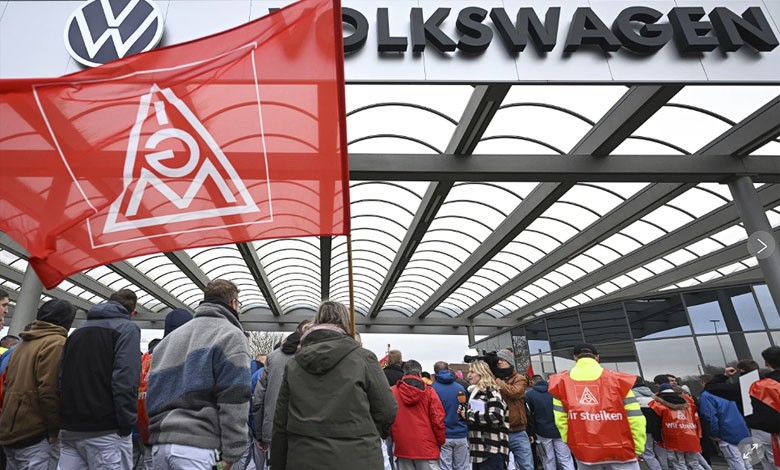
Yesterday in Germany, in the heart of a developed industrial center, factories Volkswagen stopped the usual work. It was not a technical pause, but an expressive collective statement. In Wolfsburg, where the company was founded, about 35,000 workers united in a mass protest. From Hanover to Braunschweig, from Kassel to Emden, tens of thousands of people joined the demonstration of solidarity. By the end of the day, the IG Metall union said more than 66,000 workers had stopped work at nine out of ten plants, demanding a dialogue with the leaders of the concern.
The strikers are protesting against plans by the company’s management to cut wages for the company’s 120,000 employees by 10%, as well as resort to mass layoffs and close three plants in Germany. Many employees perceive such intentions of their management as a betrayal of their many years of work that created the brand’s reputation.
IG Metall, which organized these actions, is one of the most influential trade unions in Germany. Her voice resonates not only among workers, but also in power structures. And the question she raised goes beyond salaries and jobs – it is a struggle to preserve dignity in times of change.
Why Volkswagen executives are forced to resort to layoffs
For its part, the management of Volkswagen justifies the need for reductions with the following reasons. First of all, the company is losing competitiveness in the global market due to high production and operational costs. The German auto industry in general and Volkswagen in particular are facing serious challenges due to competition with Chinese electric vehicle manufacturers. The latter, including BYD, are spreading their economic hegemony in the Eurozone by offering electric cars at temptingly low prices.
Chinese cars, the same BYD, are usually cheaper than their German counterparts. This is due to lower production costs, government subsidies and economies of scale. For example, in China, the average the price of an electric car is about 22,100 euros, while in Europe it is about 43,000 euros. This is additional pressing on German manufacturers who already have high production costs and are faced with the need for rapid transformation to electric mobility.
The European Commission is concerned about dumping by Chinese manufacturers subsidized by Beijing, which allows them to offer their cars at reduced prices in the eurozone. This puts European producers at a disadvantage, as they cannot compete on an equal footing.
To solve this problem, the European Union introduced special tariffs on Chinese electric cars. Now the import of such cars is subject to additional taxes, which depend on the manufacturing company. For example, for BYD – 17%, Geely – almost 19%, and for some other manufacturers – as much as 35%. Even Tesla cars made in China will now have an additional duty of nearly 8%. These new taxes are added to the already existing 10% duty and will be in effect for five years. Such measures are designed to protect European producers from unfair competition from the Celestial Empire.
However, positions in the German establishment were divided on this issue. Yes, Chancellor Scholz warned China from dumping car prices, calling for fair competition. He urged the EU to avoid protectionist measures that could harm European producers.
At the same time, Minister of Transport of Germany Wissing spoke against the introduction of tariffs on Chinese electric cars, arguing that global competition encourages German manufacturers to create better and cheaper cars.
An additional challenge for the German automotive industry is the decrease in demand on the European market, caused by economic instability, changes in consumer preferences and the increase in car prices. All this provokes a reduction in sales volumes, a decrease in the company’s income and increased financial pressure. In response to these problems, management is resorting to cost cutting, which includes staff optimization.
However, such decisions meet strong resistance from the trade union, for which these measures are unacceptable. IG Metall has proposed alternative cost-saving measures, including waiving bonuses, which would save up to 1.5 billion euros, but the company’s management has so far rejected those proposals. The union demands the preservation of jobs and the level of wages, appealing to the need to protect social standards and workers’ rights.
This creates a conflict between the company’s desire to maintain competitiveness and social responsibility to employees. We observe a typical confrontation between business interests and social obligations in the context of economic challenges.
How events will unfold if no understanding is reached
The round of negotiations scheduled for December 9 is an attempt to reach a compromise between the union and the company’s management. IG Metall has warned that if the negotiations fail, it may organize large-scale 24-hour or even indefinite strikes.
It is obvious that large-scale protest actions can cause serious losses to the company and negatively affect production processes, revenues and reputation. And the management of the concern is interested in avoiding such consequences. Thus, the outcome of the negotiations will largely determine whether the conflict will escalate further or whether the parties will find a compromise.
Or strikes – the biggest since 2018 – show serious disagreements between workers and management at Volkswagen over the future of production in Germany. The union argues that the burden of economic hardship must be fairly shared between workers, management and shareholders.
Similar strikes at Volkswagen have always been large-scale and had significant consequences, but at the same time they took place within the legal framework thanks to the active role of IG Metall. This trade union, one of the most influential in Germany, ensured the organization of protests, which involved tens of thousands of workers and often brought production lines to a standstill. Strikes usually lasted from a few hours to a few days, and were often preemptive in nature to demonstrate workers’ resolve but avoid a complete disruption of production processes. In some places, if the conflict escalated, the actions could last longer.
The purpose of strikes has always been to improve working conditions, guarantee employment, prevent layoffs or raise wages. Thus, in 2018, workers demanded a reduction of the working day to six hours for certain categories without a reduction in wages.
Avoiding protracted conflicts and serious losses, Volkswagen’s management generally quickly resumed negotiations with the unions. In most cases, this led to a compromise – partial fulfillment of the strikers’ demands in exchange for the stabilization of the production process. An important role in such situations was played by the tradition of social dialogue in Germany, which involves the use of state mediation or expert councils to find a balanced solution.
How the tradition of strikes in Germany evolved
It is worth noting that the labor culture of Germany involves disciplined forms of protest. Such a strike is more of an appeal to dialogue than an attempt to destroy the established order. The tradition of strikes in Germany has deep roots and has evolved from spontaneous protests to a well-regulated legal and social practice.
In the 19th century, strikes were mostly spontaneous and organized against the background of industrialization, when workers demanded better working conditions, shorter working hours and higher wages. During this period, the labor movement did not have a clear organizational structure, and protests were often suppressed by the authorities. However, gradually, with the establishment of trade unions, strikes became more organized in the second half of the 19th century. Trade unions began to play a key role in the protection of workers’ rights, acting as mediators between workers and employers.
In the period between the two world wars, strikes were often politically tinged, making not only economic demands but also countering growing authoritarianism. Under the Nazi dictatorship, as you might guess, strikes were banned and trade unions were tightly controlled or liquidated.
After the Second World War, a modern model of social partnership was created in Germany, which provided for legal regulation of labor relations and interaction between employers, employees and the state. In the 1950s and 1960s, strikes took the form of controlled pressure on employers. The legislation protected the right to strike, but required clear procedures, such as prior negotiations and employee voting.
Since the end of the 20th century, strikes in Germany have become less frequent, but more structured. This was influenced by economic development, improved working conditions and the role of trade unions, above all IG Metall and Ver.di, able to protect the interests of workers through negotiations, avoiding open conflicts. Modern strikes are more often economic in nature, related to wages, working conditions or employment guarantees, and less often involve political issues.
The evolution of strikes in Germany demonstrates the transition from chaotic and unregulated protests to a rational and legal system for resolving labor disputes, which has become a model for many countries. Strikes remain an important tool for workers, but thanks to the tradition of social dialogue they rarely take the form of protracted and destructive conflicts…
…The clash between the powerful automaker and its workers has only just begun. The stopped mechanisms and the silence of the factories became a symbol of the struggle, which is waged not through chaos or shouting, but through the determination and unity of those who seek to be heard.
Tetyana Viktorova


